

On this page
Both galvanisation and tinning are methods used to protect iron or steel from rusting by applying a thin layer of another metal. However, they rely on entirely different electrochemical mechanisms, and making the wrong choice can either poison your food or cause a pipe to rapidly rust through.
The underlying difference depends entirely on where each metal sits in the electrochemical series.
How standard reduction potentials predict rust
To understand why these coatings behave differently, we have to look at their standard electrode potentials (E°), which measure a metal's tendency to gain electrons. According to standard data tables):
Zinc (Zn²⁺/Zn): -0.76 V
Iron (Fe²⁺/Fe): -0.44 V
Tin (Sn²⁺/Sn): -0.13 V
The more negative the potential, the stronger the metal's tendency to lose electrons (oxidise) and act as an anode. In any pairing of two metals, the one with the more negative potential will corrode first, sacrificing itself to protect the other.
What happens when galvanised iron is scratched?
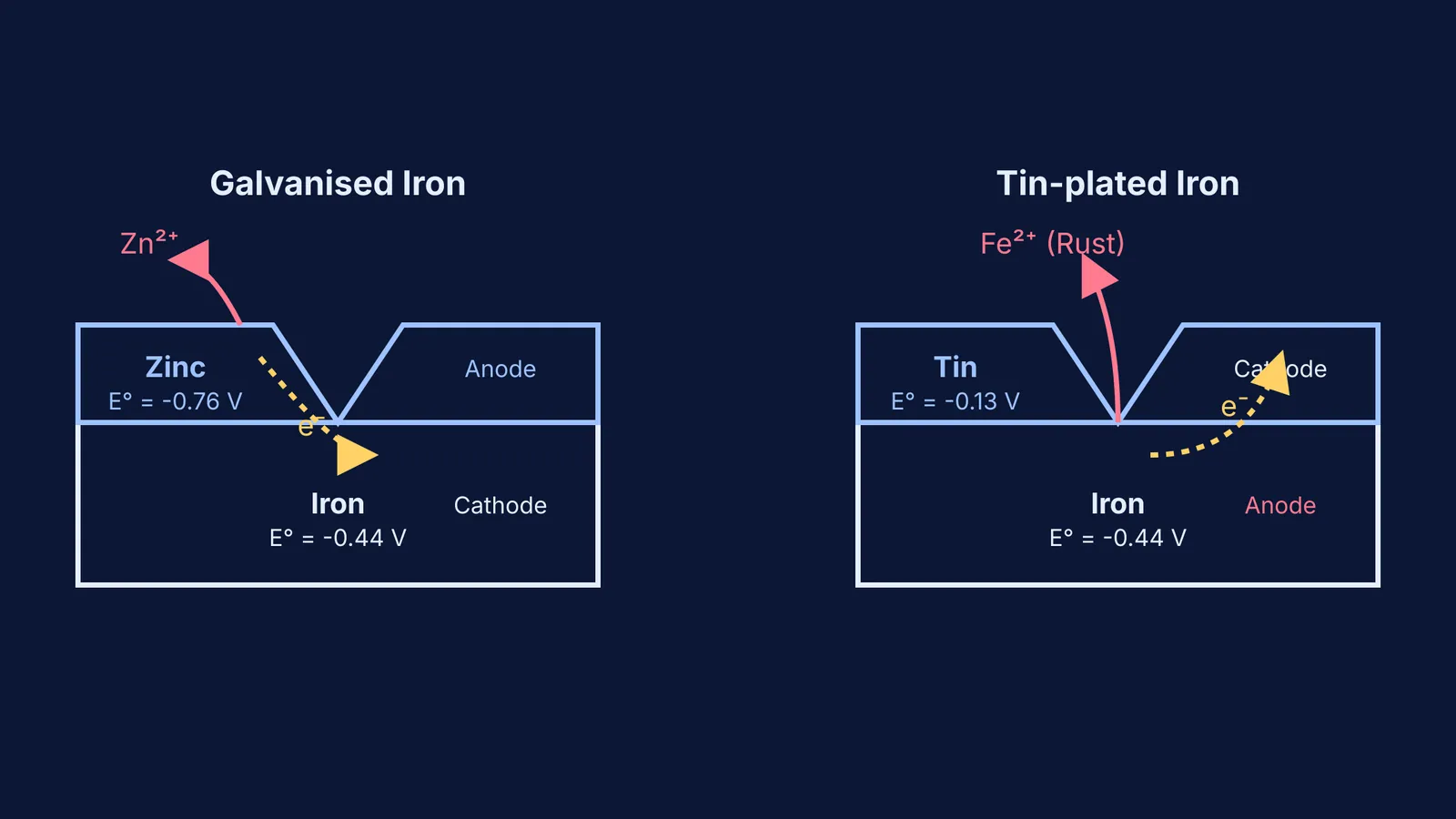
Galvanisation is the process of coating iron with a layer of zinc. Because zinc is significantly more negative than iron (-0.76 V vs -0.44 V), it is the more reactive of the two.
As long as the zinc layer is intact, it acts as a simple physical barrier. But the real advantage of galvanisation is seen when the surface is deeply scratched, exposing the iron underneath to the air and moisture.
The moisture from a water droplet acts as an electrolyte, creating a tiny galvanic cell. Because zinc has a greater tendency to oxidise, it becomes the anode. The zinc atoms give up electrons to become Zn²⁺ ions. Those electrons flow into the iron, which becomes the cathode. At the iron surface, the electrons are used to reduce dissolved oxygen from the air into hydroxide ions (O₂ + 2H₂O + 4e⁻ → 4OH⁻).
The iron remains completely protected from rust as long as there is still zinc nearby to sacrifice itself. If you are missing the fundamentals on the electrochemical series, the Fermi Concept Library contains every concept in physics, chemistry, biology, mathematics and computing, each with its own lesson and its place in the map.
What happens when a tin can is scratched?
Tinning coats iron with a layer of tin. Tin has a more positive standard potential (-0.13 V) than iron (-0.44 V), making it less reactive.
While intact, tin provides an excellent, shiny physical barrier. However, if a tin-plated iron sheet is scratched, a disastrous reversal occurs. The exposed iron is now the most reactive metal in the puddle of moisture.
The iron is forced to become the anode and immediately begins to oxidise into Fe²⁺ (rust). The vast area of the surrounding tin coating acts as a highly efficient cathode, pulling electrons away from the iron and accelerating the reduction of oxygen. Consequently, a scratched tin coating actually makes the iron rust faster than if the iron had been completely bare.
This is why tinning is never used for outdoor structures like fences, roofing sheets, or industrial pipes.
Why do food cans use tin instead of zinc?
Given that zinc provides sacrificial protection and tin accelerates rusting when damaged, why are canned goods stored in "tin cans" rather than galvanised cans?
The answer comes down to chemical safety. Zinc is highly reactive with organic acids found in everyday foods such as tomatoes, citrus fruits, and vinegar. According to the U.S. Food and Drug Administration (FDA) Food Code 2022 (Section 4-101.15), "Galvanized metal may not be used for utensils or food-contact surfaces of equipment that are used in contact with acidic food."
When zinc reacts with food acids, it produces toxic zinc salts. These salts leach into the food and, if consumed, can cause severe gastrointestinal distress and zinc poisoning.
Tin, on the other hand, is chemically inert to most food acids and is non-toxic. It will not dissolve into the food or alter its taste. While a dented or scratched tin can might rust and eventually perforate, the food inside remains free of toxic metal salts. To mitigate the risk of rusting entirely, most modern tinplate cans also feature a thin interior polymer lining.
Worked example: Predict the corrosion
In chemistry exams, you are often given an unfamiliar pair of metals and asked to predict which one will corrode. Use this four-step framework:
Check the standard potentials: Look up the E° values for both metals.
Find the more negative value: The metal with the more negative (or least positive) potential is the stronger reducing agent.
Identify the anode: The metal with the more negative potential will become the anode. It will oxidise and corrode.
Identify the cathode: The other metal becomes the cathode. It receives electrons and is protected.
This framework applies not just to corrosion, but to all Types of half-cells: metal, gas and redox electrodes. Just remember to consider What a Balanced Chemical Equation Gives and Its Limitations: electrode potentials tell you which metal will react, but they do not tell you how fast the rust will form.


