

On this page
If you open a jewellery box after several months or inspect a silver payal worn daily, its shine is often replaced by a dull grey or jet-black coating. Many assume this discoloration is dirt or rust. However, silver does not rust; its darkening stems from a specific chemical reaction with trace atmospheric gases.
Understanding this change connects everyday jewellery care to core Class 10 concepts in corrosion and redox reactions.
Why does silver jewellery turn black over time?
Unlike iron, pure silver sits low in the reactivity series and does not react with atmospheric oxygen at room temperature. Instead, silver tarnishes because it has a strong chemical affinity for reduced sulfur compounds.
The main cause is hydrogen sulfide (H₂S), a trace gas released by sewage, vehicle emissions, and organic decay. In the Journal of The Electrochemical Society, T. E. Graedel recorded indoor hydrogen sulfide levels of 86 to 600 parts per trillion (ppt) and carbonyl sulfide (OCS) levels of 400 to 850 ppt. Graedel showed that an exposure threshold of 2.5 parts per billion per year initiates visible tarnishing.
A 2019 study in Angewandte Chemie International Edition by Gabriele Saleh, Chen Xu, and Stefano Sanvito explained the molecular mechanism: while oxygen faces a high kinetic barrier on silver at room temperature, airborne sulfur chemisorbs with near-zero activation barriers to build a dark surface lattice.
What chemical reaction causes silver tarnish?
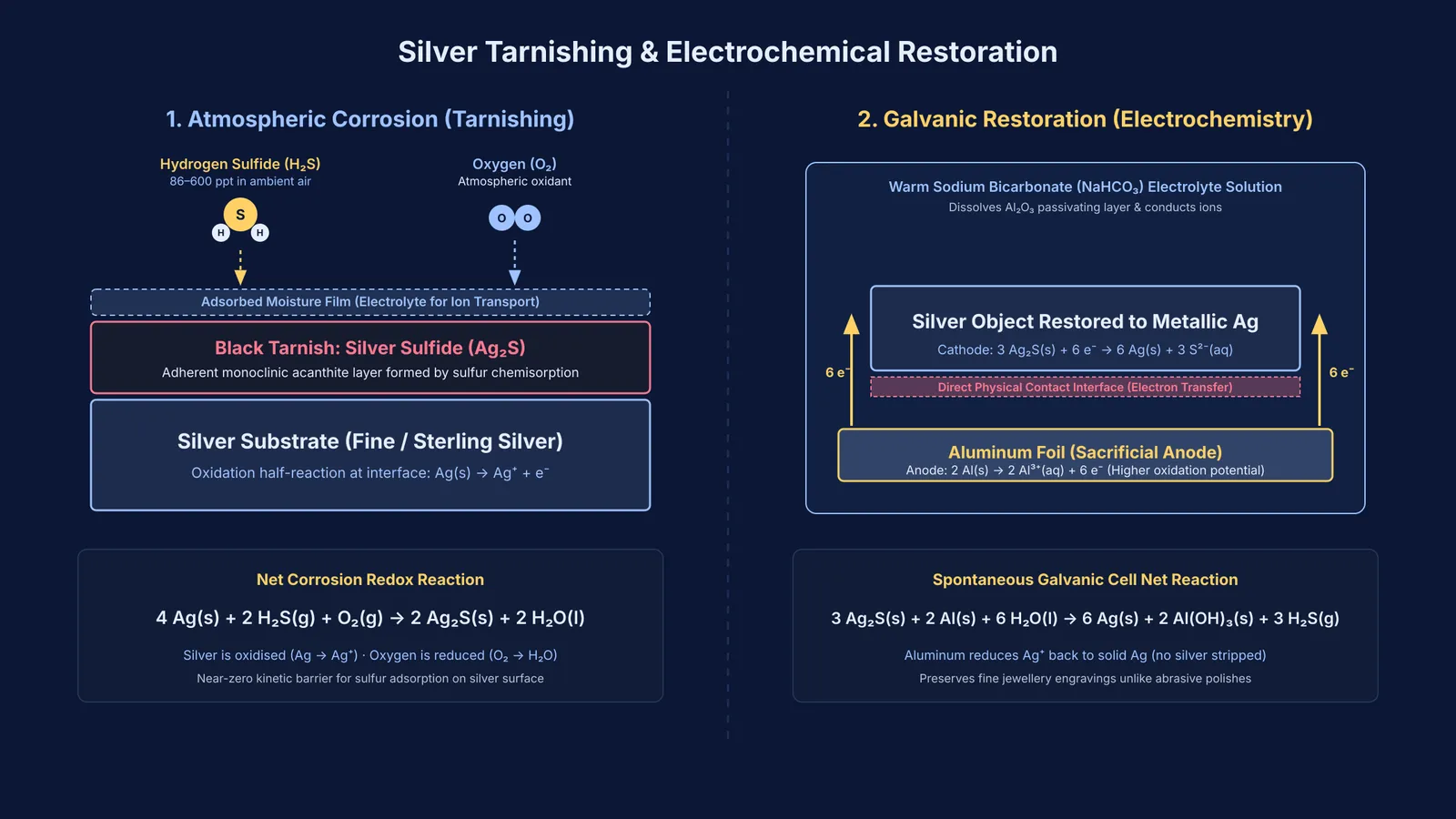
When silver encounters hydrogen sulfide and oxygen in ambient air, an electrochemical redox reaction occurs across an adsorbed moisture film:
4Ag(s) + 2H₂S(g) + O₂(g) → 2Ag₂S(s) + 2H₂O(l)
Silver is oxidised (losing electrons from Ag to Ag⁺), and oxygen is reduced (gaining electrons to form water). The resulting compound is silver sulfide (Ag₂S), a black mineral known as acanthite.
As discussed in our guide to corrosion and rancidity in Class 10 science, corrosion behaves differently across metals. Unlike iron rust, which flakes off and exposes fresh metal, silver sulfide forms an adherent barrier that slows further corrosion.
Why does sterling silver tarnish faster than pure silver?
Pure 99.9% fine silver tarnishes slowly, but most jewellery is made from 925 sterling silver—an alloy of 92.5% silver and 7.5% copper. In RSC Advances, researchers showed that copper preferentially reacts with atmospheric sulfur to accelerate early alloy darkening, as outlined in our review of metals and non-metals in Class 10.
Copper is more reactive than silver and reacts readily with oxygen and sulfur to produce copper(I) oxide (Cu₂O) and copper sulfide (Cu₂S). These compounds darken quickly, speeding up discoloration. Everyday items accelerate this reaction:
Sulfur-rich foods such as boiled eggs, onions, and garlic.
Wool and rubber bands, which release volatile sulfur vulcanisation agents.
Human sweat containing sulfurous amino acids, especially in warm, humid weather.
How can you restore tarnished silver at home using electrochemistry?
Commercial silver polishes use abrasives that rub off the silver sulfide layer, wearing down delicate engravings over time.
A safer method documented in the Journal of Chemical Education uses an electrochemical cell. Placing tarnished silver against aluminum foil in a warm baking soda solution creates a spontaneous galvanic cell that reduces silver sulfide back to solid silver:
Line a heatproof bowl with aluminum foil, shiny side up.
Place tarnished silver items on the foil in direct contact.
Dissolve 2 tablespoons of baking soda (NaHCO₃) in 1 litre of boiling water and pour it over the items until submerged.
Watch the tarnish clear within 2 to 5 minutes as electrons flow from aluminum to silver.
Rinse with clean water and pat dry with a soft cloth.
The process demonstrates corrosion as electrochemistry:
Anode (Oxidation): 2Al(s) → 2Al³⁺(aq) + 6e⁻
Cathode (Reduction): 3Ag₂S(s) + 6e⁻ → 6Ag(s) + 3S²⁻(aq)
Net Reaction: 3Ag₂S(s) + 2Al(s) + 6H₂O(l) → 6Ag(s) + 2Al(OH)₃(s) + 3H₂S(g)
Aluminum has a higher oxidation potential than silver. Baking soda serves as an electrolyte and dissolves the passivating aluminum oxide film, freeing aluminum to donate electrons and restore metallic silver without stripping any metal.
What should Class 10 students remember for CBSE exams?
CBSE Class 10 board exams frequently test silver corrosion:
Reactant gas: State that silver reacts with hydrogen sulfide (H₂S) in air, not oxygen alone.
Black compound: Identify it as silver sulfide (Ag₂S).
Reaction type: Classify it as both corrosion and a redox reaction.
To help students see how electrons move during redox processes, the Fermi Simulation Lab provides interactive simulations for the ideas that are easier to see than to read. For structured syllabus review, the Fermi Concept Library covers every concept in physics, chemistry, biology, mathematics and computing, each with its own lesson and its place in the map.


