

On this page
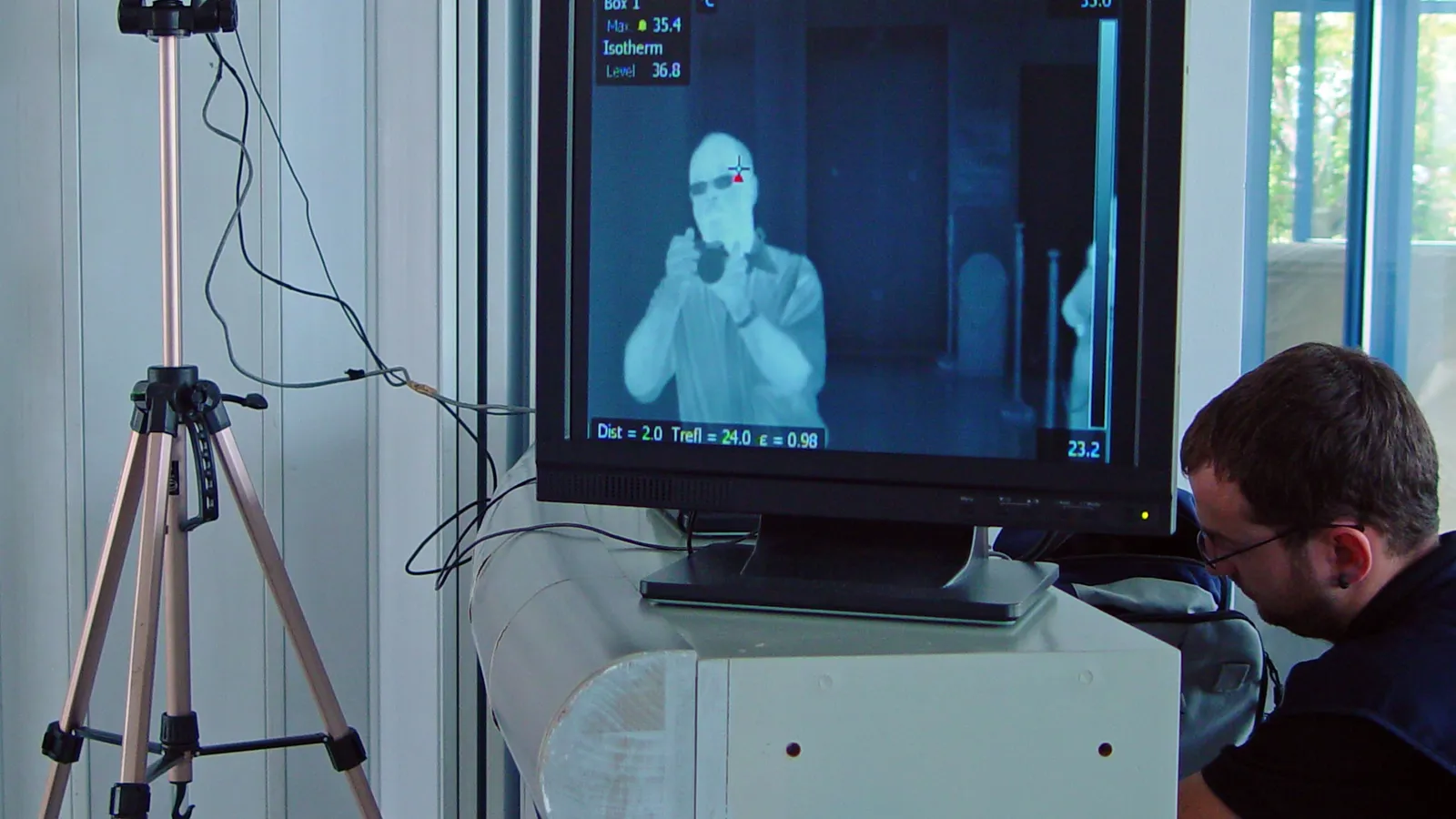
Point a thermal camera at a dark classroom and every student still shows up on screen. Nothing is shining on them: they are the light source.
How does a thermal camera work?
Every object above absolute zero radiates, and at room and body temperature almost all of it is infrared. NASA's guide to infrared waves explains that William Herschel discovered infrared in 1800, when a thermometer just beyond the red end of the spectrum read warmer than the visible colours. The same page notes that Earth scientists call the 8 to 15 micrometre (µm) band thermal infrared.
A thermal camera's lens focuses this infrared onto a grid of sensors, one per pixel. Each reports how much radiation reaches it, and the electronics turn that into a temperature and a false colour.
Wien's law says where the glow peaks: peak wavelength = b ÷ T, with b = 2.898 × 10⁻³ m·K (NIST value). For skin at about 34 °C (307 K), the peak is 2.898 × 10⁻³ ÷ 307 ≈ 9.4 µm, inside the thermal band. The curve itself has a history: see how Lummer and Pringsheim measured the blackbody spectrum.
How much infrared does your body give off?
The Stefan–Boltzmann law says a surface radiates power P = εσAT⁴. The constant σ is 5.670 × 10⁻⁸ W m⁻² K⁻⁴ (NIST CODATA), A is the area, T is in kelvin, and ε is the emissivity, a number from 0 to 1 that says how close the surface is to a perfect emitter. FDA scientists used ε = 0.98 for skin in a 2021 thermal imaging study.
Worked example:
Take skin at 307 K, a body area of 1.8 m² and ε = 0.98.
307⁴ ≈ 8.88 × 10⁹, so σT⁴ ≈ 504 W per square metre.
P = 0.98 × 1.8 × 504 ≈ 890 W of infrared going out.
Walls at 25 °C (298 K) give σT⁴ ≈ 447 W per square metre, so you absorb about 789 W.
Net loss by radiation: about 100 W.
Warm the skin one degree, to 308 K, and the power rises by (308 ÷ 307)⁴ ≈ 1.013, only 1.3% more. A camera looking for fever is hunting for a change of about one percent.
Why does emissivity matter?
The camera measures radiation and works backwards using the emissivity you set. A 2009 study in the Journal of Biomedical Optics measured skin in living people and found it behaves almost like a perfect blackbody at 10.6 µm. The FDA team's 0.98 is also the value the standard IEC 80601-2-59 recommends, their paper notes, and their cameras took both skin emissivity and room temperature as inputs.
Temperature goes as the fourth root of power, a 1% emissivity error on its own would shift the reading by a quarter of a percent, about 0.8 °C at 307 K. But a surface that emits 1% less also reflects 1% more of the room's radiation, and the camera adds that back. Do the sum with the room at 298 K and the error shrinks to about 0.1 °C.
How accurate is fever screening with a thermal camera?
The camera sees skin, and skin drifts with the room. In a clinical study of more than 1,000 people by FDA scientists, the inner corners of the eyes or the hottest point on the face matched oral temperature best, reaching a sensitivity and specificity of 84% to 94% with the best calibration. Forehead-centre readings did worse. The authors note that foreheads are more affected by room temperature and airflow, that the ISO/TR 13154 report recommends a room at 20 to 24 °C, and that volunteers first waited at least 15 minutes in a draught-free area. No one under 18 took part.
A 2020 modelling study in Eurosurveillance estimated that, in its baseline scenario, airport exit and entry screening would miss about 46% of travellers infected with the new coronavirus. The estimate depended on incubation times, screening sensitivity and how many cases had no symptoms.
Checklist: can you trust this thermal reading?
Based on the FDA study:
Has the person been indoors, out of sun and wind, for about 15 minutes?
Is the room roughly 20 to 24 °C, with no fan on the face?
Is emissivity set to about 0.98, and the room temperature entered?
Is the reading from the inner eye corner, not the forehead centre?
Has a high reading been rechecked with a clinical thermometer?
If someone feels unwell, use a proper thermometer and talk to a doctor. Read how a forehead thermometer reads temperature without touching and how paracetamol brings a fever down.
The Fermi Simulation Lab has interactive simulations for ideas that are easier to see than to read. If a Stefan–Boltzmann problem still feels slippery, Fermi's AI tutor can work through it with you, drawing the figure and checking understanding as it goes.


