

On this page
Point a forehead thermometer at someone and a number appears, with nothing touching the skin. Your body is always giving off light you cannot see, and the thermometer is a small light meter tuned to it.
Why does a warm body give off infrared light?
Every object gives off electromagnetic radiation because of its temperature: the hotter it is, the more it emits and the shorter the wavelength where it emits most. Objects that are not very hot, such as humans, emit only infrared waves, which our eyes cannot see (NASA Science: infrared waves).
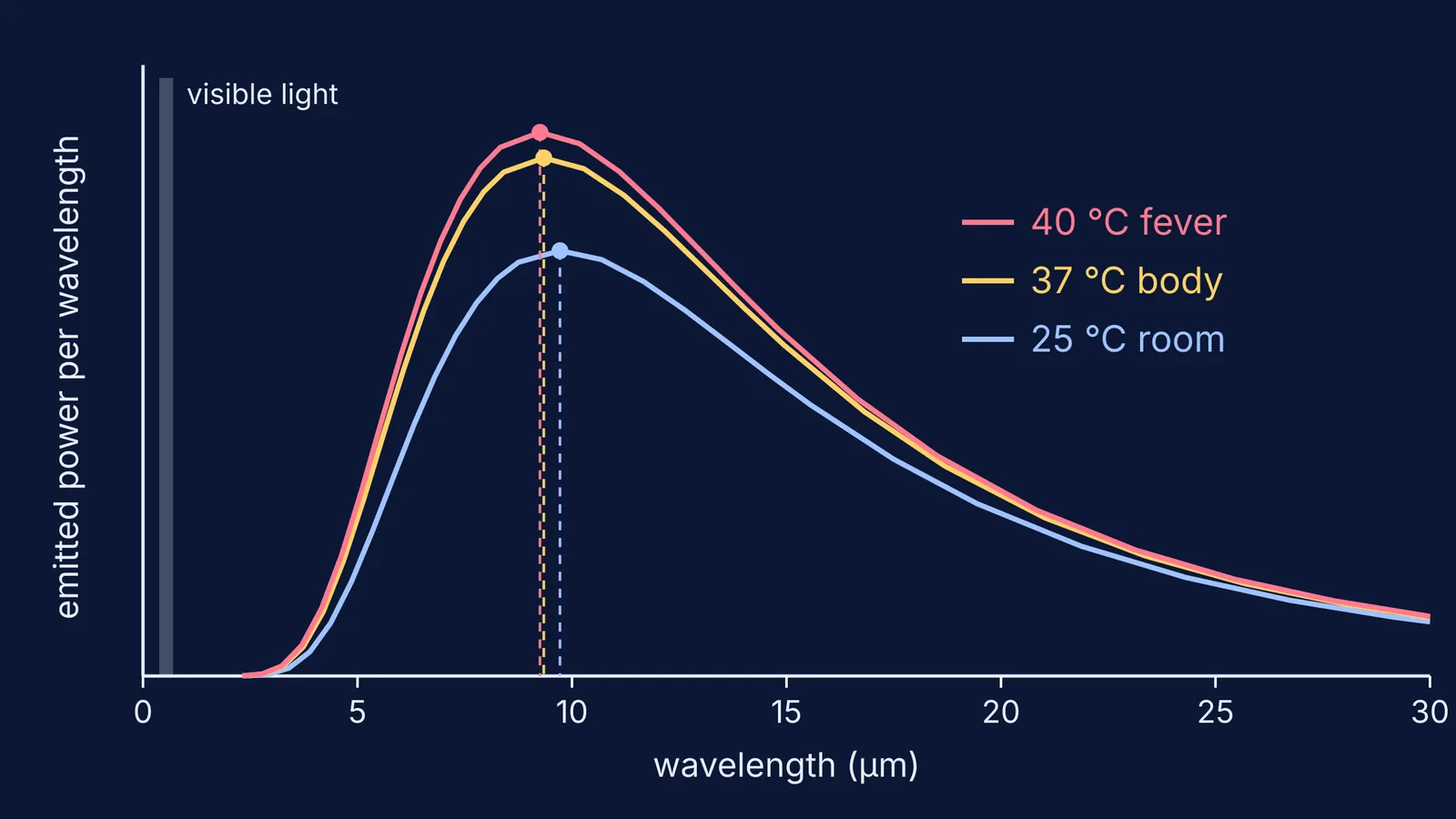
Wien's displacement law gives the peak wavelength: λmax = b/T, with b = 2.897771955 × 10⁻³ m·K (NIST CODATA). At body temperature, 37 °C or 310.15 K, the peak lands at about 9.3 µm. Human eyes detect roughly 380 to 700 nanometres (NASA Science: visible light), so your brightest glow is at a wavelength more than 13 times longer than the reddest light you can see.
Skin is also a near-perfect emitter. J. Steketee measured human skin emissivity at 0.98 ± 0.01 between 3 and 14 µm, unaffected by pigmentation, as summarised in a 2009 paper in Revista Mexicana de Física (original: Physics in Medicine & Biology, 1973). So skin behaves almost like the ideal emitter in our explainer on black-body radiation.
How does a forehead thermometer turn infrared into a number?
The basic design is "a lens to focus the infrared thermal radiation on to a detector, which converts the radiant power to an electrical signal", shown as a temperature "after being compensated for ambient temperature" (Wikipedia: Infrared thermometer). Step by step:
A lens collects infrared from a small patch of your forehead.
A detector turns that power into an electrical signal.
The electronics correct for the temperature of the room and the device.
Software converts the skin reading into an estimate of body temperature.
Step 4 matters because your forehead is cooler than your mouth. In 1,080 measurements on healthy adults, forehead temperature averaged 36.2 °C against 36.7 °C for oral and armpit readings, and the authors advise against screening with uncorrected forehead readings (Chen and colleagues, 2022).
Worked example: how big is a fever in infrared?
The Stefan–Boltzmann law gives the power radiated per square metre: P/A = εσT⁴, with σ = 5.670374419 × 10⁻⁸ W m⁻² K⁻⁴ (NIST CODATA). Take ε = 0.98 for skin.
At 37 °C (310.15 K), skin radiates about 0.98 × 524.7 ≈ 514 W/m².
At 38 °C, (311.15/310.15)⁴ ≈ 1.013, so about 1.3% more.
At 39 °C, the ratio is about 1.026, or 2.6% more.
A black body at a room temperature of 25 °C radiates about 448 W/m².
So a one-degree fever changes the signal by only about 1%, while the room glows nearly as strongly. That is why the corrections in steps 3 and 4 matter. The peak barely moves either: 9.34 µm at 37 °C, 9.25 µm at 40 °C (diagram at top).
Why can a forehead thermometer give a wrong reading?
The US Food and Drug Administration lists what can throw readings off (FDA): drafts, direct sun and nearby heat sources; a room outside 16–40 °C or above 85% humidity; a thermometer that has not sat in the room for 10–30 minutes; and a forehead that is sweaty or covered.
Sun matters, especially in an Indian summer. A study first posted in 2023 found forehead skin temperature rose by 2.00 °C after sun exposure while core temperature did not, with the effect depending on skin tone; the standard fix is to let people settle for up to 30 minutes (Zhao and colleagues, arXiv).
A 2025 meta-analysis of 16 studies with 14,234 readings found non-contact infrared thermometers had a sensitivity of 0.70 and a specificity of 0.94 for fever (Lee and colleagues, BMC Infectious Diseases). In plain terms, they missed about 3 in 10 fevers and wrongly flagged about 6 in 100 people without one.
Before you trust a reading at home:
Keep the thermometer in the room for 10–30 minutes first.
After time in the sun, sit indoors for a while before measuring.
Wipe off sweat, move hair or a cap, and hold the sensor square to the forehead at the distance in the manual.
Take two or three readings and check that they agree.
If a number seems off, recheck with a contact thermometer; see how a digital thermometer reads fever.
How can you picture thermal radiation for yourself?
Our overview of the electromagnetic spectrum shows where infrared sits. Then predict how far the peak shifts between 25 °C and 40 °C, and check with Wien's law.
If these laws still feel shaky, the Fermi Concept Library has a lesson for every concept in physics. For ideas easier to see than to read, the Fermi Simulation Lab has interactive simulations.
Next time a number pops up on that little screen, you will know it came from a 9-micron glow your eyes will never see.


