On this page
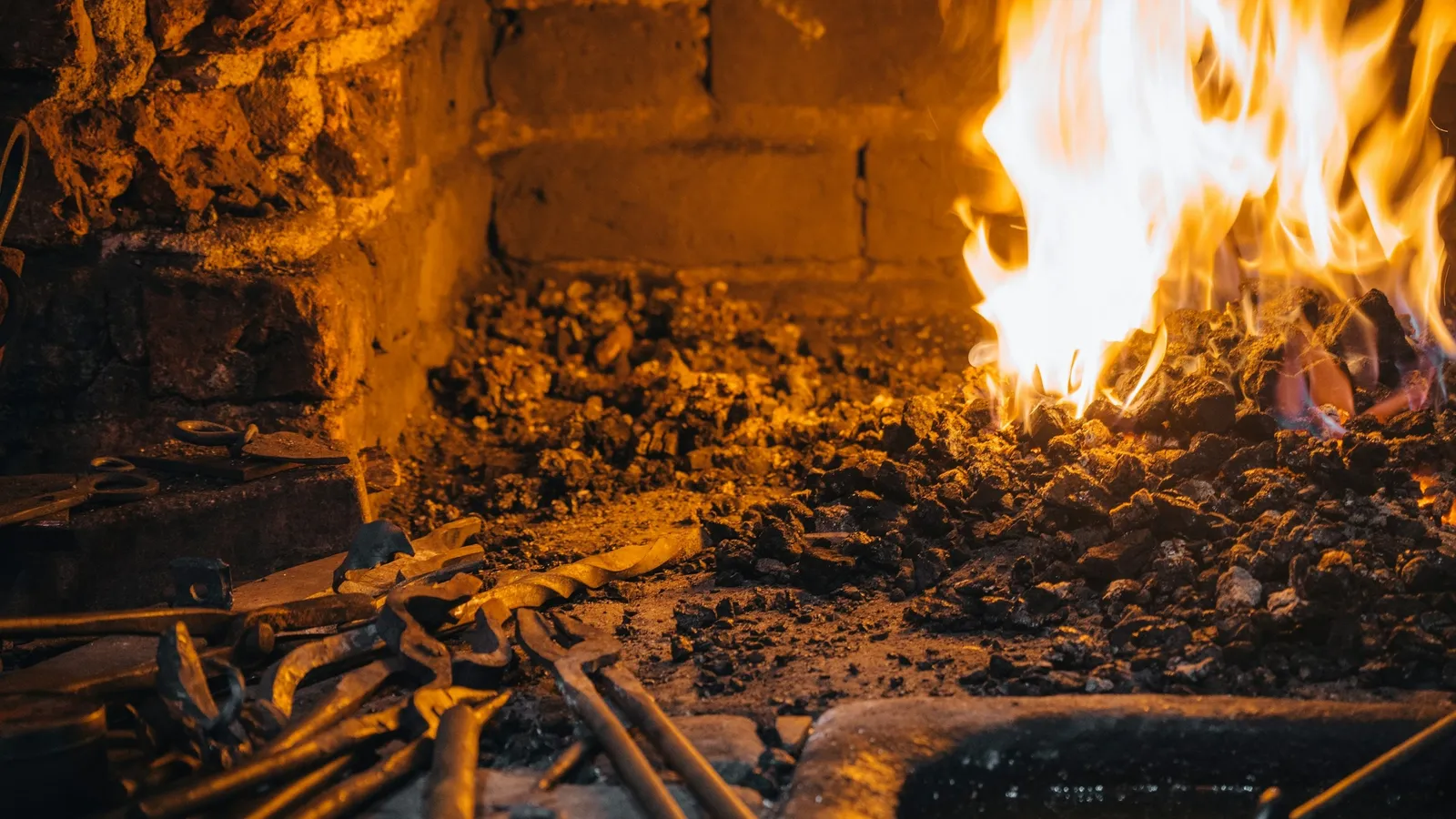
Heat a piece of iron and it glows dull red, then reddish yellow, then white. Two short laws explain both what you see and how much energy leaves the metal: Wien's displacement law and Stefan's law. They produce some of the quickest marks in thermal physics, and some of the easiest to lose. This post covers what each law says, four worked examples and the traps examiners like.
Which exams include black-body radiation?
The JEE (Advanced) 2026 brochure lists "Blackbody radiation: absorptive and emissive powers; Kirchhoff's law; Wien's displacement law, Stefan's law". The CBSE Physics curriculum for 2026-27 asks for qualitative ideas of black-body radiation, Wien's law and Stefan's law in Class 11. The JEE (Main) 2026 syllabus only names "radiation" as a mode of heat transfer. Check the current documents for your exam.
What do Wien's law and Stefan's law say?
The NCERT chapter Thermal Properties of Matter shows black-body curves of energy against wavelength. As temperature rises, the peak moves to shorter wavelengths. NCERT stresses that the curves "depend only on the temperature and not on the size, shape or material of the blackbody".
Wien's displacement law: λm × T = b. NIST gives the Wien wavelength displacement constant as 2.897 771 955 × 10⁻³ m K. NCERT rounds it to 2.9 × 10⁻³ m K.
Stefan's law: a body of area A, emissivity e and absolute temperature T radiates P = eσAT⁴. NIST gives the Stefan-Boltzmann constant as 5.670 374 419 × 10⁻⁸ W m⁻² K⁻⁴. A perfect black body has e = 1.
Net loss: a body at T in surroundings at Ts loses P = eσA(T⁴ − Ts⁴), as NCERT writes in its Eq. 10.18.
Worked example 1: the temperature of the Sun's surface
Sunlight peaks near 500 nm. What is the Sun's surface temperature?
T = b/λm = (2.898 × 10⁻³)/(500 × 10⁻⁹) ≈ 5800 K.
Now run it the other way for your own body at 310 K: λm = 2.898 × 10⁻³/310 ≈ 9.3 × 10⁻⁶ m, or 9.3 μm. That is deep in the infrared, which is why thermal cameras work in the infrared.
Worked example 2: comparing two stars
Two stars have the same radius. Star A's spectrum peaks at 290 nm and star B's at 580 nm. Compare their power output.
Wien: T is inversely proportional to λm, so TA = 2TB. (TA ≈ 10 000 K, TB ≈ 5000 K.)
Stefan: with equal areas, PA/PB = (TA/TB)⁴ = 2⁴ = 16.
If star B instead had twice the radius of A, its area would be four times larger, and the ratio would become 16/4 = 4. Always write the ratio as (area ratio) × (temperature ratio)⁴ before putting in numbers.
Worked example 3: a hot sphere in a room
A black sphere of radius 5.0 cm is held at 1000 K in a room at 300 K. Find the net rate of heat loss.
Area: A = 4πr² = 4π(0.050)² ≈ 0.0314 m².
Emitted: σAT⁴ = 5.67 × 10⁻⁸ × 0.0314 × (1000)⁴ ≈ 1781 W.
Absorbed from the room: σA(300)⁴ ≈ 14 W.
Net loss ≈ 1767 W, about 1.77 kW.
At 1000 K the room barely matters. Near room temperature the two terms are close in size, and the difference behaves like Newton's law of cooling, which our post on Newton's law of cooling works through.
Where is the peak, really?
There is a subtle trap here. NIST also lists a Wien frequency displacement constant of 5.878 925 757 × 10¹⁰ Hz K⁻¹. For a 5800 K body the peak frequency is about 3.4 × 10¹⁴ Hz, which corresponds to a wavelength near 880 nm, not 500 nm. Both are correct. The peak depends on whether the spectrum is plotted per unit wavelength or per unit frequency. School and JEE problems use the wavelength form, λmT = b, so stick with it unless a question gives frequencies.
Which mistakes cost marks?
Using Celsius. Stefan's and Wien's laws need kelvin. 727 °C is 1000 K.
Squaring instead of raising to the fourth power. Doubling T multiplies power by 16, not 4.
Using πr² for a radiating sphere. The sphere radiates from its whole surface, 4πr². (πr² is the area that intercepts radiation arriving from one direction.)
Forgetting emissivity. A grey body with e = 0.5 radiates half the black-body power at the same temperature.
Mixing up good emitters. Kirchhoff's law says good absorbers are good emitters. NCERT's exercises ask why a body with large reflectivity is a poor emitter: it absorbs little, so it also emits little.
A practice routine
Write both laws, both constants and the net-loss formula from memory.
Solve two Wien problems (find T, then find λm) and two Stefan ratio problems with different radii.
Do one problem that combines them: given two peak wavelengths and two radii, find the power ratio.
Explain in two sentences why iron glows red before it glows white.
Black-body curves are easier to understand when you can watch the peak move. The Fermi Simulation Lab has interactive simulations for ideas that are easier to see than read. For the history, our profile of Max Planck and the quantum explains how these curves led to quantum physics.
This week, solve the two-star problem with star B at three times A's radius, and check that you get a ratio of 16/9.