

On this page
Have you ever wondered how a plastic stick with a small metal tip can read your body temperature in less than a minute? Unlike old glass thermometers that rely on expanding mercury, a digital thermometer doesn't actually "see" heat at all. Instead, it measures electricity.
This invisible process is a perfect example of physics applied to everyday life, combining the properties of semiconductors with clever mathematical models to ensure your health readings are accurate.
How does a digital thermometer measure body temperature?
At the heart of a digital thermometer is a tiny electronic component called a thermistor—specifically, a Negative Temperature Coefficient (NTC) thermistor.
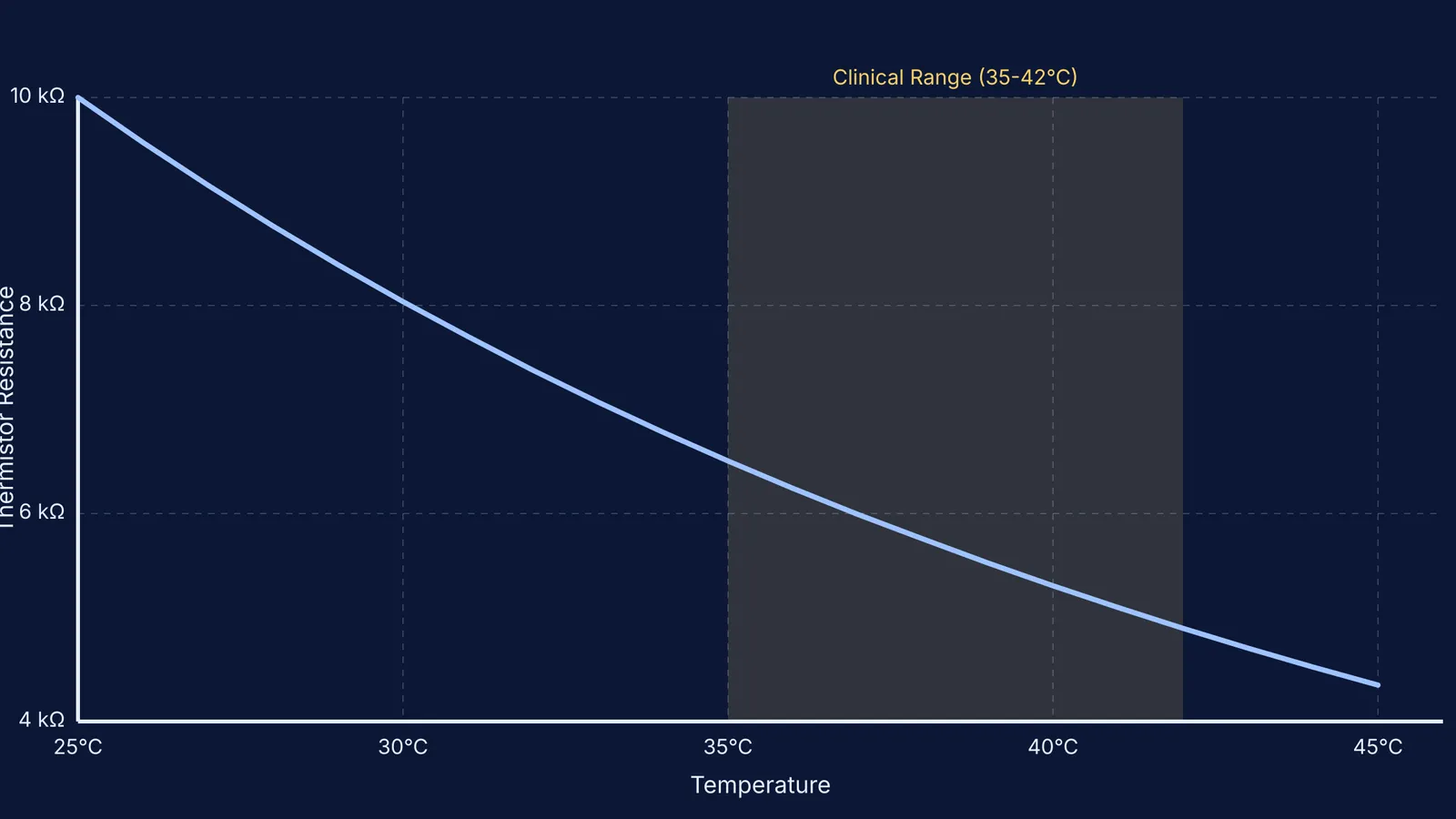
In normal metal wires, such as copper, electrical resistance increases as they get hotter. But an NTC thermistor is made of special semiconductor materials, typically sintered metal oxides like manganese, nickel, or cobalt. As its temperature rises, the added thermal energy excites the material and frees up more electrons to move from the valence band to the conduction band. Because more electrons are available to carry an electrical charge, the electrical resistance actually drops as the temperature increases (Wikipedia).
When you place the metal tip of the thermometer under your tongue or arm, your body heat warms the thermistor inside. The resistance of a standard medical NTC thermistor is carefully calibrated at room temperature, and it drops predictably as it approaches human body temperature (Wikipedia).
How does a microchip convert electricity into a temperature?
A digital thermometer is essentially a small, self-contained computer. Inside the plastic casing, it contains a microchip (microcontroller) and a battery. The battery sends a small, steady voltage through a circuit containing the thermistor, typically configured as a voltage divider.
As the thermistor warms up and its resistance drops, the voltage across it changes in real time. The microchip's built-in analog-to-digital converter continuously measures this changing electrical voltage and converts it into a digital number.
However, there is a catch. The relationship between temperature and resistance in an NTC thermistor is curved (non-linear) rather than a perfectly straight line. This means the microchip cannot just multiply the resistance by a single fixed number; it must perform some heavy mathematical lifting to determine the final reading.
To solve this, the thermometer's processor relies on a complex formula called the Steinhart-Hart equation. This third-order mathematical model takes the measured electrical resistance and translates it into a highly accurate temperature. This equation is so precise that it can calculate temperatures with an error of less than 0.02°C over a wide range of temperatures (Wikipedia).
Are digital thermometers as accurate as mercury?
For decades, mercury-in-glass thermometers were the medical gold standard. However, digital thermometers have largely replaced them worldwide due to superior safety, ease of reading, and speed.
Are they just as reliable? Yes. Digital clinical thermometers must meet stringent international engineering standards for precision. The internal components and microchip algorithms are calibrated to achieve a stated accuracy within ±0.2°C for typical home devices (Wikipedia).
When you use the device, the microchip continuously monitors the dropping resistance until the rate of change flattens out. This stabilisation means the sensor has fully warmed up and reached an equilibrium with your body heat, which is exactly when the device triggers its familiar beep. While a traditional mercury thermometer might take about five minutes to fully expand and record a temperature (Wikipedia), a modern digital device computes the curve and finishes the job accurately in around a minute.
If you are currently studying electricity, circuits, and semiconductor properties in physics, these concepts can sometimes feel abstract and disconnected from reality. Sometimes, seeing the direct relationship between temperature, resistance, and current can make the underlying mathematics click. You can experiment with these core circuit principles interactively in the Fermi Simulation Lab.
Understanding the everyday tools in our medicine cabinets reminds us that high school physics isn't just a set of equations to memorise for an exam paper—it is the foundational engineering that keeps us healthy and informed.


