

On this page
Paracetamol is the tablet many families reach for when someone has a fever. Its chemistry explains why it works and why the limit on the packet matters.
What happens in your body when you get a fever?
A fever is not your body losing control of its temperature. It is your body choosing a higher one. According to the NHS, a high temperature is usually considered to be 38C or above.
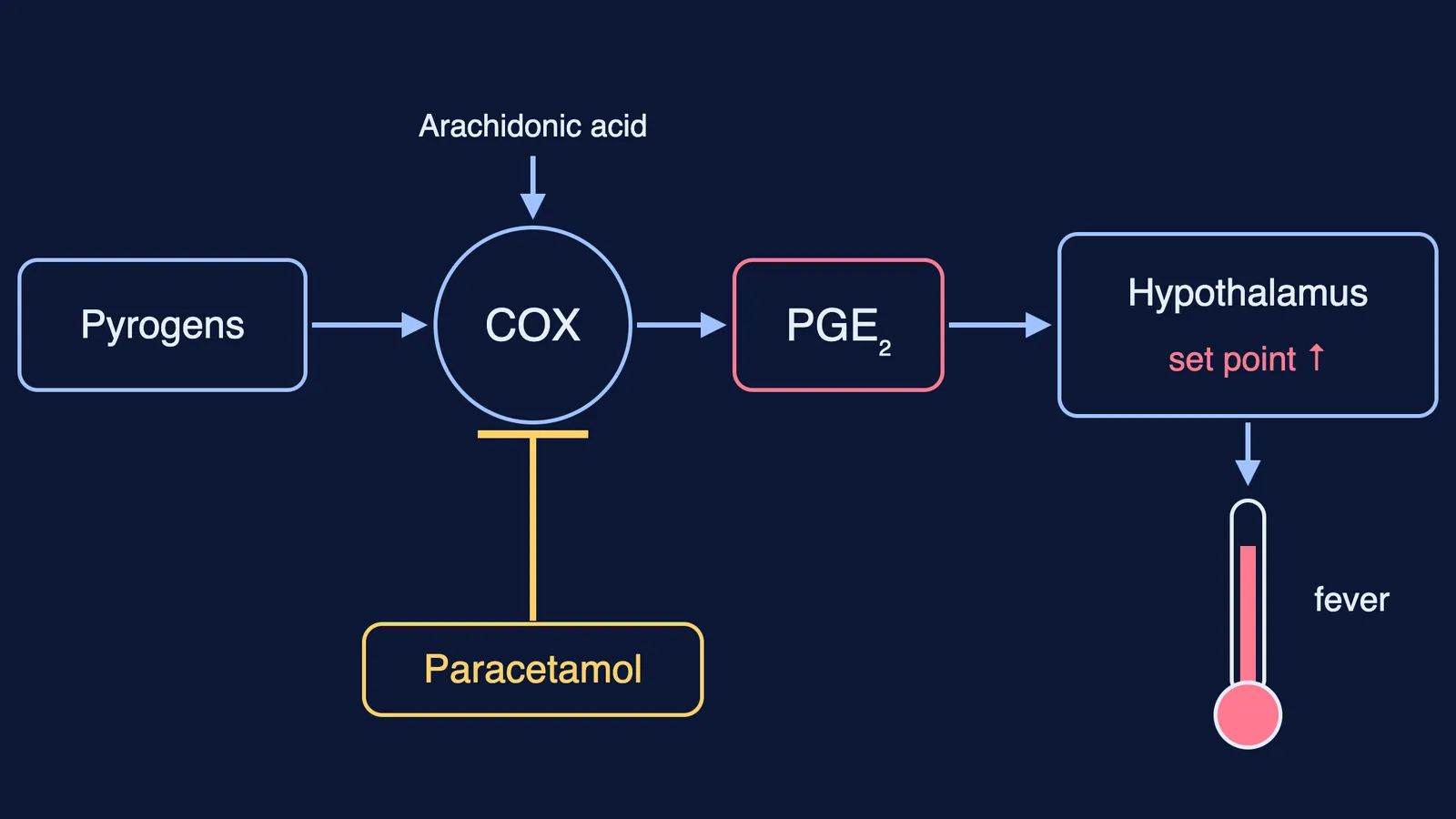
The choice is made in the hypothalamus, a small region at the base of the brain that works like a thermostat. A 2016 review in Critical Care describes the chain: pyrogens (fever-causing signals released during infection) stimulate a part of the hypothalamus, which leads to more prostaglandin E2 (PGE2). PGE2 acts in the pre-optic nucleus of the hypothalamus, slows the firing of warm-sensitive neurons and raises body temperature.
Think of it as someone turning the thermostat up a couple of degrees. Your body now feels cold at a normal temperature, so you shiver and pile on blankets until you reach the new setting. A 2015 review in Nature Reviews Immunology notes that fever confers a survival benefit during infection, which we explain in why your body gets a fever during an infection.
How does paracetamol work on fever and pain?
Prostaglandins are made from a fatty acid called arachidonic acid by enzymes called cyclooxygenases, COX-1 and COX-2. The leading explanation is that paracetamol inhibits these enzymes, so less PGE2 is made and the thermostat drifts back down.
For a long time, how paracetamol does this was uncertain. A 2013 review by Graham and colleagues in Inflammopharmacology says it is now generally accepted that paracetamol inhibits COX-1 and COX-2 by being processed by the enzymes' own peroxidase function. It also notes that drugs blocking the body's serotonin, opioid and cannabinoid systems reduce paracetamol's pain relief.
A 2005 study in the Journal of Biological Chemistry showed in rodents that, in the brain and spinal cord, paracetamol is converted into a molecule called AM404. In lab tests AM404 also inhibited the COX enzymes, and it acts on the body's cannabinoid system; both are present in the pain and temperature-control pathways.
Why is paracetamol a weak anti-inflammatory?
The same 2005 study describes paracetamol's anti-inflammatory action as weak compared with aspirin and other NSAIDs, the family that includes ibuprofen. The Graham review explains why: paracetamol blocks prostaglandin synthesis when levels of arachidonic acid and peroxides are low, but has little activity when they are high.
So, the review says, it does not suppress the severe inflammation of rheumatoid arthritis or acute gout, but it does calm the milder inflammation after a tooth extraction. Which medicine suits which illness is a question for a doctor or pharmacist.
If enzymes and inhibitors are where your biology chapter loses you, the Fermi Concept Library gives every concept in biology and chemistry its own lesson and its place in the map.
Why does the paracetamol dose limit matter?
The limit is about your liver. A 2016 review in the Journal of Clinical and Translational Hepatology describes what happens to each dose.
About 90% of paracetamol is joined to glucuronic acid or sulfate and leaves harmlessly in urine.
About 10% is oxidised, mainly by the liver enzyme CYP2E1, into a reactive molecule called NAPQI.
At normal doses, the liver's glutathione rapidly neutralises NAPQI.
At toxic doses, the safe routes saturate, most of the paracetamol is pushed into NAPQI, glutathione runs out, and NAPQI builds up and damages liver cells.
The same review reports that in the United States, paracetamol accounts for more than 50% of overdose-related acute liver failure.
How do you add up paracetamol across a day?
The NHS guidance for adults using 500 mg tablets is 1 or 2 tablets per dose, at least 4 hours between doses, and no more than 8 tablets in 24 hours, which is 4,000 mg. It also warns against taking other medicines that contain paracetamol, such as cold and flu remedies, at the same time.
A worked example of how the total creeps up for a parent with flu:
8 am, 12 noon, 4 pm: two 500 mg tablets each time. Running total: 3,000 mg.
7 pm: a cold and flu sachet. Read its label. Suppose it lists 500 mg paracetamol. Total: 3,500 mg, and the 4-hour gap since 4 pm is not yet up.
Midnight: two more tablets would make 4,500 mg, over the 24-hour limit.
A simple checklist for the family:
Read the ingredients of every syrup, sachet and combination tablet in the house, not just the strip labelled paracetamol.
Note each dose and its time while someone is ill.
Children's doses are different: follow the label or ask a doctor.
The NHS says not to take paracetamol for more than 3 days unless a doctor tells you to.
Why every 4 hours rather than all at once? Read why medicine is taken every few hours, and see how a digital thermometer reads a fever to check whether a fever has actually come down.


