On this page
The NHS tells adults taking paracetamol to leave at least 4 hours between each dose. Other medicines are taken once or three times a day. The gap depends on how fast your body clears the drug, measured by its half-life. Once you see the arithmetic, the label makes sense, and so does the warning not to skip doses.
What is a drug's half-life?
The elimination half-life is the time it takes for the concentration of a drug in the body to fall to half its starting value, as defined in StatPearls on the NCBI Bookshelf.
For many drugs the body removes a fixed fraction per hour, not a fixed amount. That is first-order kinetics, where the half-life stays constant on a concentration-time graph. It is the same maths as radioactive decay, where you find the decay constant from an ln N vs t graph.
After 4 to 5 half-lives, about 94 to 97% of a single dose has been eliminated (StatPearls).
How do repeated doses build up to a steady level?
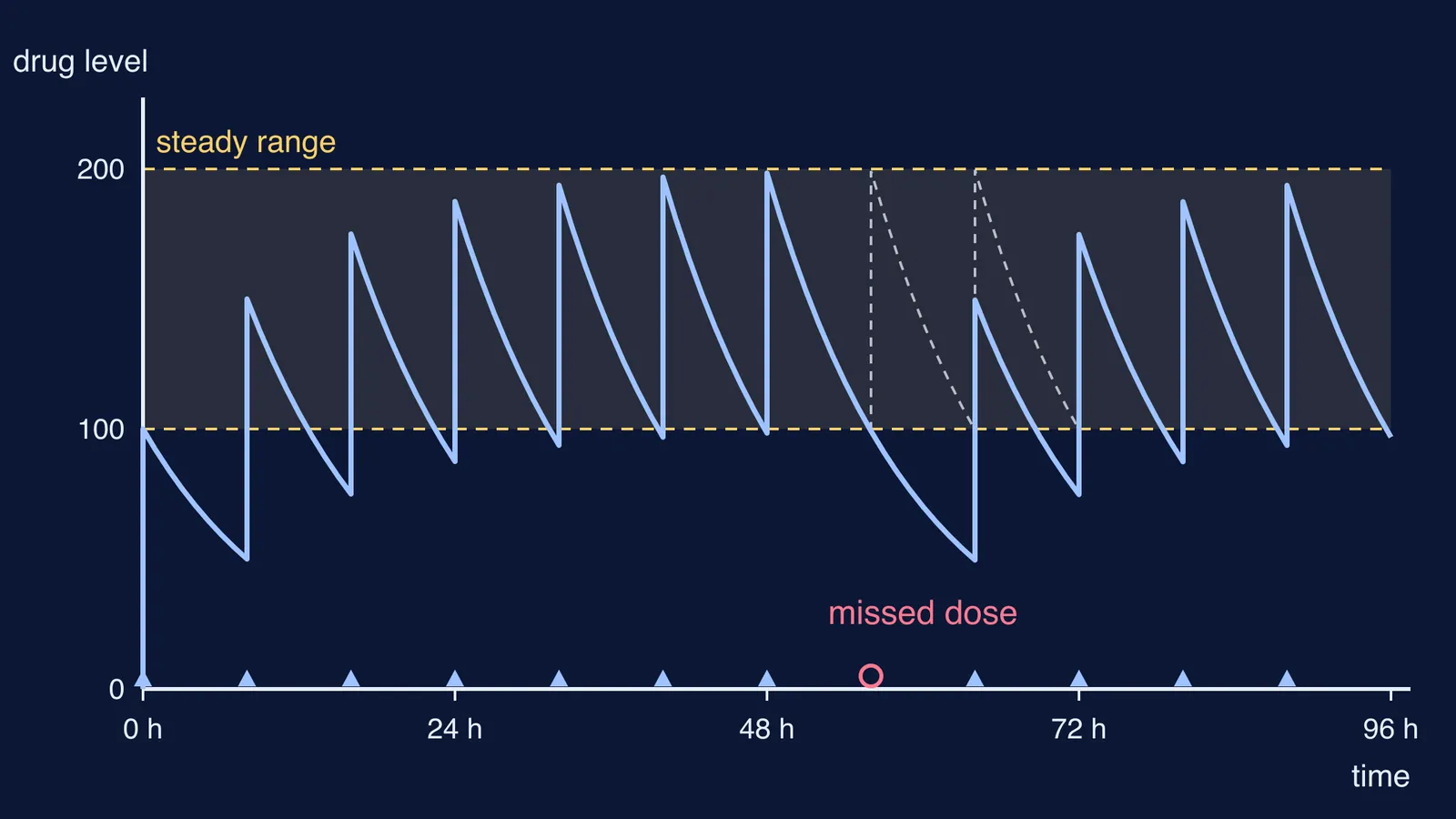
Let's simulate an imaginary medicine. Its half-life is 8 hours, you take it every 8 hours, and each dose adds 100 units to your blood. To keep the sums simple, assume each dose is absorbed instantly.
Dose 1: the level jumps to 100, then halves to 50 by the time dose 2 is due.
Dose 2: 50 + 100 = 150, falling to 75.
Dose 3: 75 + 100 = 175, falling to 87.5.
Dose 4: 187.5, falling to about 94.
Dose 5: about 194, falling to about 97.
The peaks creep towards 200 and the lowest points creep towards 100. Why does it stop there? At a peak of 200, half the drug (100 units) leaves before the next dose, which is exactly what one dose puts back. Input equals output, so the level just swings between 100 and 200. That swing is the steady state.
After 4 half-lives (32 hours, just before dose 5), the low point is about 94, which is 94% of its steady value of 100. That matches the rule that a drug on regular doses reaches steady state after about 4 to 5 half-lives (StatPearls).
Now try the same medicine once a day. 24 hours is 3 half-lives, so only one-eighth is left before the next dose. The formula gives a peak of about 114 and a low of about 14. The level swings eightfold and spends much of the day near zero. That is one reason a medicine that is cleared quickly is usually taken several times a day.
What happens if you skip a dose?
Go back to the 8-hour medicine, settled in its 100-to-200 range, and miss one dose. Nothing tops the level up, so by the time the following dose is due it has fallen to 50, half the usual low point. When you restart, the peaks go 150, 175, 187.5: about three doses, a full day, to get back near the range. The diagram above shows both paths.
The tempting fix is to take two doses at once. In the model, that puts 200 units on top of the 50 left, so the level reaches 250, a quarter above the usual peak. Real medicines have safe limits, and guidance for health professionals from the NHS Specialist Pharmacy Service says: "Never take a double dose to make up for a forgotten dose, unless advised by a prescriber" (NHS SPS).
Missed doses are common. A 2003 WHO report found that adherence rates in developed countries average only about 50%, as summarised in a 2011 review in Mayo Clinic Proceedings.
Real drugs are messier: absorption takes time, safe ranges differ and half-lives vary between people. Use this model to understand the idea, not to plan your own medicine.
What should you do if you miss a dose?
This is everyday guidance, not medical advice:
Read the leaflet first. The patient information leaflet usually has specific advice on missed doses (NHS SPS).
Do not double up unless the person who prescribed it tells you to.
If you are unsure, ask a pharmacist or your doctor, and tell them when you missed the dose and when the next one is due.
Tie each dose to something fixed, such as breakfast or a phone alarm, and use a pill box so a missed dose is easy to spot.
How can you see the curve change for yourself?
To watch the sawtooth move as you change the numbers, the Fermi Simulation Lab has interactive simulations for ideas that are easier to see than to read. If exponential decay itself feels shaky, the Fermi Concept Library gives each concept in chemistry, biology and maths its own lesson.
If working out doses from half-lives appeals to you, it is the daily work of a career in pharmacology.