On this page
If you keep asking why a tablet works, and why one dose is enough while another is too much, you are asking a pharmacologist's questions. Here is how they answer them, and the Indian routes into the work.
What does a pharmacologist actually study?
The British Pharmacological Society defines pharmacology as "the study of how medicines work and how they affect our bodies".
The field has two halves. Pharmacodynamics "refers to what an administered drug does to the body", and pharmacokinetics "refers to what the body does to an administered drug": absorption, distribution, metabolism and excretion (IUPHAR Pharmacology Education Project glossary).
India's National Medical Commission MD Pharmacology guidelines.pdf) describe pharmacology as both experimental (drug action and discovery) and clinical (prescribing, trials and pharmacovigilance).
How do pharmacologists measure what a drug does?
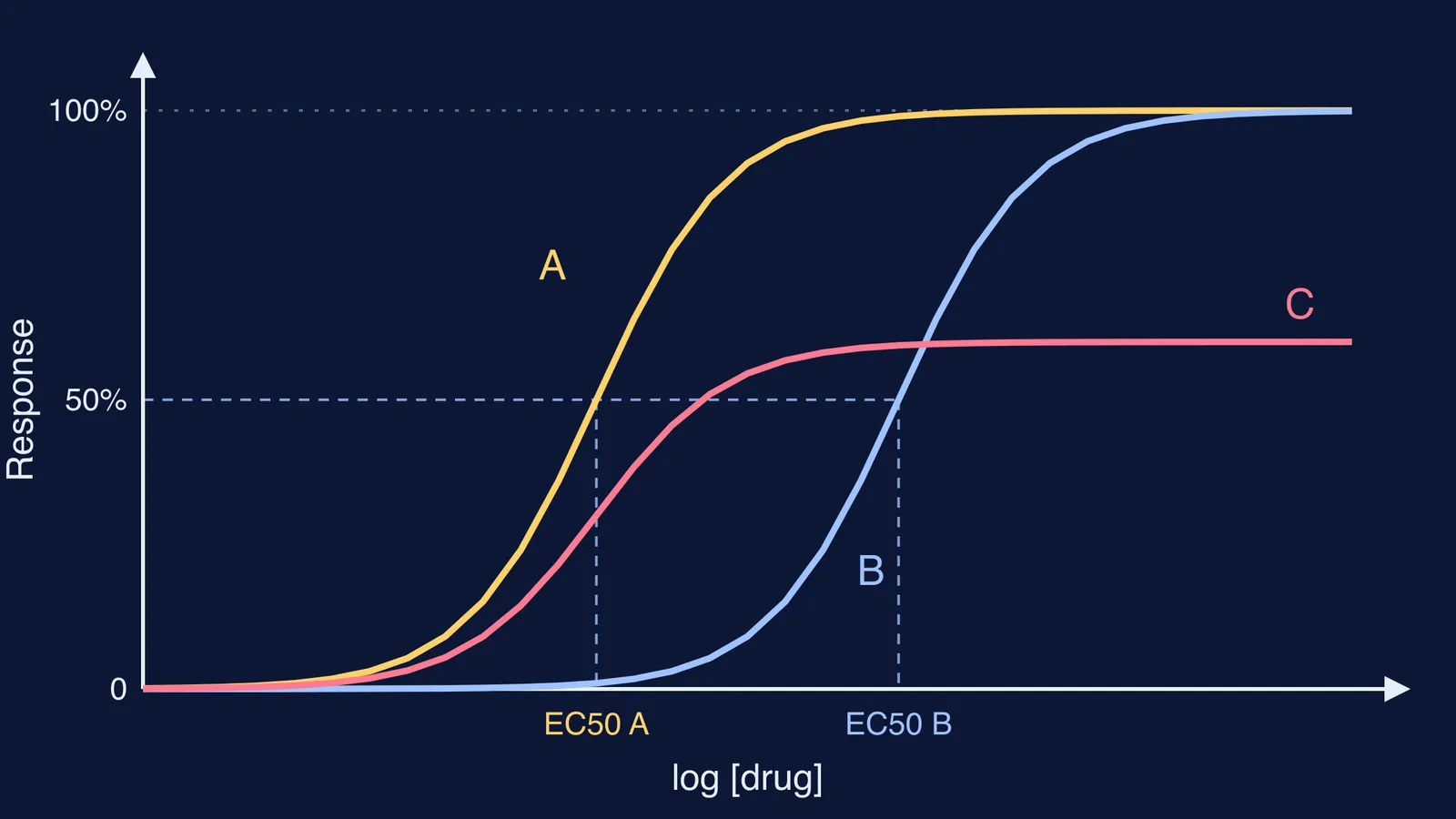
The basic tool is the concentration-response curve: expose cells or tissue to rising drug concentrations, measure the effect at each, and plot effect against log concentration. The result is an S-shaped curve.
EC50 is "the molar concentration of an agonist that produces 50% of the maximum possible response for that agonist" (IUPHAR glossary). A lower EC50 means a more potent drug.
The curve usually follows the Hill equation, which A.V. Hill first wrote to describe oxygen binding to haemoglobin and which many pharmacokinetic-pharmacodynamic models use to describe drug dose-response relationships (Goutelle et al., 2008, Fundamental & Clinical Pharmacology). In its simplest form, with a Hill coefficient of 1: response = maximum × C ÷ (C + EC50).
A worked example
Take three made-up drugs acting on the same receptor:
Drug A has an EC50 of 10 nM. At 10 nM it gives 10 ÷ (10 + 10) = 50% of maximum. At 100 nM it gives 100 ÷ 110, about 91%. At 1 nM it gives 1 ÷ 11, about 9%.
Drug B has an EC50 of 1,000 nM: 100 times less potent than A, yet at a high enough concentration it gets close to the same maximum. At 100 nM it gives 100 ÷ 1,100, about 9%.
Drug C has the same EC50 as A but tops out at 60%. That makes it a partial agonist: it has lower efficacy and cannot produce the full response "irrespective of the concentration applied" (IUPHAR glossary). At 10 nM it gives 60 × 0.5 = 30%.
If receptors and agonists feel shaky, our explainer on what drugs do to receptors, including tolerance and dependence is a good start. The Fermi Concept Library has a lesson for each concept in biology and chemistry, so you can fill a gap before it grows.
Which degrees lead to a pharmacology career?
There are three main doors in India:
Pharmacy route: B.Pharm, then M.Pharm in pharmacology. The Graduate Pharmacy Aptitude Test (GPAT), run by NBEMS for the Pharmacy Council of India, awards scholarships for M.Pharm entry. The NIPER JEE admits students to NIPER's M.S. (Pharm.), M.Pharm and PhD programmes, and NIPER Mohali has a Department of Pharmacology and Toxicology.
Biology route: a BSc in a life science such as biochemistry, then a master's and a PhD in a lab that studies drug targets. Check eligibility first: some pharmacology courses require a pharmacy or medical degree.
Medical route: MBBS, then MD Pharmacology. The NMC guidelines.pdf) expect MD students to run a research project from planning to publication and to teach MBBS students.
See also our guide to research careers after B Pharm, M Pharm and PhD.
Where do pharmacologists work: research or industry?
The US FDA splits drug development into five steps: discovery, preclinical research (lab and animal safety tests), clinical research, regulatory review, and safety monitoring after launch.
For medical pharmacologists, the NMC guidelines.pdf) list jobs in academia, pharmacovigilance centres, regulatory bodies, national research institutes and the pharmaceutical industry, and as scientific writers or science managers.
Pharmacovigilance is watching for harm once a medicine is in use. India's Pharmacovigilance Programme of India, started in July 2010 and coordinated by the Indian Pharmacopoeia Commission, reports 250 adverse drug reaction monitoring centres in medical colleges and corporate hospitals. If testing medicines in people interests you most, read how to start a clinical research career after a BSc or B.Pharm.
How can you test whether pharmacology suits you?
Try this four-week check before you commit to a degree:
Week 1: Redo the worked example with your own numbers. If it feels satisfying, that is a good sign.
Week 2: Pick one medicine from your NCERT Class 12 chapter Human Health and Disease. Write down what it does to the body and what the body does to it.
Week 3: Read the admission pages of one pharmacy college and one medical college. Note which route fits your subjects and budget.
Week 4: Ask one person who works in a lab, hospital or drug company: "What did you do yesterday, hour by hour?"
If the biology behind drug action is the sticking point, Fermi's AI tutor can work out what you already know and build a plan for the session, so you start with a clear next step.