

On this page
India's pharmaceutical and clinical trial sector is expanding. According to Invest India, there are over 94,000 clinical trials registered in the country. For students finishing a B.Sc. in Life Sciences (like biotechnology or microbiology) or a B.Pharm, this growth creates a direct path into a career that tests the safety and effectiveness of new medicines.
But university degrees teach the science, not the regulatory process of bringing a drug to market. Here is how trials work, the entry-level roles available, and the typical qualifications needed to secure them.
How do the four phases of drug trials work?
Before any new drug or vaccine reaches the public, it must pass through a strict testing sequence. The U.S. Food and Drug Administration (FDA) and the World Health Organization recognise four standard phases of clinical research:
Phase 1 (Safety): The drug is given to a small group of 20 to 100 healthy volunteers or patients. The goal is to determine the highest dose humans can safely take and to observe side effects.
Phase 2 (Efficacy): The trial expands to several hundred people who have the condition the drug is meant to treat. Researchers look at how well the drug works and continue to monitor short-term side effects.
Phase 3 (Confirmation): Involving 300 to 3,000 volunteers, this phase compares the new drug to existing standard treatments. It provides the bulk of the data on the overall benefit-risk ratio needed for regulatory approval.
Phase 4 (Post-market): After the drug is approved and available, researchers track its long-term safety and effectiveness in several thousand people in the real world.
Understanding these phases is the core of any clinical research job, whether you are helping to make human insulin by rDNA or testing new treatments for non-communicable diseases.
What are the entry roles for a CRA and CRC?
If you join the industry as a fresher, you will likely start in one of two main tracks.
Clinical Research Coordinator (CRC) A CRC works at a specific hospital or trial site. They interact directly with the patients and the doctors conducting the trial. Their day involves recruiting volunteers, ensuring they understand the risks, administering the correct doses, and recording the site data accurately.
Clinical Research Associate (CRA) A CRA is typically employed by a pharmaceutical company or a Clinical Research Organisation (CRO) to oversee the trial. They are field-based, travelling to multiple hospital sites to audit the data collected by the CRCs. A CRA ensures the site is complying with the approved protocol and international guidelines.
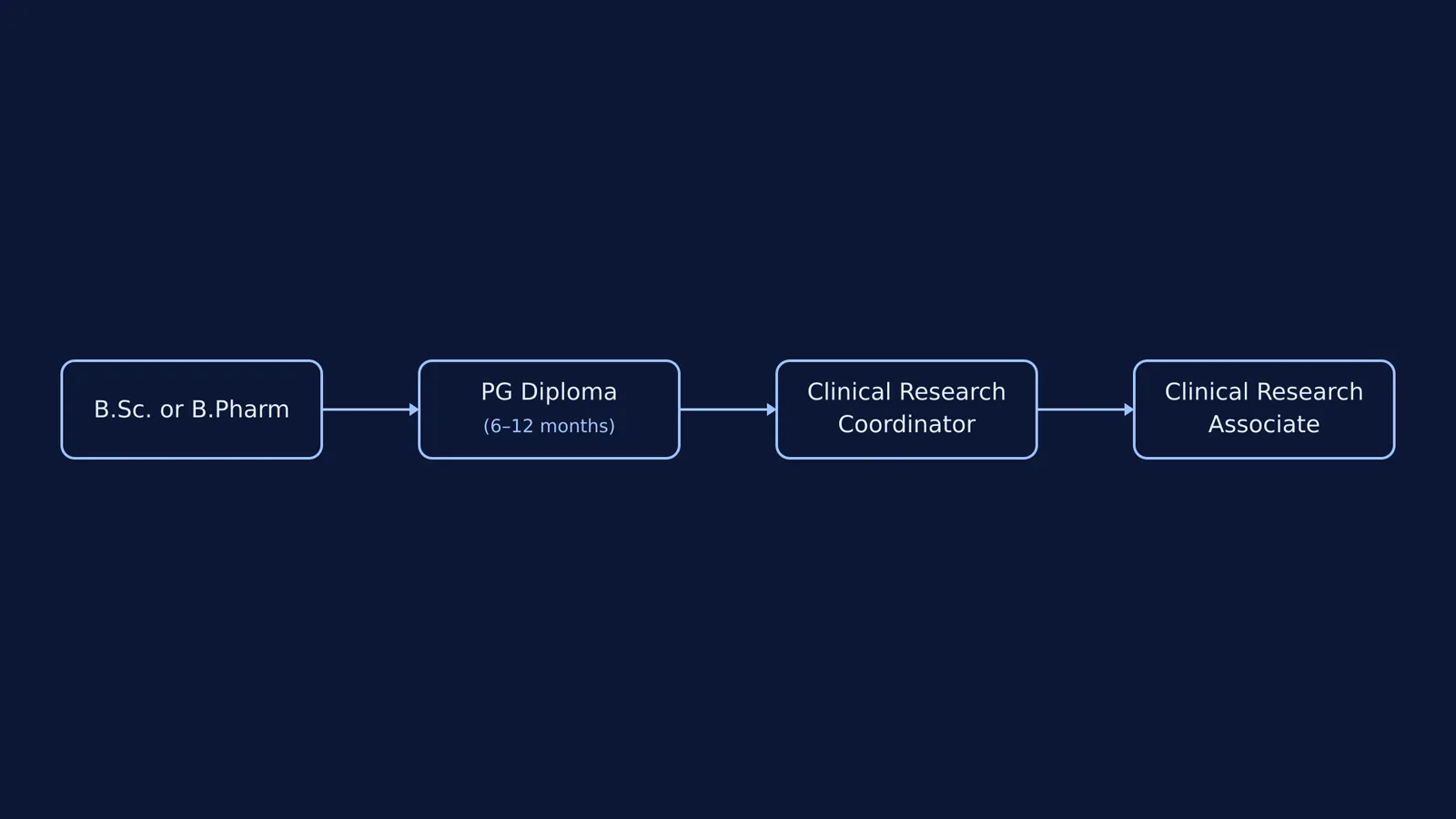
It is common to start as a CRC for the first year or two to gain hands-on site experience before moving up to a CRA role, which involves more responsibility and higher pay.
Which diploma bridges the gap for graduates?
While a B.Sc. or B.Pharm makes you eligible, most companies look for practical knowledge of trial regulations.
To bridge this gap, many graduates take a Post Graduate Diploma in Clinical Research (PGDCR). These courses typically last between six and twelve months, as offered by institutes like Jadavpur University, and cover essential industry standards. This includes the ICH-GCP (International Council for Harmonisation - Good Clinical Practice) guidelines.
When you study for these certifications, you often need to revisit your foundational university science. The Fermi Concept Library has every concept in physics, chemistry, biology, mathematics and computing, each with its own lesson and its place in the map. If you are struggling to structure your study time alongside a diploma, Fermi's AI tutor can work out what you already know and build a plan for the session, so you sit down to a clear next step.
A checklist for entering clinical research
If you are planning your move into the industry, use this framework to prepare:
Verify your eligibility: Ensure you have a B.Sc. in a Life Science (such as zoology, botany, microbiology, or chemistry) or a B.Pharm degree.
Learn the guidelines: Familiarise yourself with the ICH-GCP guidelines. This is the universal standard for ethical trial conduct and will be asked about in every interview.
Brush up on your calculations: Trial monitoring involves precise dosage and dilution mathematics. You can practise mixing and diluting solutions to ensure your foundational chemistry is solid.
Target CRC roles first: Look for Clinical Trial Assistant (CTA) or Clinical Research Coordinator positions at mid-sized CROs or local multispecialty hospitals to build your on-site experience.


