On this page
In Class 12 biology, the part on drugs and alcohol abuse uses three words that sound like a list to memorise: tolerance, dependence and withdrawal. They are really one story about receptors, the protein "locks" a drug binds to, and a body that keeps trying to get back to normal. Here it is in order, with a four-link chain for your exam answer.
What is tolerance in biology?
Tolerance is a loss of responsiveness to a drug after continued exposure, as a 2013 review of opioid receptors in Pharmacological Reviews defines it. In plain words, the same dose starts doing less.
The body gets there in two main ways. The US National Institute on Drug Abuse explains that the brain "adjusts by producing fewer neurotransmitters in the reward circuit, or by reducing the number of receptors that can receive signals." Fewer working receptors means fewer places for the drug to act.
The change can also run the other way. Caffeine works partly by blocking receptors for adenosine, a molecule that makes you drowsy. A 1993 mouse study in Pharmacology Biochemistry and Behavior notes that regular caffeine raises adenosine receptor levels and suggests this as a basis for caffeine tolerance. A 1988 rat study in the Journal of Clinical Investigation described the receptor changes it found after chronic caffeine as "likely compensatory measures to offset blockade" by the drug. Either way, the cell rebalances against the drug.
If receptors are hazy, start with our synapse structure diagram and the story of how Lefkowitz and Kobilka discovered G protein-coupled receptors.
Why are higher doses needed over time?
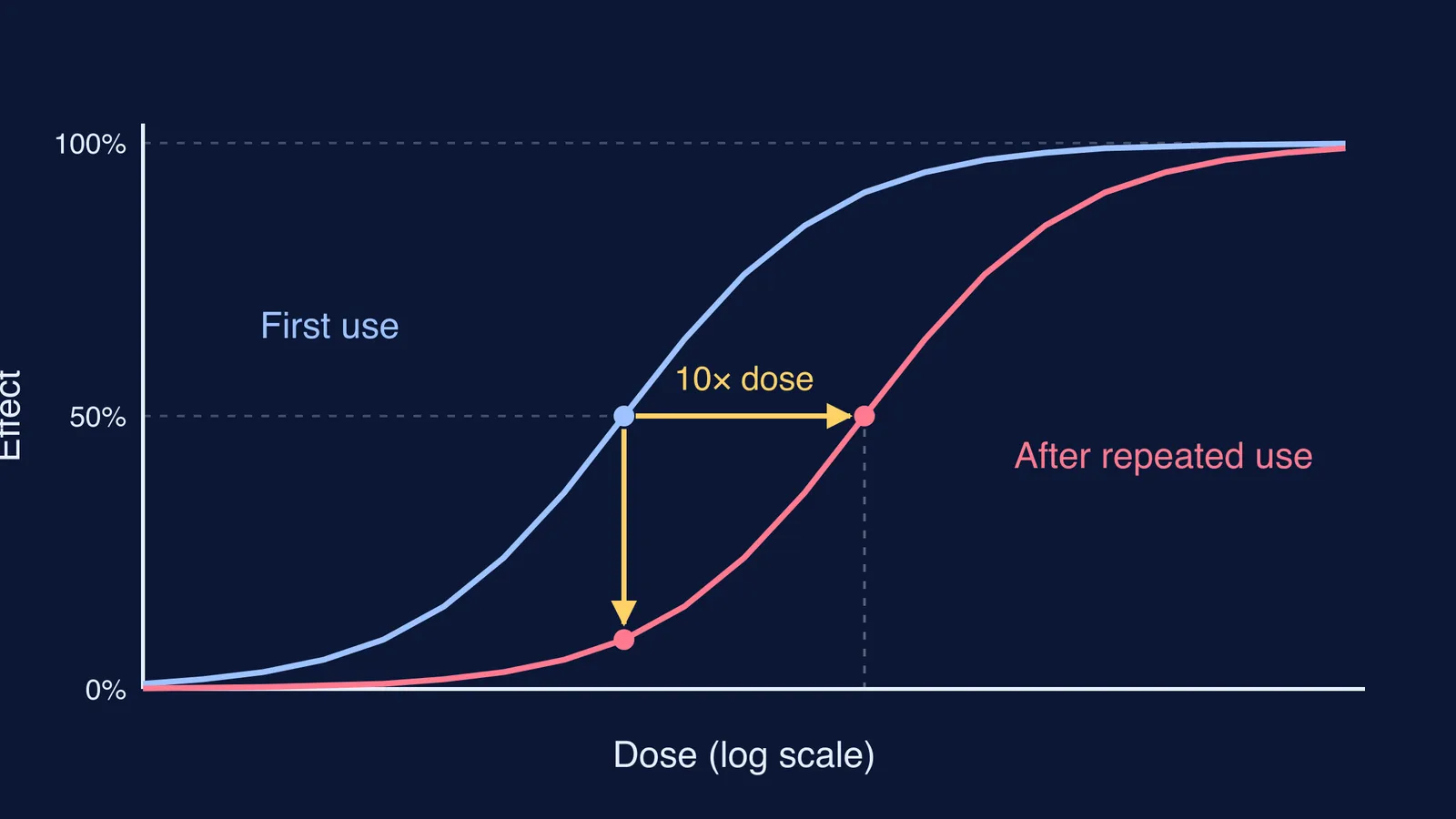
A drug's effect depends on how many receptors it occupies and how strongly each one signals. Cut either, and the old dose does less. NIDA puts it simply: a person "will often need to take larger amounts of the drug to produce the familiar high—an effect known as tolerance."
The diagram at the top shows this as a dose-response curve sliding to the right: the dose that once gave half the maximum effect now gives much less.
What is dependence, and why does withdrawal happen?
Dependence means the body has adjusted so far that it now needs the drug to work normally. Withdrawal is what happens when the drug is removed and those adjustments are left unbalanced.
Opioids give a clear example. Thomas Kosten and Tony George, psychiatrists at Yale University School of Medicine, describe how opioids quieten nerve cells in the locus ceruleus, a brainstem area that releases noradrenaline (NA). With repeated use, those cells push their activity back up to compensate. When the opioid is gone, "the neurons release excessive amounts of NA, triggering jitters, anxiety, muscle cramps, and diarrhea."
Caffeine shows the same pattern on a small scale, worth knowing if you live on chai or coffee during board revision. A 2004 review in Psychopharmacology by Laura Juliano and Roland Griffiths found that withdrawal symptoms such as headache, fatigue and difficulty concentrating typically begin 12 to 24 hours after stopping, peak at 20 to 51 hours and last 2 to 9 days. In the experimental studies it reviewed, headache occurred in about 50% of cases, and stopping doses as low as 100 mg a day was enough to cause symptoms.
How do you write tolerance and dependence in a Class 12 answer?
A cause-and-effect chain makes your answer easy to follow and easy to mark. Use these four links, in order:
Repeated use: the drug binds the same receptors again and again.
Adaptation: cells reduce receptor numbers or signalling (or, for a blocker like caffeine, make more receptors).
Tolerance: the usual dose gives a smaller effect, so a higher dose is taken.
Dependence and withdrawal: the body now works around the drug, so stopping it causes symptoms that are often the opposite of the drug's effect.
Worked example. Question: "Why is it difficult to give up a drug once you start?" A strong three-mark answer reads: "Repeated use makes the body's receptors less responsive, so the same dose gives a weaker effect (tolerance) and the person takes higher doses. The body adjusts to the drug's constant presence and comes to depend on it. When the drug is stopped, the adjusted body produces unpleasant withdrawal symptoms, and avoiding them keeps the person using the drug."
Check your answer against the four links; a missing link often means a missing point. To revise receptors and neurotransmitters as one connected map, the Fermi Concept Library gives every biology concept its own lesson and its place in the map. For the history, read how Friedrich Sertürner isolated morphine, the first alkaloid isolated from a plant.
Where can you get help if this feels personal?
If you or someone at home is worried about alcohol, tobacco or any drug, talk to a doctor. Tele MANAS, the free, 24x7 national mental-health helpline from the Ministry of Health and Family Welfare, is reachable at 14416 or 1800-891-4416, as listed by IIT Kanpur's counselling service.