On this page
Before the early 1800s, doctors treated pain with raw opium, a gamble that could be ineffective or fatal due to varying strengths in each harvest. The scientific consensus was that all active medicinal principles in plants were acids, until a young pharmacist's apprentice in Paderborn, Friedrich Wilhelm Adam Sertürner, decided to investigate the poppy in his spare time and successfully isolated morphine.
How did Friedrich Sertürner isolate morphine?
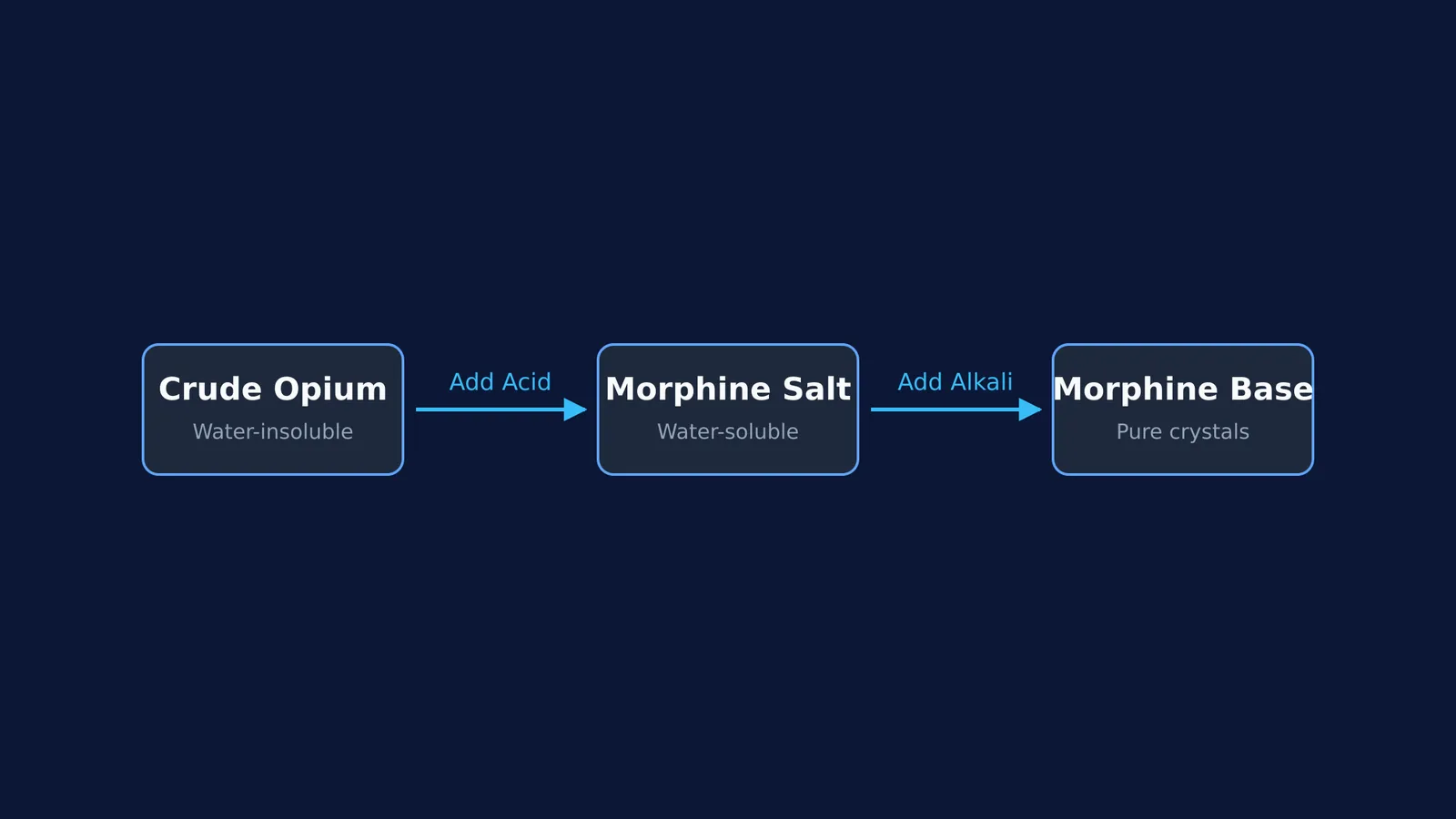
Working with limited equipment, Sertürner found that the active substance in the tarry poppy seed juice was a weak base, soluble in acidic solutions. According to a 2016 historical review in the *Indian Journal of Anaesthesia*, he successfully isolated and extracted morphine crystals using this property.
Sertürner originally named these crystals "morphium" after Morpheus, the Greek god of sleep and dreams. He published his initial findings in 1805, though it took until his comprehensive paper in 1817 for the scientific community to fully grasp the magnitude of his achievement. What he had found was a naturally occurring, nitrogen-bearing organic compound that acts as a base.
Why was morphine the first alkaloid?
Sertürner's discovery was a profound shock to early 19th-century chemistry. By demonstrating that morphine was alkaline rather than acidic, he overturned the existing rules of plant chemistry. The term "alkaloid" (meaning alkali-like) was coined in 1818 by W. Meissner specifically to describe this new class of base compounds.
His discovery proved that specific, measurable chemical molecules were responsible for a plant's medical effects, giving birth to the field of alkaloid chemistry. Within years of his landmark paper, his initiative led to the isolation of numerous other alkaloids such as strychnine, quinine, and codeine.
If you are a student preparing for board exams, you will encounter Sertürner's legacy in the biomolecules and chemistry in everyday life chapters. Alkaloids form a major part of the syllabus. When you need to revise these molecular structures or understand their acid-base properties, the Fermi Concept Library contains every concept in physics, chemistry, biology, mathematics and computing, each with its own lesson and its place in the map.
How did standard dosing change medicine?
To prove his discovery was the true sleep-inducing principle of opium, Sertürner tested the purified crystals on himself and three young volunteers. Through careful, albeit dangerous, self-experimentation, he observed that a 30 mg dose caused a happy, light-headed sensation, while subsequent doses led to drowsiness, fatigue, confusion and somnolence. Through trial and error, he suggested that 15 mg of the substance should be the optimal dose.
This was the first time in medical history that a standardized, predictable dose was established for a painkiller. Doctors could suddenly weigh an exact amount of morphine, knowing precisely what effect it would have on the patient, removing the deadly guesswork of raw opium extracts.
How to study alkaloids for your exams: a 3-step plan
Questions about alkaloids appear frequently in biology and chemistry exams. Here is a framework to help you master them without relying purely on rote memorisation:
Identify the biological source: Memorise the scientific name of the source plant. For example, morphine is extracted from the latex of *Papaver somniferum*.
Understand the chemical structure: Note the presence of the basic nitrogen atom. This is what makes the compound an alkaloid and allows it to form water-soluble salts when it reacts with acids in the human stomach.
Map the physiological effect: Connect the molecule to its target receptor in the body (such as opioid receptors in the central nervous system) and its clinical use (like analgesia).
If you are stuck trying to memorise the differences between these various plant extracts, Fermi's AI tutor can work out what you already know, build a plan for the session, and teach through it.
Sertürner's story is a reminder that scientific breakthroughs do not always come from famous university professors. A young apprentice with a mortar, a pestle, and a willingness to question established rules can completely change how we understand the natural world.