On this page
The Indian pharmaceutical industry is evolving from a generic manufacturing hub into an innovation-driven research centre. For pharmacy students, this shift is opening up many high-skill roles. However, the type of research you do depends entirely on your highest degree.
If you are weighing your options across different science fields, you might also wonder whether to do an MSc or a job after a BSc in chemistry. For pharmacy graduates, the hierarchy is quite structured.
What is a research career after B Pharm, M Pharm, PhD?
The level of your degree dictates your entry point into the research and development (R&D) ecosystem.
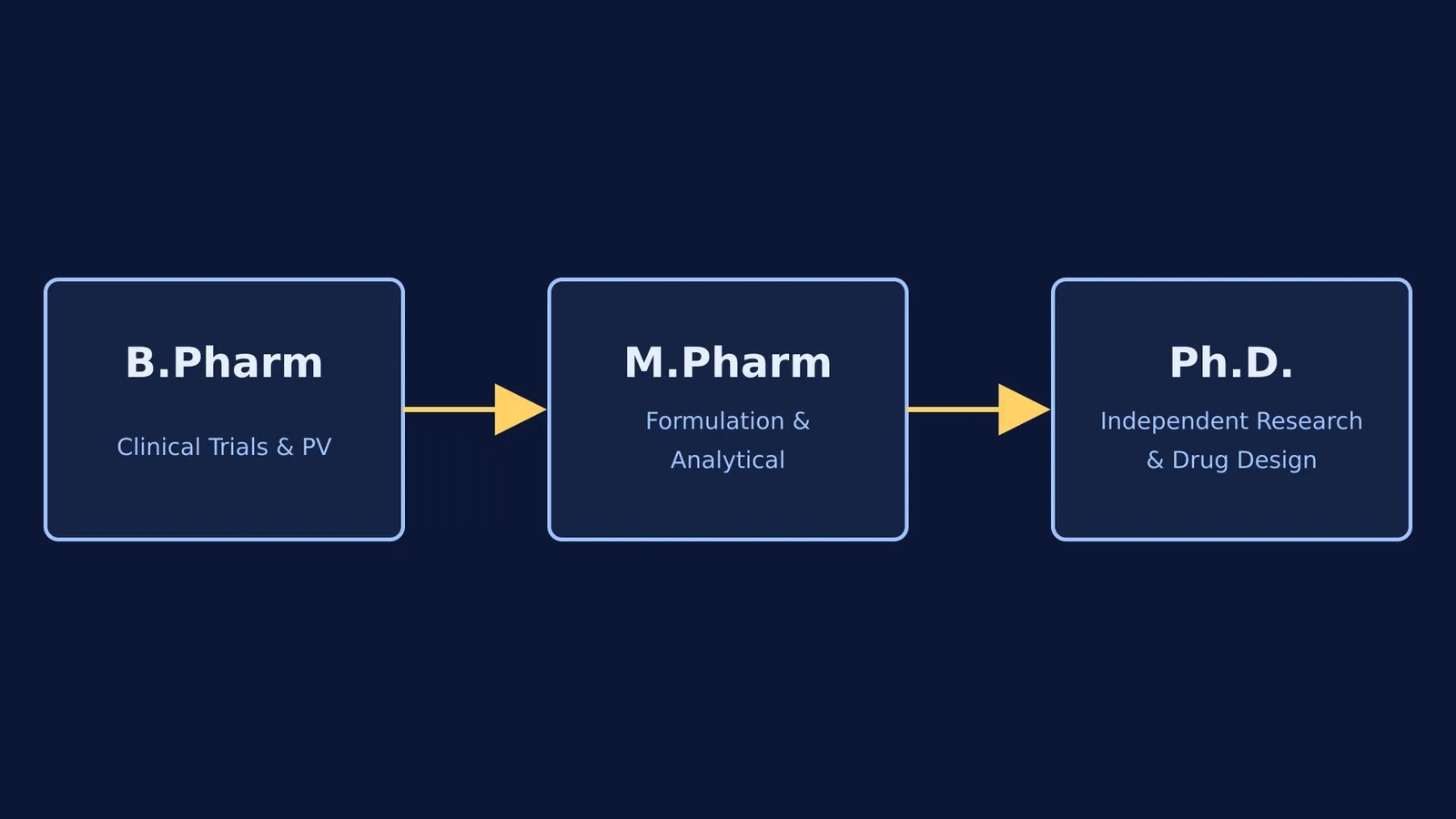
B.Pharm (Bachelor of Pharmacy): A bachelor’s degree qualifies you for operational and data-driven roles. Graduates typically start as Clinical Trial Coordinators, Pharmacovigilance (PV) Associates, or Data Management Trainees. You will focus on monitoring adverse drug reactions and ensuring trials follow regulatory protocols.
M.Pharm (Master of Pharmacy): This is where core laboratory research begins. With a master's degree, you can become a Research Associate (RA), Formulation Scientist, or Analytical R&D Officer. You will spend your days developing drug delivery systems or testing compound purity. If you found organic chemistry challenging during your bachelor's degree and need to catch up, the Fermi Concept Library contains every concept in physics, chemistry, biology, mathematics and computing, each with its own lesson and its place in the map.
PhD: A doctorate leads to independent research design and leadership. Roles include Senior Scientist, Principal Investigator, or Medical Science Liaison (MSL). PhD holders are the ones who design the molecular structures of entirely new drugs.
What do researchers do in the pharmaceutical industry?
The Indian pharmaceutical industry is expected to reach US$ 130 billion by 2030, according to the India Brand Equity Foundation. Research within these companies is split across a few key domains.
Formulation R&D (FR&D): These scientists figure out how to deliver a drug into the human body. They turn an active pharmaceutical ingredient (API) into a stable tablet, syrup, or injection that absorbs efficiently.
Analytical R&D (AR&D): Analytical researchers develop testing methods using instruments like HPLC (High-Performance Liquid Chromatography) and LC-MS to ensure the drug is pure and safe. In AR&D, you will often rely on predicting reaction outcomes, much like deciding leaving group ability in organic chemistry. If you get stuck on a complex mechanism during your studies, the Fermi Problem Library has worked problems with a step-by-step solver that explains the reasoning rather than printing an answer.
Clinical Research: This sector tests drugs on human volunteers. Contract Research Organisations (CROs) hire pharmacists to manage vast amounts of trial data and monitor patient safety.
Which government labs hire pharmacists for research?
While private giants like Sun Pharma and Dr. Reddy's are massive employers, the Indian government runs some of the most prestigious research institutes in the country. To push the industry forward, the government's Promotion of Research and Innovation in Pharma (PRIP) scheme has an outlay of ₹5,000 crore to build Centres of Excellence.
Two major government bodies regularly hire pharmacy graduates:
Council of Scientific and Industrial Research (CSIR): Institutes like the Central Drug Research Institute (CDRI) in Lucknow and the Indian Institute of Chemical Technology (IICT) in Hyderabad are hubs for drug R&D. They hire B.Pharm and M.Pharm graduates as Project Associates.
Indian Council of Medical Research (ICMR): ICMR focuses heavily on public health and biomedical research. M.Pharm and Pharm.D graduates can enter as Young Professionals or Scientist B, which is a high-level entry point into the permanent cadre.
How should you plan your pharmacy research career?
If you want to build a career in R&D, use this checklist to prepare while you are still in college:
Clear the GPAT: The Graduate Pharmacy Aptitude Test is your gateway. A good score secures a monthly stipend during your M.Pharm and makes you eligible for premier institutes like the National Institute of Pharmaceutical Education and Research (NIPER).
Master an instrument: Do not just pass your lab practicals. Become an expert at operating and reading data from an HPLC machine or a UV-Vis spectrophotometer. Hands-on instrumentation skills are the fastest way to get hired in Analytical R&D.
Start as a Project Associate: Keep an eye on the official CSIR and ICMR career pages for interviews. Working as a Project Associate gives you the strongest possible foundation for a PhD application or a top-tier industry role.