

On this page
Finishing a Bachelor of Science (BSc) in chemistry leaves you with a major choice: enter the workforce immediately or pursue a Master of Science (MSc). With the Indian chemical industry expanding rapidly, both paths offer opportunities, but they lead to very different careers in the long run.
Should I take a job immediately after my BSc?
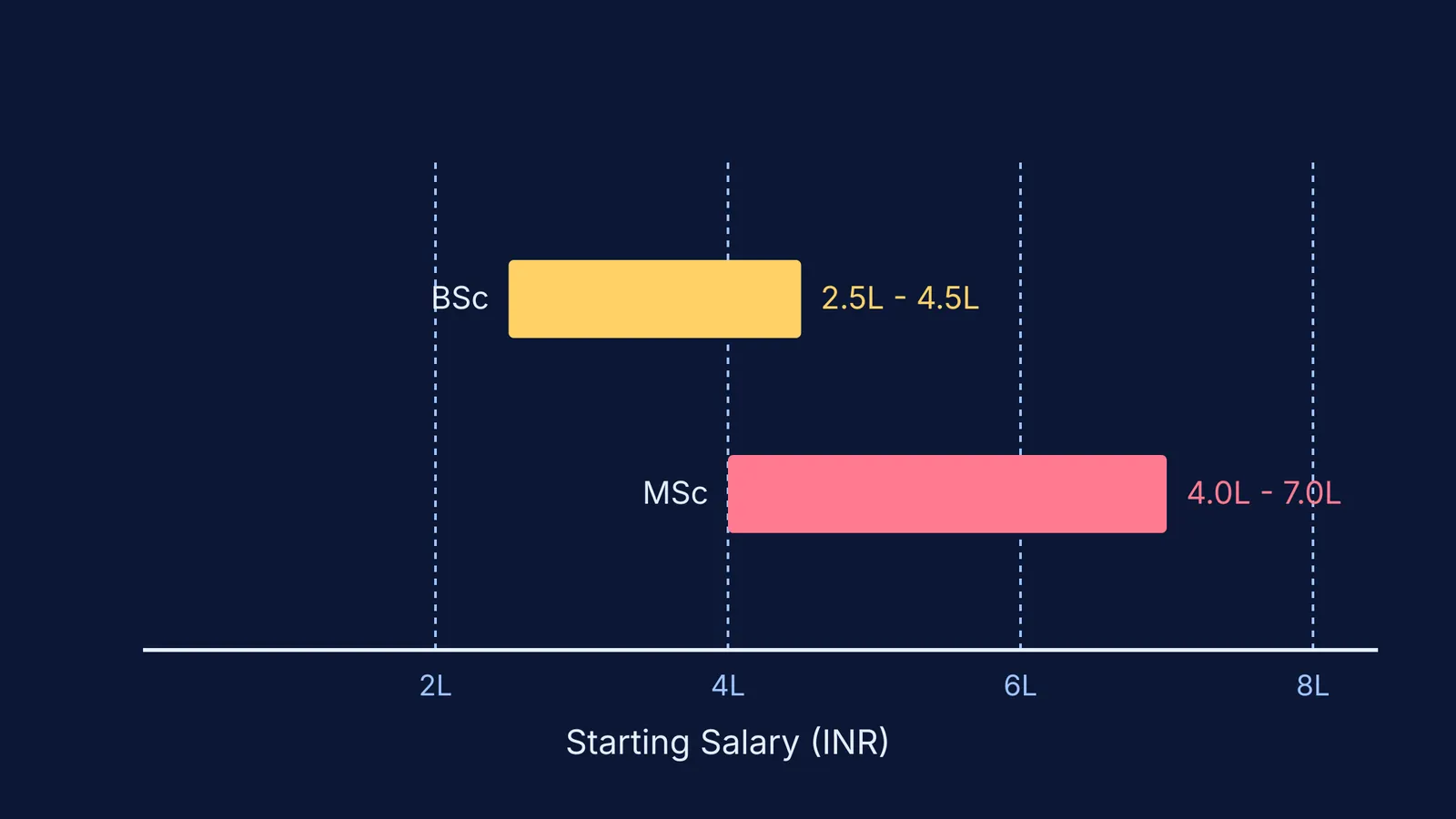
If you need immediate financial independence, taking a job after your BSc is a viable path. Many graduates start in entry-level roles such as junior quality control (QC) analysts, chemical technicians, or production floor supervisors. According to career platforms like AmbitionBox, starting salaries for these roles typically range from ₹2.5 to ₹4.5 lakh per annum.
However, the challenge with stopping at a BSc is employability and long-term growth. The 2024 India Skills Report by Wheebox found that the employability of BSc graduates stands at just 51.27%. Furthermore, many BSc roles involve routine testing and shop-floor supervision. While this provides good initial experience, graduates often hit a "glass ceiling" where moving into senior management or research and development (R&D) becomes difficult without a postgraduate degree.
Why do an MSc in chemistry?
An MSc acts as a critical threshold for high-growth roles in the chemical industry. The Indian chemical sector is shifting from basic manufacturing to high-value, specialised fields. According to Invest India, the chemical sector is projected to reach $383 billion by 2030, driven heavily by specialty chemicals and pharmaceuticals.
These sectors demand advanced knowledge of organic synthesis, spectroscopy, and method development—skills taught at the master's level. With an MSc, you can apply for roles like research scientist, analytical chemist, or formulation scientist. These positions not only start at a higher salary (often between ₹4.0 and ₹7.0 lakh per annum, according to data from platforms like AmbitionBox) but also offer a much higher ceiling as you gain experience.
What are the career paths after an MSc?
An MSc opens doors across several distinct fields:
Industry R&D and Quality Assurance: You can design new compounds or lead quality assurance teams in pharmaceutical and agrochemical companies. (Invest India notes India is the 2nd largest exporter of agrochemicals globally, creating massive demand in this sector.)
Government and Public Sector: An MSc makes you eligible for exams like CSIR-NET and GATE. Clearing these can lead to secure jobs in public sector undertakings (PSUs) like ONGC, or research positions in DRDO and CSIR labs.
Teaching and Academia: If you enjoy explaining concepts, an MSc followed by a B.Ed or clearing the NET allows you to teach in schools or apply for assistant professor roles.
If you are a parent helping your child weigh these options, reading about Talking about STEM careers beyond engineering and medicine can provide a broader perspective on the industry.
How active learning helps in your MSc
If you choose the MSc route, you must upgrade your study habits. A master's degree requires you to move away from memorising reactions and towards understanding underlying mechanisms.
Active learning is essential here. A landmark 2014 study by Freeman et al. published in the *Proceedings of the National Academy of Sciences* (PNAS) analyzed STEM education and found that failure rates under traditional lecturing increase by 55% over the rates observed under active learning. Instead of passively reading textbooks, you need to engage with the material by solving unseen problems and explaining concepts aloud. You can practice this by using the Ask 'why is this true?' while studying: elaborative interrogation method.
When you encounter complex topics like advanced thermodynamics, Fermi's AI tutor can help. Most learning tools answer questions, but Fermi teaches—it holds a line of reasoning across a whole session, notices where a student is stuck, and decides whether to explain, ask, or show. If you are struggling with a specific mechanism, you can also explore the Fermi Concept Library, which covers every concept in physics, chemistry, biology, mathematics and computing, each with its own lesson and its place in the map.
A framework for making your decision
To decide on your next step, ask yourself these three questions:
Do I want to work in a laboratory designing new things? If yes, an MSc is mandatory. R&D roles are rarely given to BSc graduates.
Do I need to start earning immediately? If yes, take a QC or production job now. You can always return for an MSc or pursue a distance-learning MBA later if you want to shift into technical sales or management.
What is my preferred specialisation? If you enjoyed organic or analytical chemistry during your BSc, pursuing them at the master's level offers the highest return on investment in the pharmaceutical sector.
Ultimately, your BSc is just the foundation. Whether you build on it with work experience or further education depends entirely on where you want to be in ten years.


