On this page
Feeling hot and shivery with the flu can seem like your body has lost control. It hasn't. A fever is something your body produces on purpose, where two chapters you study separately meet: immunity and temperature control.
What actually happens in your body during a fever?
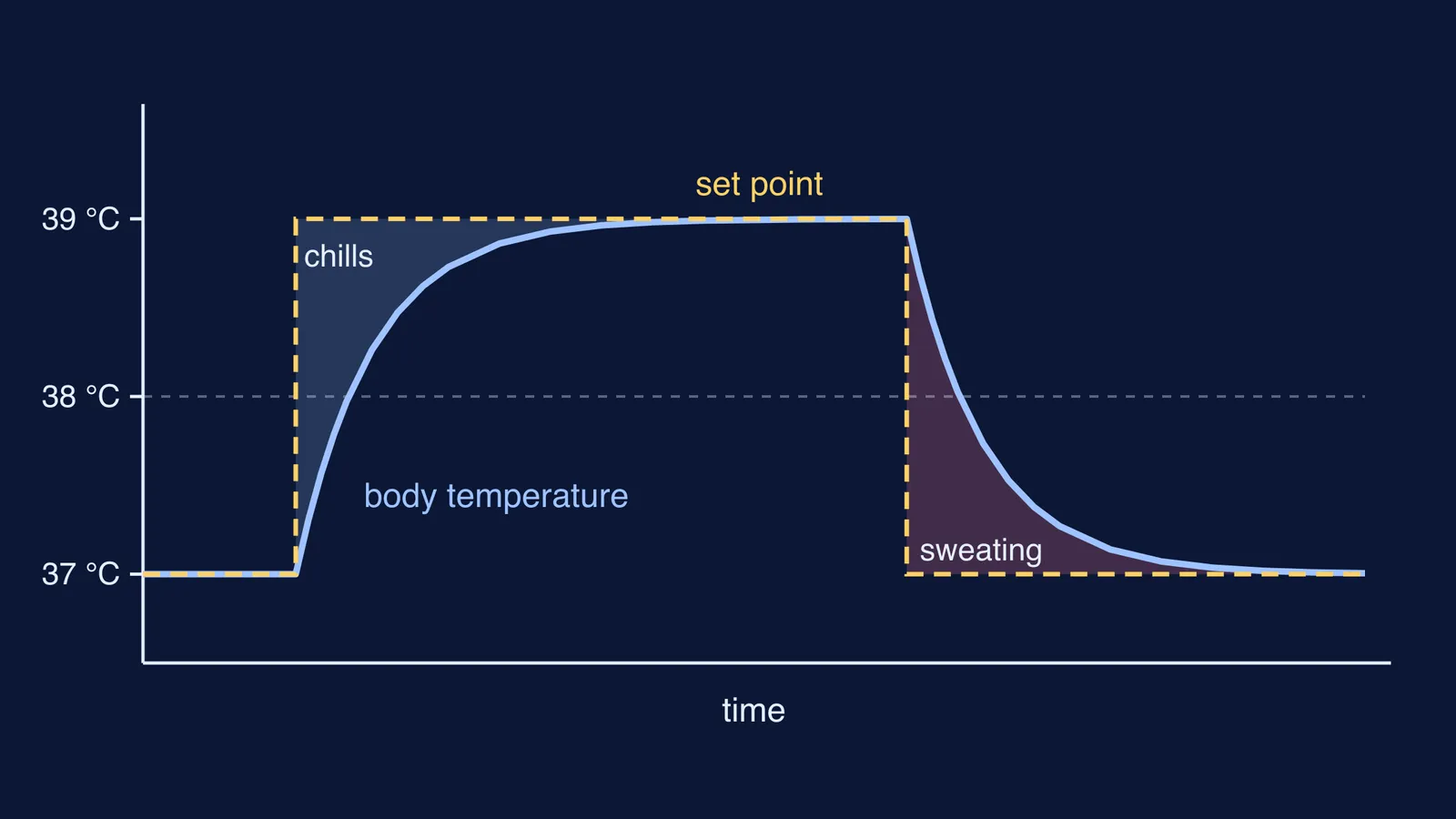
Your body temperature is run by a thermostat in the hypothalamus, a small region at the base of the brain, which normally holds your core temperature steady. During an infection, a messenger called prostaglandin E2 (PGE2) binds to receptors on temperature-control neurons in the hypothalamus and sets off the fever, according to a 2015 review in Nature Reviews Immunology by Sharon Evans, Elizabeth Repasky and Daniel Fisher. Biology textbooks describe this as raising the brain's temperature set point.
Fever is a 1 to 4°C rise in core body temperature, as the same Nature Reviews Immunology review describes it.
Once the set point moves up, your real temperature is suddenly "too low" by the brain's new standard, so you feel cold and shiver: the chills phase. When the infection is under control, the set point drops back, your body is now "too hot", and you sweat to lose the extra heat. The diagram at the top shows this lag.
The review notes that fever has been conserved in warm- and cold-blooded vertebrates for over 600 million years of evolution, a strong hint that it does something useful.
How does a higher temperature help fight infection?
It works on both sides of the fight, as Evans and colleagues describe.
It slows some microbes. In mammalian cells, fever-range temperatures of 40–41°C cut the replication rate of poliovirus more than 200-fold.
It speeds up immune cells. In animal studies, fever-range heat boosts the "respiratory burst" that neutrophils use to kill bacteria.
It helps immune cells travel. Lymphocytes heated in the lab became about twice as good at binding to high endothelial venules, the special blood vessels they use to enter lymph nodes.
It sharpens the killers. Heat-treated CD8+ T cells showed enhanced cytotoxic function, meaning they were better at destroying target cells.
Is there evidence that fever helps you survive?
The classic experiment used desert iguanas, which are cold-blooded and raise their temperature by moving to warmer spots. In a 1975 study in Science, Matthew Kluger, Daniel Ringler and Miriam Anver infected the lizards with the bacterium Aeromonas hydrophila, and the lizards developed a fever of about 2°C. Infected lizards placed in warmer surroundings (40 or 42°C) survived significantly better than those placed in cooler ones (34 or 36°C), according to the study abstract.
The Evans review says the desert iguana's survival is reduced by 75% if it is prevented from raising its core temperature by about 2°C after infection. In people, it notes that the use of fever-lowering drugs correlates with a 5% increase in mortality in populations infected with influenza. A pattern across large populations is a correlation, not a rule for one sick person.
What does a fever cost your body?
Heat is not free. According to Evans and colleagues, in warm-blooded animals each 1°C rise in body temperature requires a 10–12.5% increase in metabolic rate.
Here is a rough worked example, assuming the cost simply adds up for each extra degree. Suppose your body uses 100 units of energy an hour at rest.
A 1°C fever: 100 + 10 to 12.5 = 110 to 112.5 units an hour.
A 2°C fever: 100 + 20 to 25 = 120 to 125 units an hour.
So, on this estimate, a 2°C fever asks your body for roughly a fifth to a quarter more energy.
How do you write the fever chain in a biology answer?
A clear cause-and-effect chain makes a strong answer. Learn it as six links:
Microbes get past the body's first defences and the immune system detects them (revise the four barriers of innate immunity first).
The response leads to release of prostaglandin E2.
PGE2 acts on the hypothalamus and raises the temperature set point.
The body heats itself: you feel cold and shiver (chills).
The higher temperature slows some microbes and makes neutrophils and lymphocytes work better.
The infection is controlled, the set point falls, and sweating brings temperature back to normal.
Steps 3 to 6 are negative feedback around a new target, the same steady-state idea behind Walter Cannon's term homeostasis.
If the lag between set point and body temperature is hard to picture, the Fermi Simulation Lab has interactive simulations for ideas that are easier to see than to read.
What temperature counts as a fever?
The NHS says a high temperature is usually considered to be 38°C or above. It advises adults to ask for an urgent GP appointment or contact NHS 111 if a high temperature is not getting better with home treatment or is getting worse. Babies and young children have their own guidance, so parents should check with their paediatrician or family doctor.
Next time you shiver under a blanket with a fever, you will know which part of your brain made that call.