

On this page
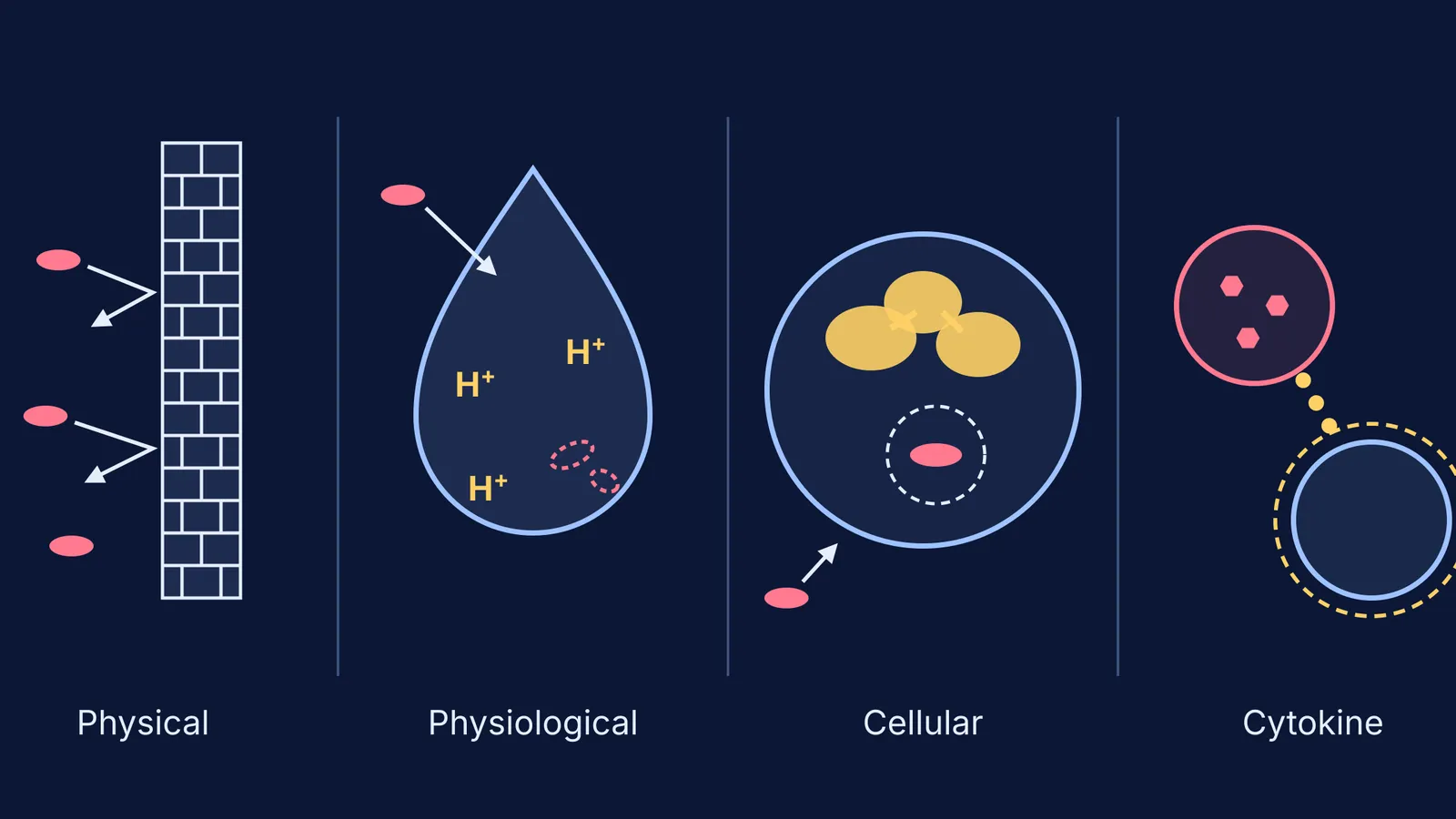
Every day you swallow, breathe in and touch microbes, and very few of them make you ill. Most are stopped by defences you were born with. NCERT's Class 12 Biology chapter on Human Health and Disease defines innate immunity as a "non-specific type of defence, that is present at the time of birth", made up of four types of barriers.
Below: one example per barrier, and a quick test for sorting any example.
What are the four barriers of innate immunity?
In section 7.2.1 of the NCERT chapter, the four barriers and their examples are:
Physical barriers: skin, plus the mucus coating the lining of the respiratory, gastrointestinal and urogenital tracts, which traps microbes.
Physiological barriers: acid in the stomach, saliva in the mouth and tears from the eyes, which all prevent microbial growth.
Cellular barriers: white blood cells such as neutrophils (PMNL), monocytes and natural killer cells in the blood, and macrophages in tissues, which phagocytose and destroy microbes.
Cytokine barriers: interferons, proteins secreted by virus-infected cells that protect non-infected cells from further viral infection.
Think of them as layers. A microbe first meets a wall, then a hostile chemical environment, then cells that eat it, and, if it is a virus that gets inside a cell, a warning signal that puts the neighbours on guard.
How does skin act as a physical barrier?
In NCERT's scheme, skin counts as a physical barrier because it works mainly through its structure. A review in Experimental Dermatology, "The skin: an indispensable barrier" (Proksch, Brandner and Jensen, 2008), describes the outermost layer, the stratum corneum, as protein-enriched corneocytes with lipid-enriched spaces between them. The same review notes that when this structure is disrupted, as in atopic dermatitis, allergens can get through.
Mucus belongs in the same group in NCERT's scheme: it is a sticky coat that traps microbes before they reach the cells underneath.
Why is stomach acid called a physiological barrier?
Stomach acid inactivates microbes chemically rather than blocking them. A review titled "Gastric juice: a barrier against infectious diseases" (Martinsen, Bergh and Waldum, 2005) opens with the point that all vertebrates produce gastric acid and that its main function is inactivating microbes we swallow. The authors write that most ingested pathogens never reach the intestine because of this barrier, and that gastric acidity is known to protect against cholera and non-typhoid salmonellosis.
Saliva and tears belong here too: they are secretions that make conditions hostile to microbes.
What do neutrophils do in innate immunity?
Neutrophils are the first cellular barrier NCERT lists. A review by Carlos Rosales in Frontiers in Physiology (2018) states that neutrophils represent about 70% of all leukocytes. The same review says the bone marrow makes more than 100 billion of them every day, and their half-life in circulation is only about 6 to 12 hours.
Rosales lists three ways they kill microbes: phagocytosis (engulfing them), degranulation (releasing toxic granules) and neutrophil extracellular traps, nets of nuclear material that catch microbes. For how these eating cells were discovered, read our post on Metchnikoff and the discovery of phagocytes.
How do interferons protect cells from viruses?
Interferons are the cytokine barrier. They were named in 1957 by Alick Isaacs and J. Lindenmann, whose paper "Virus interference. I. The interferon" described a new factor released when heat-inactivated influenza virus was incubated with fragments of chick chorio-allantoic membrane. The factor made fresh pieces of membrane resist the growth of live virus.
Interferons act on nearby cells by switching on interferon-stimulated genes. A review in the Annual Review of Immunology by Schneider, Chevillotte and Rice (2014) describes how these gene products together resist and control pathogens. For more detail, read our explainer on what interferons are and how they work.
How do you sort any example into the right barrier?
Ask these four questions in order and stop at the first "yes":
Does it block entry because of its structure (a layer, a coat)? Physical.
Is it a secretion or chemical condition that stops microbes growing? Physiological.
Is it a whole cell that destroys microbes? Cellular.
Is it a protein signal released by an infected cell to protect other cells? Cytokine.
Now try these, then check your answers below:
Mucus lining the trachea
Tears
Macrophages in tissue
Natural killer cells
Interferon from a cell infected by a virus
Stomach acid
Answers: physical, physiological, cellular, cellular, cytokine, physiological.
A second common mistake is mixing innate and acquired immunity. Antibodies, B cells and T cells belong to acquired immunity, which is specific and has memory. Our guide to human health and disease for NEET covers that side of the chapter.
If a term in this chapter still feels shaky, the Fermi Concept Library has a lesson for every concept in biology, each placed in its map.


