

On this page
In 1957, virologists Alick Isaacs and Jean Lindenmann noticed something strange while studying influenza. When they exposed chick cells to a heat-killed flu virus, the cells released a mysterious substance. When this substance was transferred to healthy cells, those cells became completely resistant to live flu viruses. Isaacs and Lindenmann had discovered a built-in cellular alarm system, and they named the messenger protein "interferon" (Wikipedia).
Today, understanding interferons is not just crucial for immunology, but it is also a staple of the Class 12 biology syllabus. Let's look at what these proteins are and how they halt a viral invasion in its tracks.
What are interferons?
The NCERT Class 12 biology textbook gives a clear, one-sentence definition that often appears in exams: "Virus-infected cells secrete proteins called interferons which protect non-infected cells from further viral infection." (NCERT Class 12 Biology)
They belong to a family of signalling proteins known as cytokines. In the context of the immune system, they are classified as a cytokine barrier, which forms a crucial part of your innate (non-specific) immunity. Unlike antibodies—which take days to form and are tailored to a specific pathogen by the adaptive immune system—interferons are produced quickly and offer broad, immediate protection against many types of viruses. There are three main types of interferons (Type I, Type II, and Type III) (Wikipedia), with Type I (IFN-α and IFN-β) being the most heavily involved in direct antiviral defence.
It is important to note that interferons do not save the cell that is already infected. Instead, that cell sacrifices itself, sending out a chemical distress signal to save its neighbours.
How do they work?
The biological mechanism of interferons happens in two distinct phases: sensing the virus, and raising the shields.
The alarm phase (Induction)
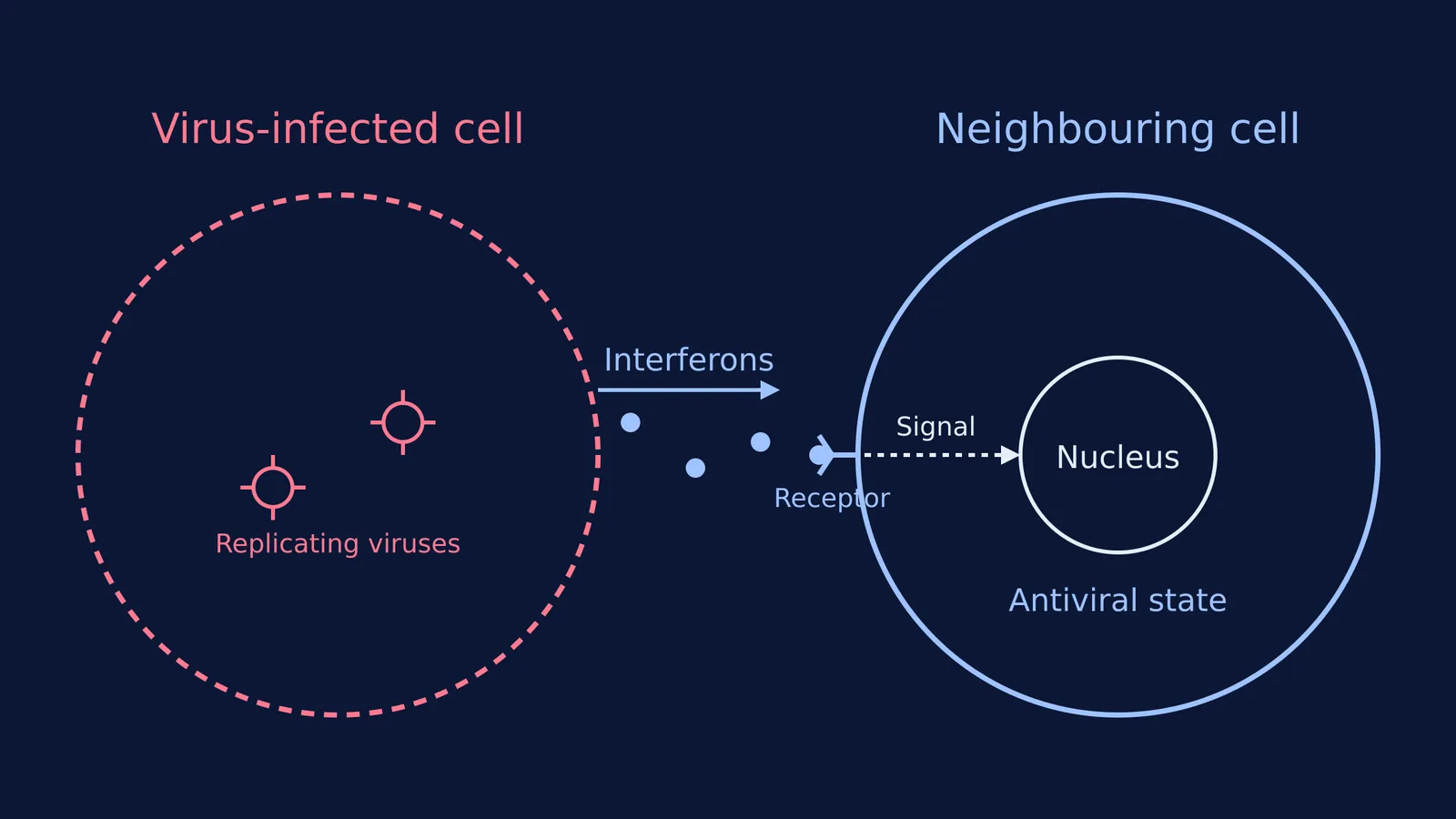
When a virus enters a cell and begins unpacking its genetic material, the host cell detects the foreign viral RNA or DNA using special sensors called pattern recognition receptors. This detection triggers the cell's nucleus to rapidly manufacture and secrete Type I interferons. The infected cell pumps these cytokines into the surrounding tissue fluid before the virus can fully take over.
The defence phase (Signalling)
The secreted interferons bind to specific receptors on the surface of nearby, healthy cells. This binding acts like a switch on the outside of the cell, activating a rapid internal communication chain called the JAK-STAT pathway. The signal travels straight to the nucleus of the healthy cell, turning on hundreds of specific genes known as Interferon-Stimulated Genes (ISGs) (Wikipedia).
The antiviral state
By turning on these genes, the healthy cell enters an "antiviral state"—a hostile environment where the virus can no longer replicate. The cell achieves this by deploying several molecular traps:
Protein Kinase R (PKR): An enzyme that shuts down the cell's protein-making machinery. If the cell cannot make proteins, the virus cannot manufacture new viral parts.
RNase L: An enzyme that actively shreds both viral and cellular RNA, destroying the virus's genetic instructions before they can be read.
Mx Proteins: These act like molecular cages, trapping viral components and preventing them from assembling into new, functional virus particles.
Beyond blocking viruses, interferons also flag down passing immune cells. For instance, α-interferon is sometimes given as a biological response modifier to cancer patients because it activates the immune system to help destroy tumours (NCERT Class 12 Biology).
For students, keeping track of these overlapping pathways and barriers can be tricky. This is where Fermi's AI tutor can help. Instead of just giving you the answer, the tutor works out what you already know and builds a plan for the session, teaching you the connections between innate and adaptive immunity. You can explore the entire immune system map in the Fermi Concept Library, or test your recall with step-by-step questions in the Fermi Problem Library.
If you are reviewing immunology and cell biology, it helps to see how other pathogens operate and how the body responds. You might also want to look at Viruses, viroids and lichens: the misfits of five-kingdom biology, How HIV replicates: reverse transcription and helper T cell loss, and Cell: the unit of life for NEET, with organelles compared.
Interferons prove that cells do not just wait for white blood cells to arrive; they have their own frontline defence. The next time you fight off a mild cold quickly, you have your cytokine barriers to thank.


