On this page
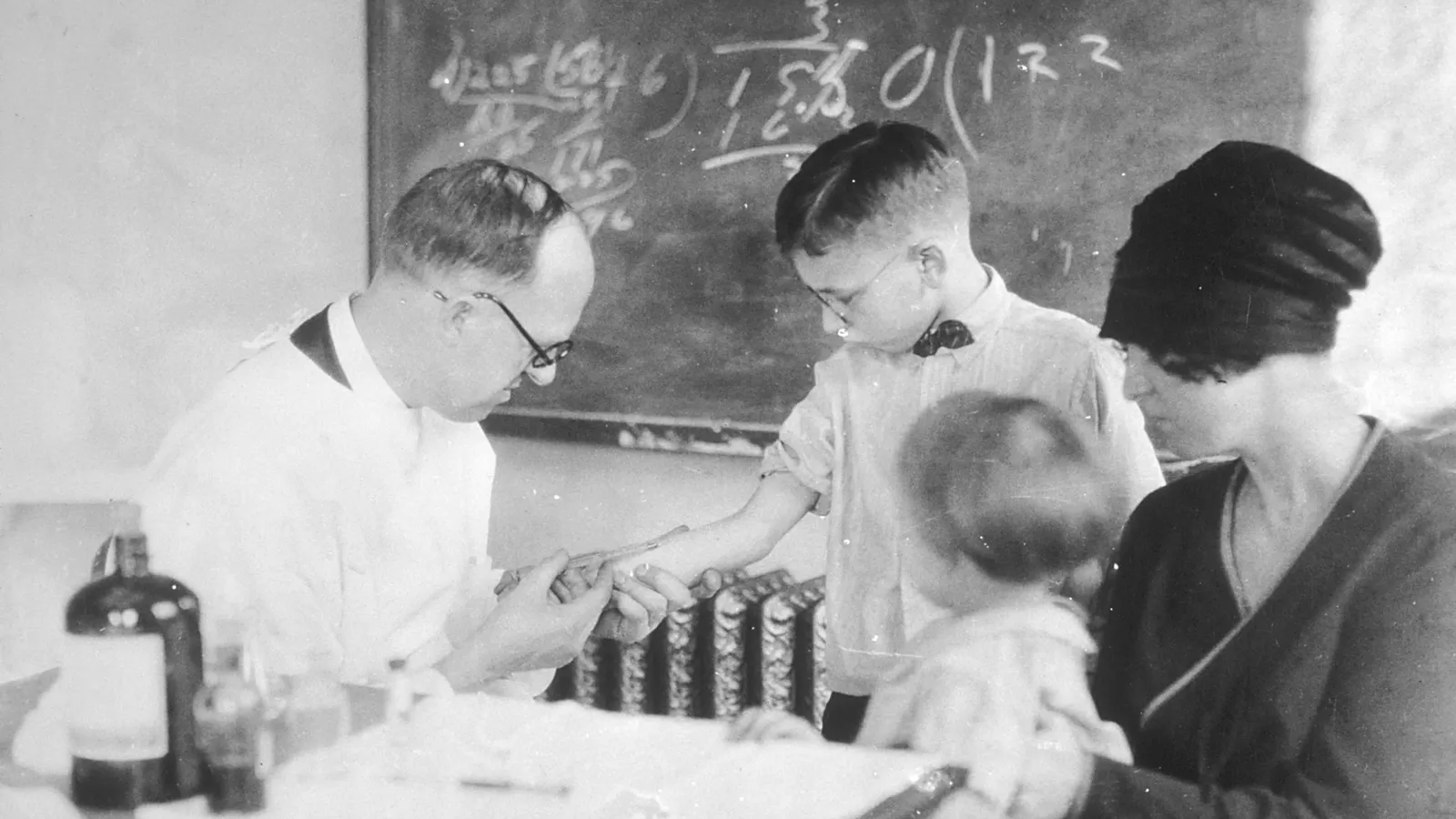
In 1913 Béla Schick, a paediatrician at the University of Vienna, published a skin test that answered a question doctors faced in every diphtheria outbreak: which children actually need protecting? His paper appeared in the Münchener Medizinische Wochenschrift, and the Garrison-Morton bibliography of medicine records that he designed it to show whether exposed children needed a preventive injection of antitoxin.
Who was Béla Schick?
Schick was born on 16 July 1877 in Balatonboglár, Hungary, went to medical school in Graz, and worked at the University of Vienna's medical faculty from 1902 to 1923, according to his Wikipedia biography. From 1923 he directed the paediatric department at Mount Sinai Hospital in New York, and he died on 6 December 1967.
With Clemens von Pirquet he wrote a 1905 study of serum sickness, the reaction some patients had to injected horse serum (Garrison-Morton entries for Schick). The same biography credits the pair with establishing allergy as a clinical idea.
Why did doctors need a diphtheria immunity test?
Diphtheria toxin damages the airways and can spread through the body, inflaming the heart and the nerves. Without vaccination or proper treatment the disease can be fatal in around 30% of cases, with young children at higher risk (WHO fact sheet). Antitoxin made in horses had been used to treat diphtheria in the United States since the 1890s (CDC Pink Book), building on Emil von Behring's diphtheria antitoxin.
That left a dilemma. Antitoxin is borrowed protection, the kind explained in our post on active vs passive immunity, and horse serum risked serum sickness. Giving it to every exposed child meant taking that risk even for children already protected. Schick's test sorted them first.
How does the Schick test work?
If your blood carries enough antitoxin, a tiny dose of toxin placed in your skin is neutralised and nothing happens. If it does not, the toxin damages the skin cells around the injection and you see a red, swollen patch.
In practice, 0.1 ml of diluted diphtheria toxin (one-fiftieth of a minimum lethal dose) is injected into the skin of one arm, and the same material with the toxin destroyed by heat goes into the other arm as a control (Schick test overview). A positive result is a wheal 5-10 mm across that peaks in four to seven days while the control arm stays clear, which means the person lacks antitoxin and is susceptible.
How do you read a Schick test result?
Because the heated control material contains everything except working toxin, any redness that shows on both arms cannot be the toxin's doing. The same overview lists four outcomes:
Positive: a 5-10 mm wheal on the test arm only, peaking at four to seven days. Not immune.
Negative: no reaction on the test arm. Immune.
Pseudo-positive: redness on both arms that fades within four days. A sensitivity to the injected material, not a sign of missing antitoxin, so the child counts as immune.
Combined: redness on both arms, but on the test arm it lasts after the control arm fades. Sensitivity to the material plus too little antitoxin, so not immune.
A worked example: on day 5 a school doctor checks three children. Asha has a 7 mm red patch on the test arm and a clear control arm: positive, not protected. Ravi had pink marks on both arms on day 2, gone by day 5: pseudo-positive, immune. Meera's control arm cleared on day 3, but her test arm is still red and swollen: combined, not protected. None of them can be read from the test arm alone.
What happened after 1913?
A 1926 Kensington Medical Officer of Health report noted that testing and immunisation were put into practice in New York by Park in 1913, that some 50,000 schoolchildren had been treated in the city, and that 90 per cent of them remained immune after seven years.
The need was large: in the 1920s the United States recorded 100,000-200,000 diphtheria cases and 13,000-15,000 deaths a year (CDC Pink Book). The same chapter says diphtheria toxoid, the idea behind Gaston Ramon's toxoid vaccine, was developed in the early 1920s but not widely used until the early 1930s. Once safer toxoids were available, susceptibility tests were no longer needed (Schick test overview).
Does anyone still need a Schick test today?
Routine vaccination does the job the test used to guide. WHO recommends three primary doses of a diphtheria-containing vaccine in infancy plus three boosters through childhood and adolescence (WHO fact sheet). A quick check you can do this week:
Find the family vaccination card.
India's National Immunization Schedule lists DPT boosters at 16-24 months and 5-6 years, and Td (tetanus and adult diphtheria) at 10 and 16 years.
If a dose looks missing, take the card to your doctor or the nearest government health centre and ask what to do.
If you are revising immunity for Class 12 biology, the Fermi Concept Library covers every concept in biology, each with its own lesson. Fermi's AI tutor can ask you to work through each Schick outcome and check your understanding as it goes.
Next time you see a positive result, ask the question Schick did: positive for what?