On this page
You take a big spoon of kulfi on a hot afternoon, and a second later a sharp ache stabs your forehead. That ache has an official medical name, a known trigger and a fairly well-supported explanation, and it is a neat lesson in how nerves and blood flow work together.
What is brain freeze, medically?
Doctors call it "headache attributed to ingestion or inhalation of a cold stimulus", code 4.5.2 in the International Classification of Headache Disorders (ICHD-3). The same page lists "ice-cream headache" and "brain-freeze headache" as older names for it.
ICHD-3 describes it as a short-lasting frontal or temporal pain caused by cold food, drink or air passing over the palate or the back of the throat. By definition, it resolves within 10 minutes after the cold is removed. The classification also notes that it is common, especially in people who get migraine.
It is also common in teenagers. A survey of 8,359 Taiwanese students aged 13 to 15 found that 40.6% had experienced ice-cream headache (Fuh and colleagues, Cephalalgia, 2003). Students with migraine reported it more often: 55.2%, against 39.6% of those without.
Why does cold ice cream make your forehead hurt?
Think of it as a chain with three links.
The sensor. Cold lands on the roof of your mouth or the back of your throat, which ICHD-3 names as the trigger zones.
The wire. The trigeminal nerve (cranial nerve V) carries sensation from your face and mouth to the brain, as BrainFacts.org explains. The same nerve also serves your forehead, which is one reason the pain may be felt there rather than in your mouth.
The plumbing. According to BrainFacts.org, the cold first narrows blood vessels and they then widen again; that rapid change in flow is what the brain reads as pain.
The plumbing has been watched directly. In a study led by Jorge Serrador of Harvard Medical School and presented at Experimental Biology 2012, 13 healthy adults sipped ice water through a straw pressed against the upper palate while ultrasound tracked their brain blood flow (ScienceDaily summary of the study). The anterior cerebral artery widened rapidly as pain began, then narrowed as it went away. Serrador suggested the widening might bring in warm blood to keep the brain warm. It was a small conference study: a strong clue, not the final word.
A second study points at the nerve side. When German researchers gave 77 volunteers ice cubes and ice water, people who got the headache also had watery eyes more often, which the authors read as a sign that a trigeminal-autonomic reflex is involved (Mages and colleagues, Cephalalgia, 2016). If reflexes are new to you, our explainer on the five parts of a reflex arc shows how a signal travels in and out without waiting for conscious thought.
Does eating ice cream fast really make it worse?
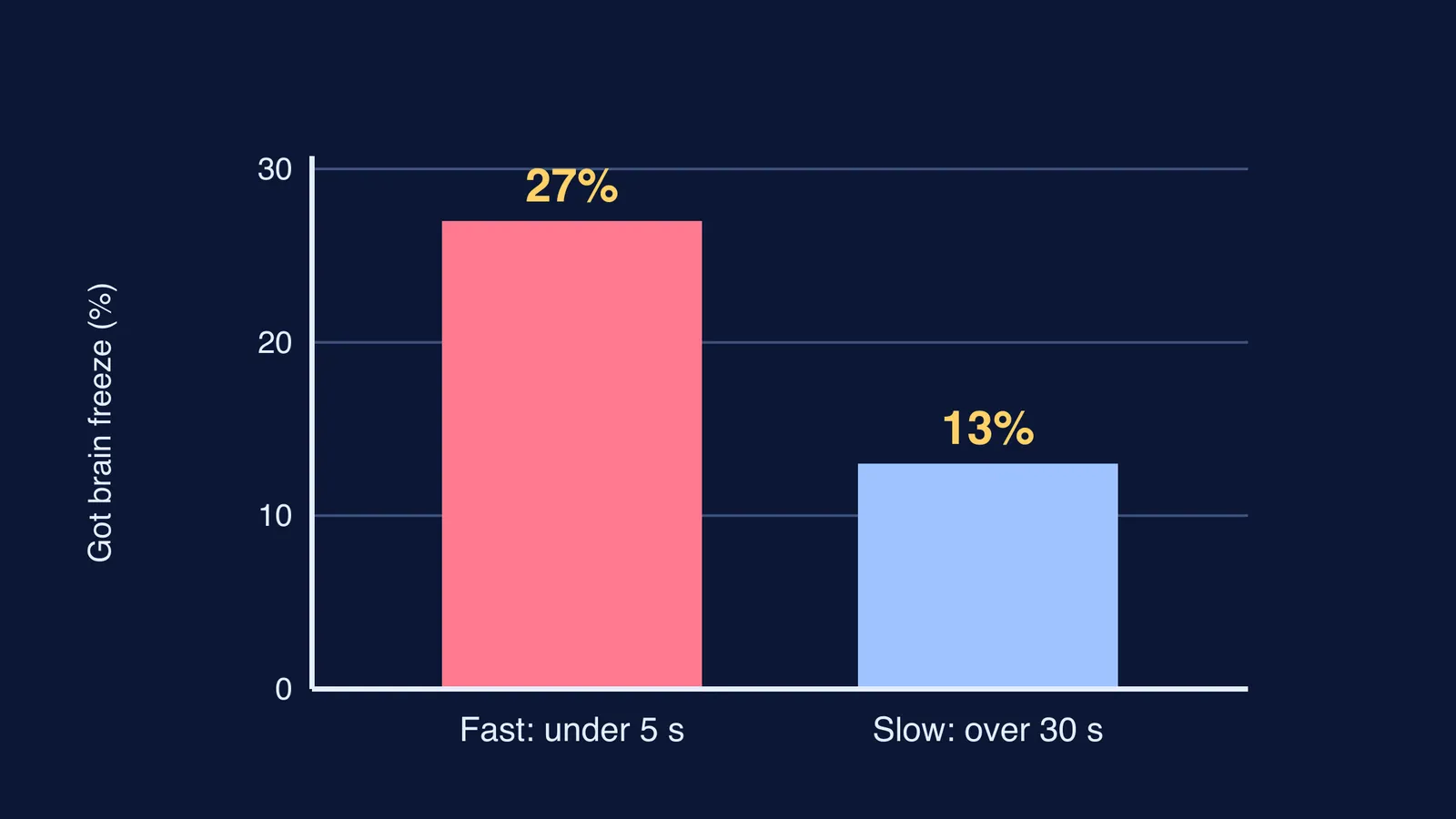
Yes, and there is a randomised trial to show it. In the ICE-H study published in the BMJ in 2002, all 145 students at a middle school in Hamilton, Canada, were split into two groups. Of the 73 students told to finish in under 5 seconds, 20 (27%) got brain freeze. Of the 72 told to take more than 30 seconds, 9 (13%) did.
That is a relative risk of 2.2: eating fast roughly doubled the chance of a headache in this group.
The form of the cold matters too. In the Mages study, fast-swallowed ice water set off the headache in 39 of 77 volunteers, against 9 of 77 for ice cubes pressed to the palate. The ice-water headaches also arrived sooner, after a median of 15 seconds compared with 68.
How do you stop brain freeze?
A plan built from the studies above:
Slow down. Take more than 30 seconds over a scoop, the pace of the slower group in the BMJ trial. Even so, 13% of slow eaters still got it.
Keep cold off the roof of your mouth. Let each bite melt on the front of your tongue before swallowing. BrainFacts.org notes that keeping cold food away from the back of the palate can stop the symptoms.
If it hits, pause. Stop eating and wait. A common tip is to press your tongue to the roof of your mouth to warm it; that fits the mechanism, but we found no trial that has tested it.
Know the limit. Brain freeze should be gone within 10 minutes of stopping the cold, by the ICHD-3 definition. A headache that lasts longer or comes without anything cold is not brain freeze, and is worth asking a doctor about.
To revise the biology behind all this, read how the nervous system is divided into central and peripheral parts and how arteries, veins and capillaries differ. Flow through a vessel that suddenly widens is the kind of idea that is easier to see than to read, and the Fermi Simulation Lab collects interactive simulations for ideas like that.
Next time the kulfi bites back, you will know which nerve sent the message.