On this page
The paper lands on your desk. Your heart speeds up, your mouth goes dry, and your hand picks up the pen. Each of those ran through a different division of your nervous system. Once you can name which division did what, most exam questions on this chapter become sorting exercises.
What are the main divisions of the nervous system?
The first split is about where the nerve tissue is. The central nervous system (CNS) is the brain and spinal cord, and the peripheral nervous system (PNS) is everything else, as OpenStax Anatomy and Physiology defines it.
The PNS is the wiring that carries messages in and out. Humans have twelve cranial nerves, numbered CN I to CN XII, and 31 spinal nerves, according to the OpenStax chapter on the peripheral nervous system. The spinal nerves are 8 cervical, 12 thoracic, 5 lumbar, 5 sacral and 1 coccygeal, named for the level where each leaves the cord.
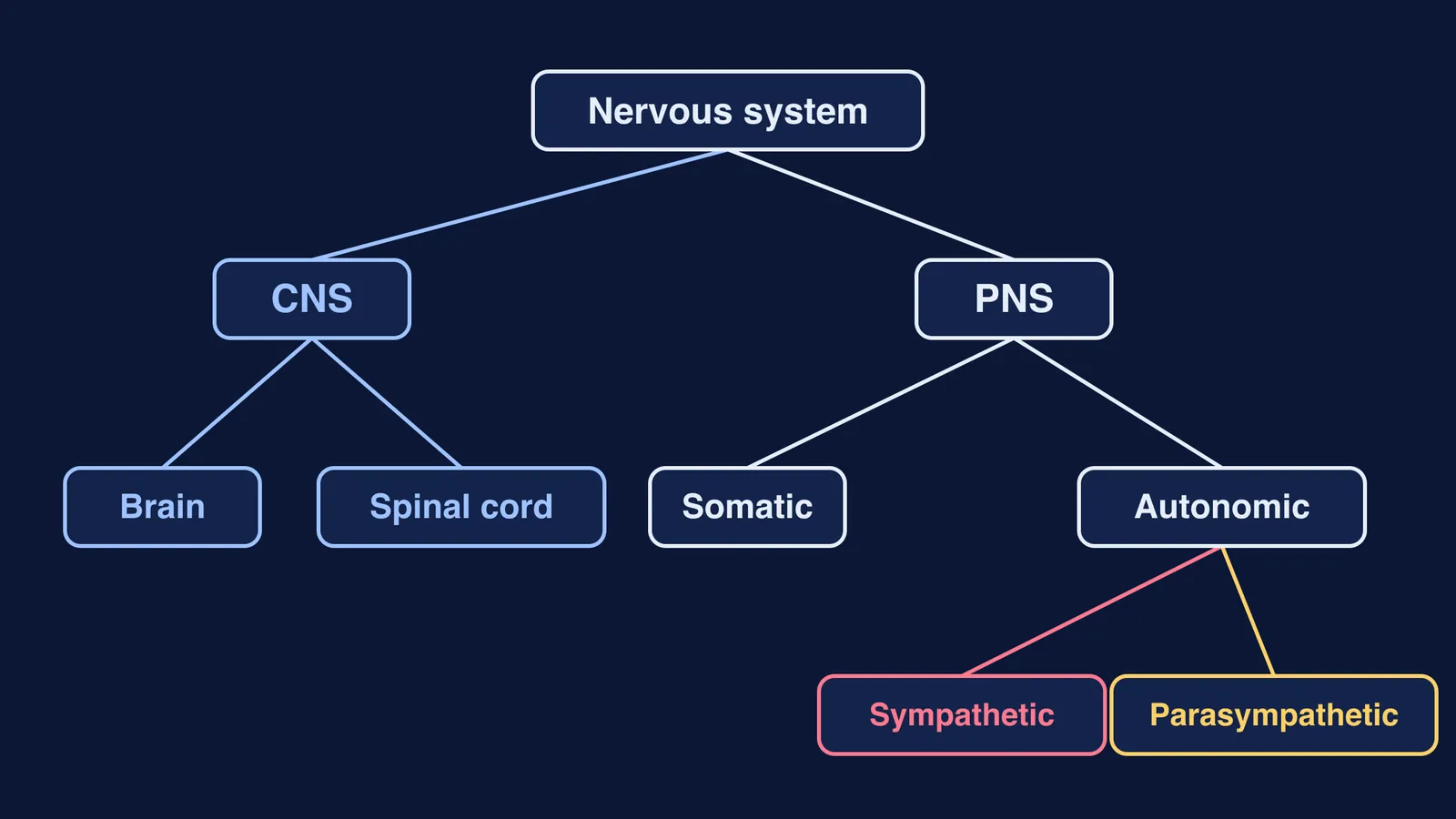
The second split is about what the nerves control. Read the full map from top to bottom:
Nervous system: CNS (brain, spinal cord) and PNS (all other nerves)
PNS: somatic division and autonomic division
Autonomic division: sympathetic and parasympathetic branches
Enteric nervous system: the part of the PNS that runs the gut, which OpenStax describes separately but says it is sometimes valid to treat as part of the autonomic system
Unsure of the basic terms? Read our explainer on nerve vs neuron vs nerve fibre.
What is the difference between the somatic and autonomic nervous system?
The somatic nervous system is responsible for conscious perception and voluntary motor responses, which means contracting skeletal muscle, according to OpenStax. The autonomic nervous system handles involuntary control, usually to keep the body stable (homeostasis), and its targets are smooth muscle, cardiac muscle and glands.
There is also a wiring difference. An autonomic signal uses a chain of two neurons: a preganglionic neuron from the CNS to a ganglion, then a postganglionic neuron from the ganglion to the organ (OpenStax, divisions of the autonomic nervous system).
How do the sympathetic and parasympathetic systems differ?
The sympathetic division leaves the CNS from the thoracic and upper lumbar spinal cord, while the parasympathetic division starts in the brain stem and the sacral spinal cord, which is why it is called craniosacral (OpenStax). All preganglionic fibres in both branches release acetylcholine. Sympathetic postganglionic fibres release norepinephrine, except those going to sweat glands and to blood vessels in skeletal muscle, which release acetylcholine. Parasympathetic postganglionic fibres release acetylcholine.
The vagus nerve (CN X) makes up about 75% of the parasympathetic nervous system, connecting to the heart, lungs and other internal organs, according to Cleveland Clinic.
What each branch does to the same organ, from Cleveland Clinic's pages on the sympathetic and parasympathetic systems:
Pupils: sympathetic enlarges them; parasympathetic constricts them
Heart: sympathetic raises the rate; parasympathetic lowers the rate and pumping force
Airways: sympathetic relaxes the airway muscles; parasympathetic tightens them
Digestion: sympathetic slows it; parasympathetic speeds it up and makes the mouth produce saliva
The two branches are not on-off switches. Organs such as the heart get input from both (dual innervation), and homeostasis is the balance between them, as OpenStax puts it.
How do you work out which division controls a response?
Use these three questions, in order, on any example in a question paper:
Is the action happening in the brain or spinal cord? If so, it is CNS. Every nerve outside them is PNS.
Which tissue responds? Skeletal muscle means somatic. Heart, smooth muscle or a gland means autonomic.
If autonomic, is the body gearing up for action or settling down to rest and digest? Gearing up is sympathetic; settling down is parasympathetic.
Now try it on five everyday responses:
Writing your roll number on the answer sheet: skeletal muscle in the fingers, so PNS, somatic.
Heart pounding as papers are handed out: cardiac muscle, gearing up, so autonomic, sympathetic.
Mouth watering at the smell of lunch: a gland, digesting, so autonomic, parasympathetic.
Pupils shrinking when you step into sunlight: smooth muscle of the iris, so autonomic, parasympathetic.
Leg kicking when the knee is tapped: skeletal muscle, so somatic, even though you did not choose it. The reflex is processed in the spinal cord, which is CNS. Our post on the knee jerk reflex traces the full path.
If one of these steps feels shaky, the Fermi Concept Library gives every biology concept its own lesson and shows where it sits in the map. For practice, the Fermi Problem Library has worked problems with a step-by-step solver that explains the reasoning rather than printing an answer.
A racing heart before an exam is your sympathetic system doing its job. If exam nerves start to feel hard to manage, talk to a parent, teacher, school counsellor or doctor.
Next, see how the CNS itself is protected in our guide to the skull, meninges and cerebrospinal fluid.