On this page
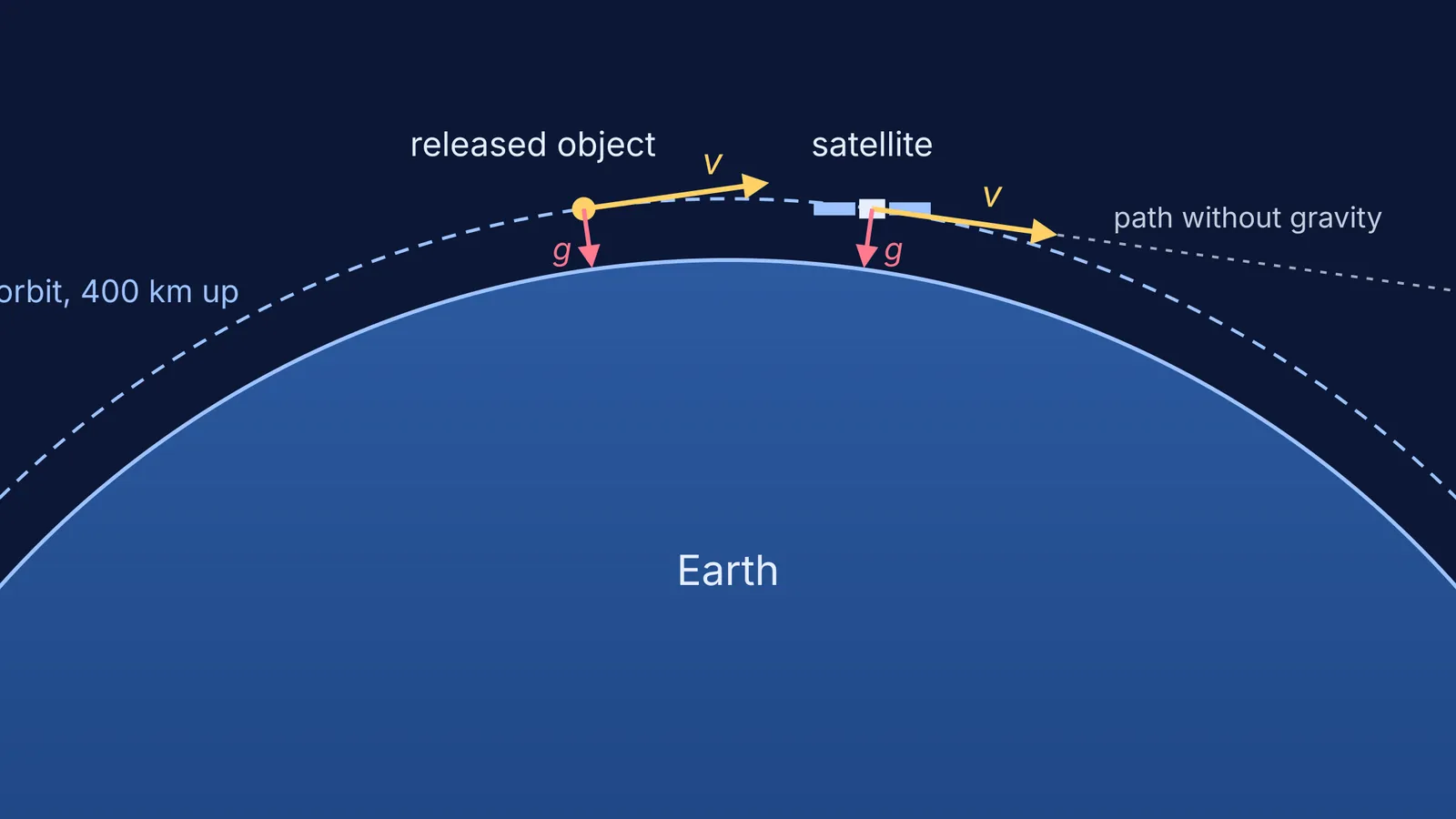
Imagine an astronaut outside the International Space Station opens their hand and lets go of a spanner. It does not drop towards Earth; it goes on circling the planet, almost alongside the station. The whole answer rests on one idea: the spanner was already moving at orbital speed before it was let go.
Why doesn't an object released from a satellite fall to Earth?
A satellite is not floating above gravity. It is falling all the time, but it moves sideways so fast that, in the words of the OpenStax University Physics textbook, "Earth's surface curves away from them at exactly the same rate as they fall toward Earth."
At the instant you let go, the object has the satellite's velocity, because it was travelling with the satellite. Gravity pulls on it just as it pulls on the satellite, so it keeps falling around Earth in the same way.
The deeper reason is that orbital speed does not depend on the mass of the thing orbiting. For a circular orbit of radius r around Earth (mass M), the orbital speed is v = √(GM/r). As OpenStax puts it, orbital velocity depends "only upon the distance from the center of the planet, and not upon the mass of the object being acted upon." A huge station and a small spanner at the same radius need the same speed. Kepler's third law, T² = (4π²/GM)a³ (OpenStax, section 13.5), contains only Earth's mass and the orbit's size, so they share the same period too.
What happened when astronauts lost a tool bag in orbit?
On 1 November 2023, during a spacewalk lasting 6 hours and 42 minutes, NASA reported that "one tool bag was inadvertently lost" (NASA space station blog). Mission Control analysed the bag's path and judged the risk of it striking the station to be low.
The bag did not fall. It became a tiny satellite. EarthSky reported that by 11 November it was about five minutes ahead of the ISS and shining at around magnitude +6, just below what the unaided eye can see.
Why did it drift ahead at all? Any small push as it slipped away, and differing air drag on bag and station, could have given it a slightly different orbit, and by Kepler's third law a slightly different orbit has a slightly different period. Over many laps, a tiny difference in period becomes a visible gap. An object let go with no push at all would start out alongside the satellite.
Worked example: how fast is the released object moving?
Take the ISS at 400 km, with the values used in the OpenStax worked example:
Orbital radius: r = 6.36 × 10⁶ m + 4.00 × 10⁵ m = 6.76 × 10⁶ m.
GM = (6.67 × 10⁻¹¹)(5.96 × 10²⁴) ≈ 3.98 × 10¹⁴ m³/s².
v = √(3.98 × 10¹⁴ ÷ 6.76 × 10⁶) ≈ 7.67 × 10³ m/s, about 7.7 km/s.
Period T = 2πr/v ≈ 5.5 × 10³ s, just over 90 minutes.
The released spanner moves at the same 7.67 km/s. NASA's space station facts page gives the same orbit in round numbers: about five miles per second, one lap every 90 minutes, 16 orbits in 24 hours. For the full derivation of both formulas, see our step-by-step derivation of orbital velocity and time period.
Does the object ever come down?
Yes, eventually, but not because it was dropped. NASA's ISS deorbit analysis explains that the station flies at an altitude where Earth's atmosphere still creates drag, so it needs regular reboosts to stay up; without them, its orbital lifetime is roughly one to two years, depending on solar activity.
EarthSky reported that the tool bag, with no thrusters, would descend until it reached about 113 km and then disintegrate, with re-entry estimated between March and July 2024.
How should you answer this in an exam?
A full-marks checklist:
State the result: the object keeps moving in the same orbit along with the satellite; it does not fall to Earth.
Give the reason: at release it has the satellite's velocity.
Show why that velocity is enough: v = √(GM/r) is independent of the object's mass.
Name the force: Earth's gravity on the object supplies the centripetal force, exactly as it does for the satellite.
If asked why it seems to float, say that the object and the satellite are in free fall together.
The free-fall idea connects to two related questions examiners like: why astronauts feel weightless in orbit and why a pendulum clock stops in an orbiting satellite.
To practise variations, such as an object thrown backwards from a satellite, the Fermi Problem Library has worked problems with a step-by-step solver that explains the reasoning rather than printing an answer.
Next time someone says the spanner would drop, ask them how fast it was already going.