On this page
You can know that DNA is made of nucleotides and still freeze when a question asks whether adenosine is a nucleoside or a nucleotide. The chemistry is simple: one part separates the two. The names make it hard, because adenine, adenosine and adenylic acid sound almost the same. This guide gives you the definitions, one worked example, and a quick test for any name an exam throws at you.
What is the difference between a nucleoside and a nucleotide?
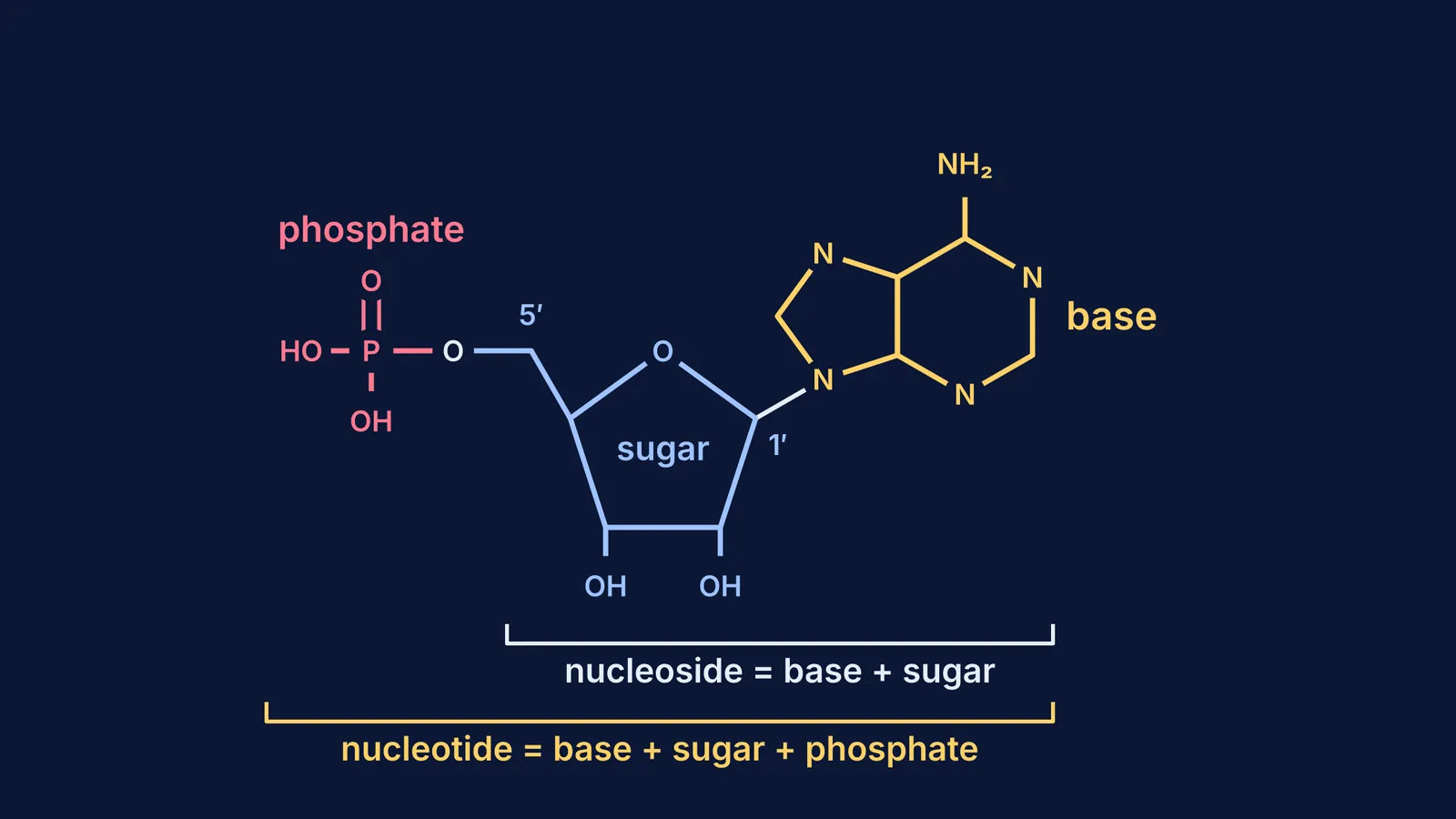
A nucleoside is a purine or pyrimidine base attached to a ribose or deoxyribose sugar, according to the MeSH entry for nucleosides from the US National Library of Medicine.
A nucleotide has three parts: a purine or pyrimidine base, a pentose sugar and a phosphate group, according to the MeSH entry for nucleotides.
So a nucleotide is simply a nucleoside with a phosphate added. The MeSH indexing note for nucleosides puts it plainly: "nucleoside phosphates = NUCLEOTIDES". The NHGRI genetics glossary adds the part you need for DNA and RNA: nucleotides are the building blocks of nucleic acids, and the sugar is ribose in RNA and deoxyribose in DNA.
Keep it as two short sums:
Nucleoside = base + sugar
Nucleotide = base + sugar + phosphate
If you mix up which bases are purines and which are pyrimidines, read our guide to purines vs pyrimidines first.
Is adenosine a nucleoside or a nucleotide?
Adenosine is a nucleoside: the base adenine joined to ribose. PubChem lists adenosine as C10H13N5O4, with a molar mass of 267.24 g/mol. Its IUPAC name on PubChem contains "6-aminopurin-9-yl", which tells you that adenine attaches to the sugar through its nitrogen 9.
Adenylic acid is a nucleotide. PubChem's record for adenosine monophosphate lists "5′-adenylic acid", "adenosine 5′-monophosphate", "AMP" and "adenylate" as names for the same compound, formula C10H14N5O7P, molar mass 347.22 g/mol.
Here is a worked check you can do in your notebook. Subtract the nucleoside's formula from the nucleotide's:
C10H14N5O7P minus C10H13N5O4 leaves HPO3.
HPO3 is phosphoric acid (H3PO4) minus one water (H2O). The phosphate joins the sugar's 5′ carbon as an ester, and one water is lost.
The masses agree: 347.22 minus 267.24 is 79.98 g/mol, the mass of HPO3.
So adenosine plus phosphoric acid, minus water, gives adenylic acid. The phosphate is the whole difference. For a side-by-side view of how the phosphate links nucleotides into a chain, see our post on peptide, glycosidic and phosphodiester bonds.
Why do the names confuse students?
The naming rules come from the IUPAC-IUB Commission on Biochemical Nomenclature, and its 1970 recommendations on nucleic acid symbols explain most of the traps:
Base and nucleoside differ by a few letters. Adenine is the base; adenosine is the nucleoside. Guanine and guanosine work the same way. Pyrimidine nucleosides end in "-idine" instead: cytidine, uridine.
Nucleotides go by several names. The document abbreviates adenosine's 5′-monophosphate as AMP, and PubChem lists adenylic acid and adenylate as other names for it. Adenylate is the ionised form.
Thymidine is the odd one. IUPAC uses "thymidine" for 2′-deoxyribosylthymine, the DNA version, and calls the ribose version ribosylthymine.
ATP has "adenosine" in its name but is a nucleotide. It is adenosine with three phosphates, and the document lists AMP, ADP and ATP together under "Simple Nucleotides".
If you want the backstory of how chemists first worked out the parts of a nucleotide, read our profile of Phoebus Levene and nucleotide structure.
How do you tell if a name is a base, a nucleoside or a nucleotide?
Ask these three questions in order:
Is it adenine, guanine, cytosine, thymine or uracil? Then it is only a base.
Does it say phosphate, monophosphate, "-ylic acid" or "-ylate", or is it an abbreviation ending in MP, DP or TP? Then it is a nucleotide.
Does it end in "-osine" or "-idine" with none of those phosphate clues? Then it is a nucleoside. A "deoxy" or "d" prefix just means the sugar is deoxyribose.
Now try it. Cover the answers and say each one aloud:
Uridine: nucleoside
Guanylic acid: nucleotide
Cytosine: base
Deoxyadenosine: nucleoside
dTMP: nucleotide
ATP: nucleotide
If one of these catches you out, the gap is usually earlier: which sugar is which, or what a purine looks like. The Fermi Concept Library has every concept in biology and chemistry, each with its own lesson and its place in the map, so you can go back to the step you skipped.
Once the labels feel automatic, practise questions that mix them with DNA structure. The Fermi Problem Library has worked problems with a step-by-step solver that explains the reasoning rather than printing an answer.