On this page
Every biology textbook draws a nucleotide as a phosphate, a five-carbon sugar and a base. Much of that picture comes from Phoebus Levene, a chemist in New York in the early 1900s. He identified both sugars, worked out how the parts join, then made a confident guess that was wrong.
Who was Phoebus Levene?
Levene was born in Sagor, Russia, on 25 February 1869, according to the Dictionary of Scientific Biography entry by Aaron J. Ihde. In 1905 Simon Flexner chose him to head biochemical work at the newly created Rockefeller Institute for Medical Research, where he worked until he retired in 1939.
The Cold Spring Harbor DNA Learning Center biography says he published over 700 original papers and articles, and that he is mostly remembered now for his incorrect tetranucleotide theory of DNA.
Ihde's entry says that in 1900 little was known about nucleic acids except that they were present in nucleoproteins and contained phosphoric acid groups along with nitrogenous and non-nitrogenous material. Friedrich Miescher had first found this substance decades earlier, a story we tell in Friedrich Miescher and the discovery of nuclein.
How did Levene find ribose and deoxyribose?
Levene's approach was to take a nucleic acid apart and identify each piece chemically. The sugar was the unknown piece.
Yeast nucleic acid came first. Ihde writes that Levene showed it was made of four nucleosides, in which he identified a sugar that had not been known before: D-ribose. Levene and his colleague Walter Jacobs published "Über die Pentose in den Nucleinsäuren" ("On the pentose in the nucleic acids") in the Berichte der deutschen chemischen Gesellschaft in 1909.
The sugar in thymus nucleic acid, which we now call DNA, took much longer. Ihde's entry says it was identified in 1929, twenty years after ribose, as 2-deoxy-D-ribose. That year Levene and E. S. London published "The structure of thymonucleic acid"77108-1) in the Journal of Biological Chemistry.
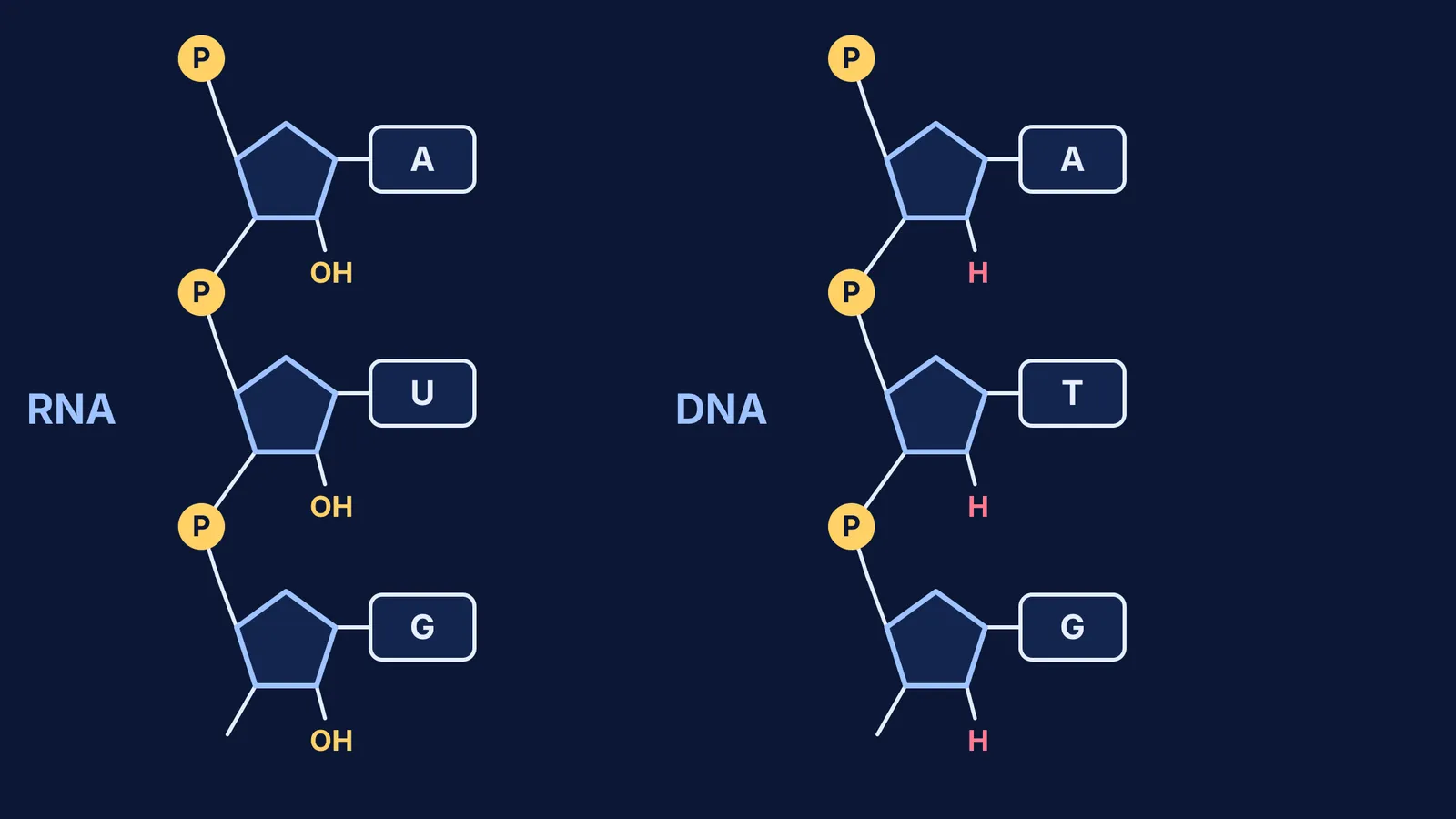
"Deoxy" means "missing an oxygen": deoxyribose is ribose with the -OH on carbon 2 replaced by -H.
How did he show a nucleotide is phosphate, sugar and base?
Once he knew the parts, Levene worked out the order. Nature Education's Scitable overview of DNA's discovery says he was the first to discover the order of the three major components of a single nucleotide: phosphate-sugar-base. In other words, the sugar sits in the middle, with the base on one side and the phosphate on the other.
Scitable also credits him with the polynucleotide model: a nucleic acid is a series of nucleotides, each made of one of four nitrogen-containing bases, a sugar and a phosphate group. That is still how you are taught to see DNA and RNA: a sugar-phosphate backbone with bases sticking out. For the textbook chemistry of these units, see our guide to nucleosides vs nucleotides.
What was wrong with the tetranucleotide hypothesis?
Levene went one step too far. According to Scitable, he proposed a tetranucleotide structure in which the nucleotides were always linked in the same order. A molecule that only repeats the same four units cannot carry much information.
Erwin Chargaff showed the idea was wrong. Using a paper chromatography method he developed, he found that the nucleotide composition of DNA varies among species, which a fixed repeat cannot explain. One of his papers, Chargaff, Zamenhof and Green in Nature in 1950, reported the composition of human DNA. His finding that A roughly equals T and G roughly equals C became known as Chargaff's rule, which you can practise in our post on Chargaff's rule numericals.
The parts Levene identified directly, the sugars and the order of the pieces, were right. The part he guessed, the fixed repeat, was wrong.
How do you draw a nucleotide today?
Here is a five-step check you can use in an exam answer or a revision sheet:
Draw a five-membered sugar ring: four carbons and one oxygen. Number the carbons 1′ to 5′, with 5′ outside the ring.
Attach the base to carbon 1′.
Attach the phosphate to carbon 5′.
Decide the sugar. RNA: -OH on carbon 2′ (ribose). DNA: -H on carbon 2′ (deoxyribose).
To make a chain, join the 3′ carbon of one sugar through a phosphate to the 5′ carbon of the next.
Cover these steps, draw two units of RNA and two of DNA, then compare. If a phosphate touches a base, or carbon 2′ has the wrong group, redo steps 3 and 4.
If the numbering of sugar carbons still feels shaky, the Fermi Concept Library has a lesson for every concept in chemistry and biology, each with its place in the map, so you can see what nucleotides connect to. And if you want to be walked through a structure question, Fermi's AI tutor works out what you already know and checks your understanding as it goes.
Next time you draw that small pentagon with a phosphate on one side and a base on the other, you are drawing Levene's answer.