

On this page
If you are studying the structure of DNA or RNA for biology or chemistry exams, you will quickly encounter the five nitrogenous bases that make up the genetic code. These bases are divided into two distinct chemical families: purines and pyrimidines. Knowing the difference between them is not just a rote memorisation exercise for a test; it is the fundamental key to understanding how the DNA double helix maintains a constant width, how genetic information is accurately copied, and how mutations occur when mistakes happen.
At the most basic chemical level, the difference comes down to physical size, the elements present, and the underlying ring structure.
What is the difference between purines and pyrimidines?
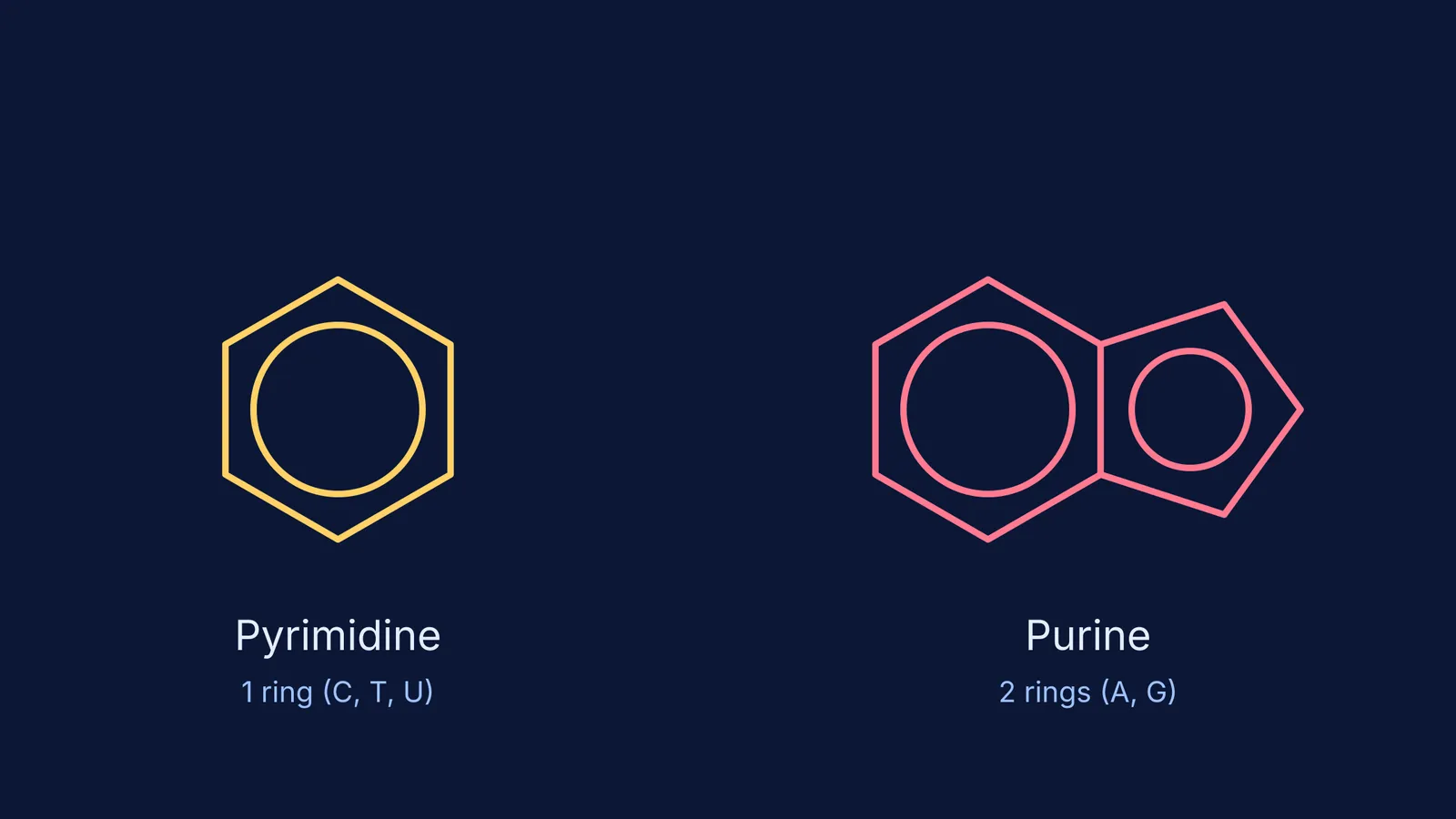
The primary distinction between purines and pyrimidines is the number of carbon-nitrogen rings in their molecular framework. Both molecules are known as heterocyclic aromatic compounds, meaning their rings are made of carbon and nitrogen atoms that share electrons.
According to a review of DNA structure published in *StatPearls* by the National Center for Biotechnology Information (NCBI), purines are large, two-ringed molecules consisting of a five-membered ring tightly fused to a six-membered ring (NCBI StatPearls). Pyrimidines are much smaller, containing only a single six-membered ring.
This size difference dictates how the bases pair up in a DNA molecule. A wide purine always bonds with a narrow pyrimidine across the center of the helix. Because one large molecule always pairs with one small molecule, the "rungs" of the DNA ladder are always exactly three rings wide, giving the double helix a uniform, completely stable diameter.
If you find yourself with concept gaps on genetics or the structure of genetic material, the Fermi Concept Library has every concept in physics, chemistry, biology, mathematics and computing, each with its own lesson and its place in the map.
Which bases are purines and which are pyrimidines?
There are five primary nitrogenous bases across all DNA and RNA molecules, split into these two distinct categories based on their ring count.
The Purines (2 rings):
Adenine (A)
Guanine (G)
The Pyrimidines (1 ring):
Cytosine (C)
Thymine (T)
Uracil (U)
In cellular DNA, you will only ever find adenine, guanine, cytosine, and thymine. However, in RNA, the pyrimidine thymine is entirely replaced by a different pyrimidine called uracil (NCBI StatPearls). This is a crucial distinction that examiners frequently test when asking students to transcribe a DNA sequence into an mRNA sequence.
When they pair up inside the DNA double helix, the bases follow strict chemical rules based on hydrogen bonding. Adenine (a purine) forms two hydrogen bonds with thymine (a pyrimidine) (NCBI StatPearls). Guanine (a purine) forms three hydrogen bonds with cytosine (a pyrimidine). This consistent one-to-one pairing ratio means the amount of adenine equals the amount of thymine, and the amount of guanine equals the amount of cytosine. Understanding this proportional relationship is the basis for solving Chargaff's rule numericals in your board exams.
How to remember purines and pyrimidines?
Students often mix up which nitrogenous bases belong to which family. The confusion usually stems from the fact that the longer word (pyrimidine) describes the smaller, single-ring molecule, and the shorter word (purine) describes the much larger, two-ring molecule.
Here are two straightforward mnemonic tricks to keep them straight on test day:
"Pure As Gold": Use this short phrase to remember the purines.
Pure = Purines
As = Adenine
Gold = Guanine
"CUT the Py": Use this aggressive little phrase to remember the pyrimidines.
C = Cytosine
U = Uracil
T = Thymine
Py = Pyrimidines
How do bases fit into nucleotides?
When you study biomolecules in chemistry, it is incredibly important to remember that purines and pyrimidines are just the "nitrogenous base" portion of the larger genetic code puzzle. They cannot build DNA on their own.
To form a complete nucleotide—the actual structural building block of a DNA or RNA strand—the nitrogenous base must covalently attach to a five-carbon sugar (which is ribose in RNA, or deoxyribose in DNA) and a phosphate group. If the phosphate group is missing, the resulting molecule is simply a base attached to a sugar. This subtle structural detail is why there is a strict chemical difference between nucleosides vs nucleotides.


