On this page
Finishing BSc Nursing leaves you with one question everyone asks: job or more study? In India the two are linked. Most specialist routes ask you to work first, so the real choice is which experience to collect and what to aim it at.
The demand is real. The global nursing workforce grew from 27.9 million in 2018 to 29.8 million in 2023, and the shortage is projected to fall from 5.8 million in 2023 to 4.1 million by 2030, according to WHO's State of the World's Nursing 2025. The same report found that 62% of countries reported advanced practice nursing roles, up from 53% in 2020.
What can I do after BSc Nursing?
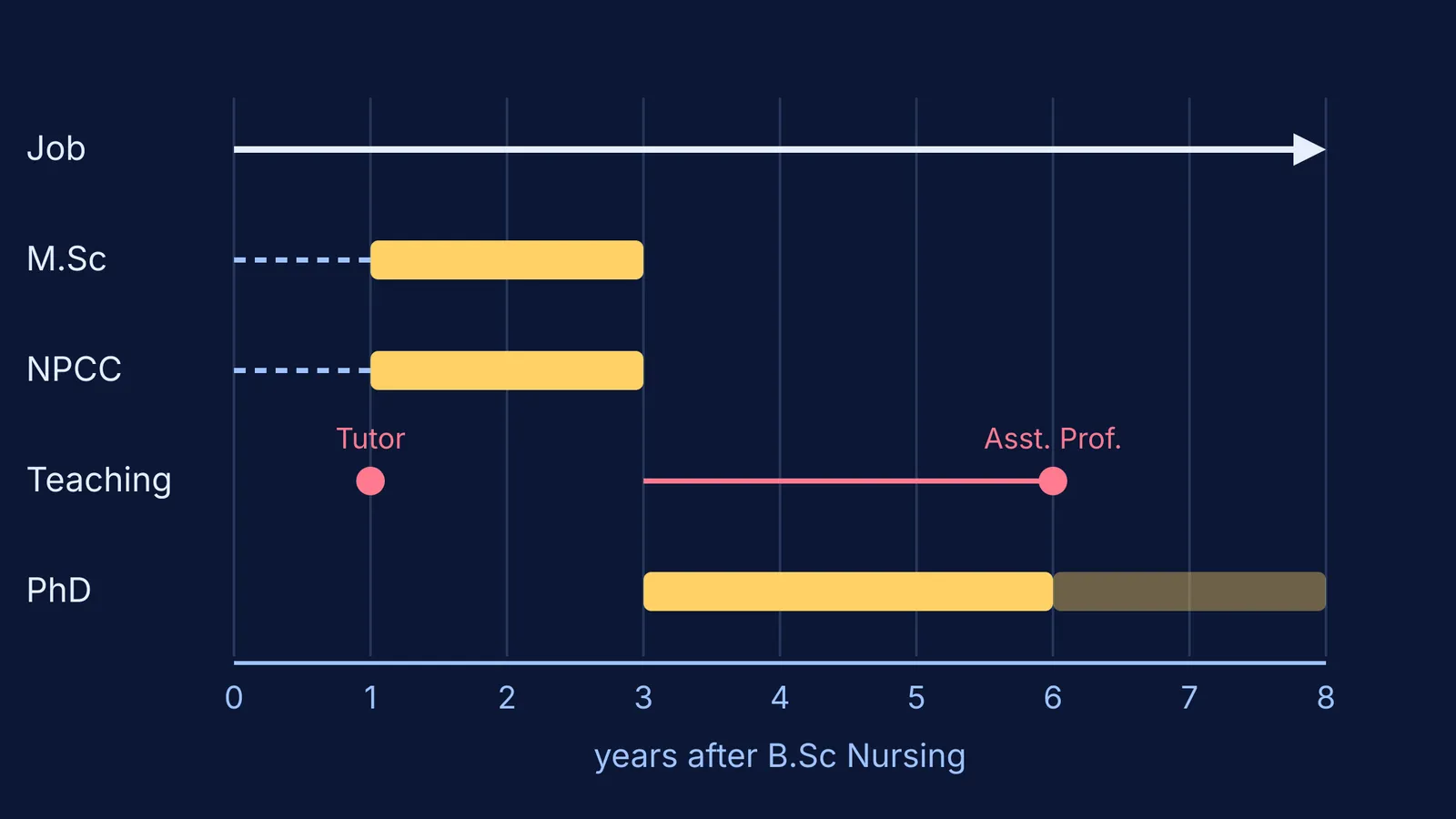
The Indian Nursing Council's list of programmes maps the options: one-year post basic diplomas, a two-year M.Sc, a two-year Nurse Practitioner in Critical Care course, and a PhD of three to five years. With jobs and teaching, that gives five routes:
Work as a registered nurse. AIIMS hospitals recruit nursing officers through a common test called NORCET; check the current notice on AIIMS's exam portal for eligibility and age limits.
Take a one-year specialty diploma. Options include critical care, operation room, oncology, psychiatric, neonatal, emergency and disaster, and geriatric nursing.
Do an M.Sc Nursing. Two years in a clinical speciality such as child health, mental health, community health, obstetrics, or critical care.
Train as a nurse practitioner. The NPCC is a two-year critical care residency; midwifery has its own 18-month residency.
Teach, manage or research. Covered below.
Do you need work experience for M.Sc Nursing?
Yes. The INC's M.Sc Nursing guidelines require you to be a registered nurse and midwife, to have passed B.Sc Nursing with at least 55% aggregate marks, and to have at least one year of work experience after basic B.Sc Nursing. Selection is through an entrance exam held by the university or competent authority, so dates and patterns vary from place to place.
The INC M.Sc syllabus says the degree prepares nurse specialists, consultants, educators, administrators and researchers, with papers in nursing education, research and nursing management. That is why it sits under almost every senior route.
The Nurse Practitioner in Critical Care (NPCC) programme was approved by the INC in 2017, as Manipal College of Nursing's NPCC page notes. Saveetha College of Nursing lists its entry rules as B.Sc Nursing with at least 55% and one year of clinical experience, preferably in critical care. The INC's Nurse Practitioner Midwifery Educator regulations say the earlier one-year Nurse Practitioner in Midwifery diploma has been redesigned as an 18-month residency.
Can a BSc Nursing graduate become a teacher?
Yes, and sooner than you might think. The INC's table of teacher qualifications for colleges of nursing sets these minimums:
Tutor: M.Sc Nursing, or B.Sc / Post Basic B.Sc Nursing with one year of professional experience.
Assistant Professor: M.Sc Nursing with three years of teaching experience.
Associate Professor: M.Sc Nursing with eight years of experience, including five of teaching.
Professor: M.Sc Nursing with ten years of experience, including seven of teaching. A PhD is desirable at every level from Assistant Professor up.
So a tutor post after one year of ward work lets you test teaching before you spend two years on an M.Sc.
For running a hospital rather than a ward, see our guide to hospital administration careers; for population health, our explainer on public health careers and what MPH graduates do.
How do you choose between a job and further study?
Work through these four questions in order.
Which patients do you look forward to? Children, mothers, ICU, mental health, community. That points to a speciality.
How much time can you give? Per the INC programme list, a diploma takes one year, an M.Sc or NPCC two (after a year of work), and a PhD three to five.
Do you want to stay at the bedside? If yes, look at the diploma or NPCC. If you want to teach above tutor level or manage, the M.Sc is the gate.
What does your first year look like? Pick the job whose postings feed the route you chose.
A worked example: Ananya, a fictional graduate, likes the neonatal unit and enjoys explaining things to juniors. She asks for paediatric postings in her first job, then sits her state M.Sc entrance for child health nursing. By year three she has a speciality and is eligible to teach.
If your M.Sc entrance covers basic science and a biology or chemistry topic has faded, the Fermi Concept Library has a lesson for each biology and chemistry concept, so you can rebuild the gaps one at a time. And if you are still at the start, read our guide to the BSc Nursing admission process.
Start by asking for your first-year postings in the area you might specialise in.