On this page
Nuclear physics in India splits into research, studying nuclei with accelerators and detectors, and applied work for the Department of Atomic Energy (DAE): reactors, radiation safety and fuel-cycle technology. Both start with a strong physics degree; what changes is the exam after it.
Which degree do you need for a career in nuclear physics?
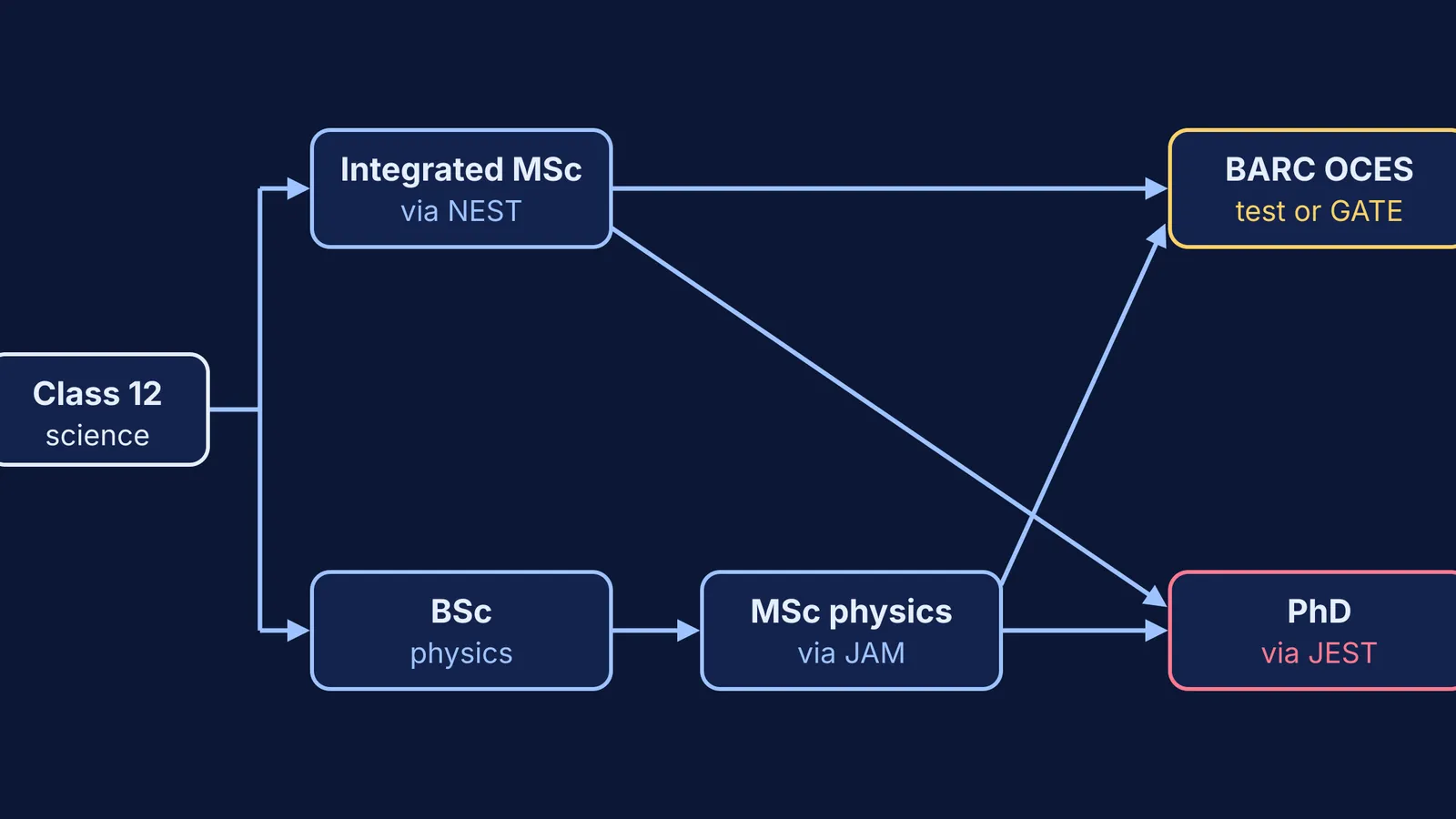
For almost every route, a master's in physics is the entry ticket. There are two common ways to get one.
Integrated MSc straight after Class 12. The National Entrance Screening Test (NEST) is the compulsory online test for the five-year integrated MSc at NISER Bhubaneswar and UM-DAE CEBS Mumbai, both set up by the DAE in 2007. Admitted students are eligible for a DISHA scholarship of ₹60,000 a year, and you need at least 60% in Class 12 (55% for SC, ST and PwD candidates), according to the NEST site.
BSc, then MSc. After a BSc in physics, the Joint Admission Test for Masters (JAM) is the main route into MSc programmes at the IITs. JAM 2027 is organised by IIT Kharagpur and held on 14 February 2027, and its site lists about 3,000 seats.
BARC's OCES-2026 advertisement also accepts a BTech in engineering physics for its physics stream, but not an MSc in medical physics. If radiation in hospitals interests you more than reactors, read our guide on how to become a medical physicist in India.
How do you get into BARC as a physicist?
The main door into DAE's applied work is the BARC Training School. Here is what the official OCES/DGFS-2026 advertisement says (applications go through barcocesexam.in):
OCES is a one-year orientation course at BARC Mumbai and AMD Hyderabad. Trainees who complete it are appointed Scientific Officers, a Group-A government post, in a DAE unit or the Atomic Energy Regulatory Board.
For the physics discipline you need an MSc or integrated MSc in physics with at least 60% marks. If your MSc is not integrated, you also need 60% in your BSc.
Screening is either BARC's online exam or a valid GATE physics score, followed by an interview. Final selection is based on the interview, subject to medical fitness.
Trainees get a stipend of ₹74,000 a month. On appointment in Mumbai, total monthly pay comes to about ₹1,35,000 with the maximum three pay increments.
Physics candidates train in physics or in Radiological Safety and Environmental Science. The general-category age limit was 26 years.
Placements named in the advert include BARC, IGCAR Kalpakkam, VECC Kolkata, RRCAT Indore and the Nuclear Power Corporation of India. Selected candidates sign a bond to serve DAE for at least three years.
What if you want research rather than plant work?
Research in nuclear physics usually means a PhD. The Joint Entrance Screening Test (JEST) is a national test in physics and theoretical computer science that institutes use to shortlist candidates for PhD and integrated PhD programmes. Its participating institutes include TIFR Mumbai, the Saha Institute of Nuclear Physics in Kolkata, VECC Kolkata and the Institute for Plasma Research. JEST 2026 was held on 12 April 2026, so check the site for the next date.
Universities are part of this too. The Inter-University Accelerator Centre in New Delhi was set up by the UGC for university scientists; its Pelletron accelerator is rated for up to 15 MV, though the centre says stable operation is currently limited to 13 MV. IUAC offers accelerator facilities for research within the university system and runs a PhD training programme. For university PhD fellowships, our explainer on what CSIR NET JRF is and who should take it covers that route.
A route plan from Class 11 to your first job
Class 11 and 12: go deep in modern physics and mechanics, and keep maths strong. In Class 12, take NEST alongside JEE or CUET.
Early degree years: spend a summer on a project at a research lab to learn whether you enjoy detectors, accelerators or theory.
Final BSc year: take JAM if you are not in an integrated programme.
Final MSc year: sit GATE physics and BARC's online test, plus JEST if you lean towards a PhD. Keep your marks above the 60% line in the BARC advertisement.
After selection: OCES leads to a Scientific Officer post; a PhD leads to postdoctoral research and scientist or faculty jobs.
A simple way to choose: if you want to build and run real systems, aim for OCES. If you want to ask open questions about how nuclei behave, aim for a PhD. You can sit both and decide once offers arrive.
If Class 12 ideas such as binding energy or half-life still feel shaky, the Fermi Concept Library gives each physics concept its own lesson and shows where it fits in the map. For entrance-test practice, the Fermi Problem Library has worked problems with a step-by-step solver that explains the reasoning rather than printing an answer.
For a sense of where an applied nuclear career can lead, read how M. R. Srinivasan built India's nuclear power plants.