

On this page
Every radiotherapy department in India needs a qualified medical physicist. Someone has to plan the dose for each cancer patient, check that the machine delivers it, and keep staff and the public safe from radiation. If you like physics but don't want to become a doctor, this is a hospital career built on it. Here is the route, from the official notices.
What does a medical physicist do in a hospital?
A medical physicist works alongside radiation oncologists and technologists. They measure radiation beams, plan treatment doses and run quality checks on the equipment. Many also serve as the Radiological Safety Officer (RSO), the person responsible for radiation protection in the department. Even the unit of dose they work in, the gray, is named after a physicist: Louis Harold Gray and the unit of radiation dose.
A 2009 article in the Journal of Medical Physics by S. D. Sharma says that having a qualified medical physicist and an RSO in institutions that offer radiotherapy is "an essential requirement for purposeful and safe usage of ionizing radiations" in cancer care. The need is large: India's National Cancer Registry Programme report projected about 1.4 million cancer cases for 2020. BARC's 2026 admission notice says demand for medical physicists is rising as more radiotherapy centres open.
How do you become a medical physicist in India?
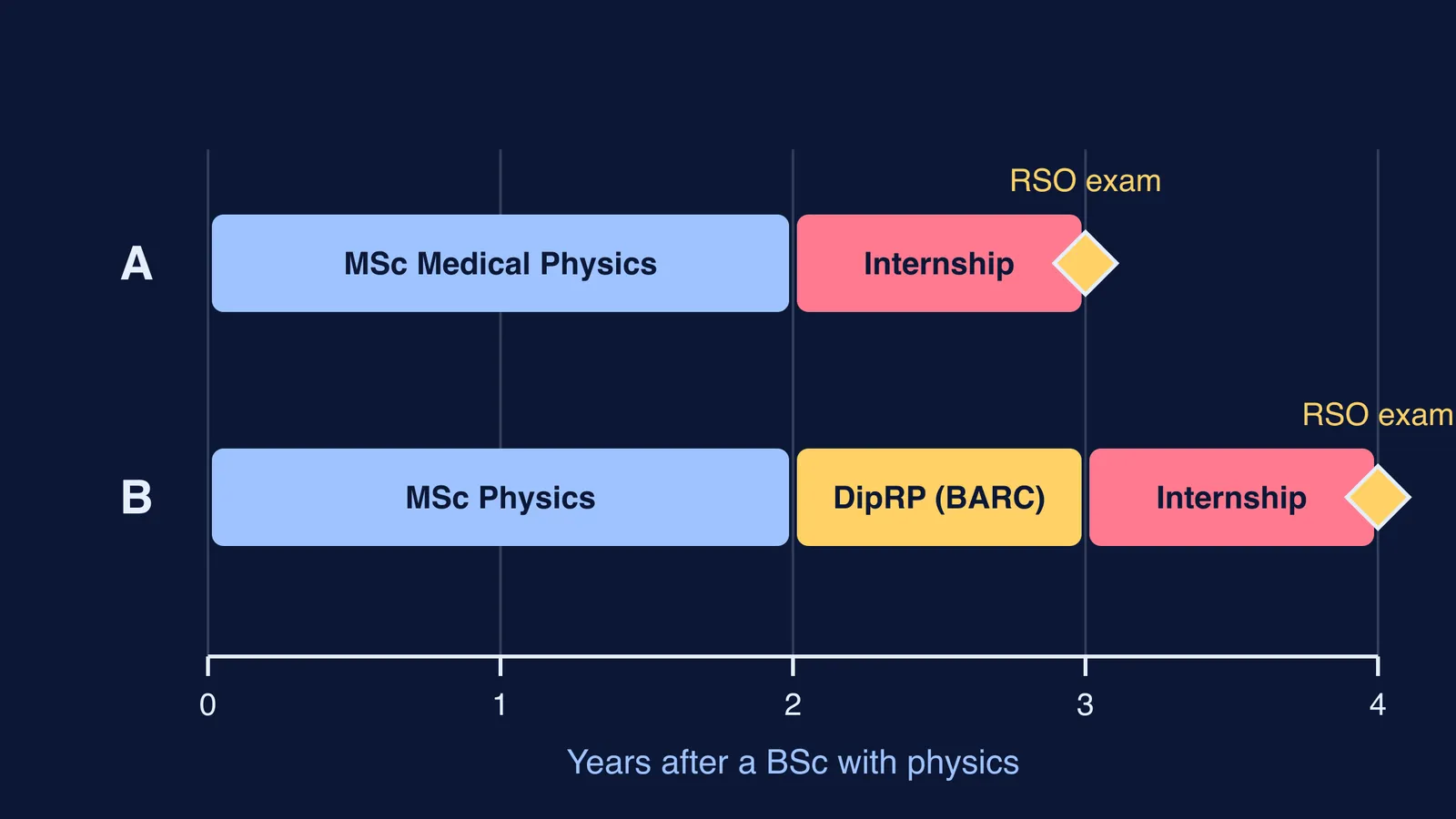
The 2009 Journal of Medical Physics article describes two academic routes. Both start with a BSc that has physics as a main subject, and both end with a hospital internship.
Route A: MSc in Medical Physics. A two-year MSc after your BSc, then a one-year internship. At JSS Academy of Higher Education, for example, the course is four semesters plus one year of internship in a cancer hospital.
Route B: MSc Physics, then BARC's diploma. A regular MSc Physics, then the one-year Diploma in Radiological Physics (DipRP) at the Bhabha Atomic Research Centre in Mumbai, then the internship.
The internship is not optional. BARC's 2026 notice says AERB, the national radiation regulator, requires a one-year medical physics internship at an AERB-recognised radiotherapy centre before you can work as a medical physicist. Sharma's article explains why: a degree makes you academically qualified, but the job needs clinical training.
What does the BARC diploma ask for?
BARC has run the DipRP since 1962. Its Advertisement No. 05/2026 sets these rules for the course starting in August 2026:
Seats: 30, including up to 5 sponsored candidates from government institutions.
Marks: at least 60% in a full-time MSc Physics and at least 60% in a BSc with physics as a main subject. An integrated MSc Physics with 60% also counts.
Upper age limit: 26 for general category, 29 for OBC and 31 for SC/ST, as on 1 August 2026.
Selection: a 1.5-hour multiple-choice screening test with negative marking, then an interview. The final choice rests on the interview alone.
Stipend: Rs 30,000 a month for one year for non-sponsored candidates.
Training: eight weeks of field training at BARC, Tata Memorial Hospital and AERB.
What happens after the course?
The 2026 notice sets out the next steps. BARC pays no stipend during the internship, though some radiotherapy centres that offer internships may. Once you finish the internship, you can sit the RSO (Medical) certification exam run by BARC's Radiological Physics and Advisory Division. If you pass, a hospital can nominate you as its RSO, subject to AERB approval. The same notice says a few top-ranked DipRP students may be recruited as Technical Officers in DAE or AERB when there are vacancies.
MSc Medical Physics graduates have a matching path: BARC's 2023 newsletter lists RSO-Med certification for university MSc (Medical Physics) courses among the certifications it conducts.
A plan you can follow from Class 11
Class 11-12: Take physics, chemistry and maths, and get comfortable with modern physics: X-rays, radioactivity, nuclei. If half-life or binding energy feels shaky, the Fermi Concept Library gives each concept its own lesson.
BSc: Choose a course with physics as a main subject and protect your marks every year. If you are torn between options, read BSc physics or BTech engineering physics.
Final BSc year, pick a route: Route A suits you if you are sure about hospital physics. Route B keeps more doors open, because an MSc Physics also leads to research and teaching. See how your MSc physics specialisation shapes your career.
Before you pay any fees: ask the university, in writing, whether its medical physics course meets AERB's requirements, and which hospitals took its last batch for internships.
During the MSc: practise dosimetry and nuclear physics numericals. The Fermi Problem Library has a step-by-step solver that explains the reasoning rather than printing an answer.
After the course: complete the one-year internship that BARC's notice says AERB requires, then take the RSO (Medical) certification exam.
Applications for the 2026 DipRP batch closed on 10 June 2026. Dates, seats and age limits can change every year, so read the latest BARC notice before you apply.


