On this page
If you love physics, the choice after Class 12 often comes down to two lines on a form: a B.Sc. in physics or a B.Tech in engineering physics. Both will teach you quantum mechanics. They differ in how much else sits around the physics, what the labs ask you to do, and which doors open first.
What is the difference between BSc physics and BTech engineering physics?
A B.Sc. is built around one major subject. Under the University Grants Commission's Curriculum and Credit Framework for Undergraduate Programmes, a three-year degree needs 120 credits and a four-year honours degree needs 160 credits. The same framework says a single-major B.Sc. Physics must earn at least half its credits from physics, which is 60 of 120 in three years.
You can see that depth in a real syllabus. Delhi University's B.Sc. (Hons) Physics syllabus under UGCF 2022 lists 20 core physics papers across eight semesters, from Mathematical Physics I to Quantum Mechanics II.
A B.Tech in engineering physics puts physics next to engineering. IIT Delhi's Engineering Physics programme template sets a minimum of 152 credits, of which 59 are programme core. Its general engineering basket includes Introduction to Electrical Engineering, Introduction to Computer Science, Digital Electronics and Engineering Visualization. IIT Madras describes the aim of its engineering physics programme as "to strengthen the scientific basis of engineering, especially electrical engineering".
Which degree has more lab work?
Lab hours are counted differently from lectures. Under the UGC framework, one lecture credit means one hour a week, while one practicum or lab credit means two hours a week, or 30 hours in a 15-week semester.
Here is a worked example. In Delhi University's 2022 physics programme structure, four of the six first-year core papers are split into 2 theory credits and 2 practical credits. Each of those papers means 2 hours of lectures and 4 hours in the lab every week, or about 60 lab hours in a 15-week semester. Those four papers add up to roughly 240 hours of physics lab in your first year, and the 1-credit practicals in Mechanics and in Electricity and Magnetism add about 60 more.
In engineering physics, the labs sit beside electronics. IIT Delhi's programme template lists four Engineering Physics Laboratory courses alongside Digital Electronics. IIT Madras says its programme has "a strong laboratory component", and the final-semester project can be done in either the physics or the electrical engineering department.
Can you do MSc physics after BTech engineering physics?
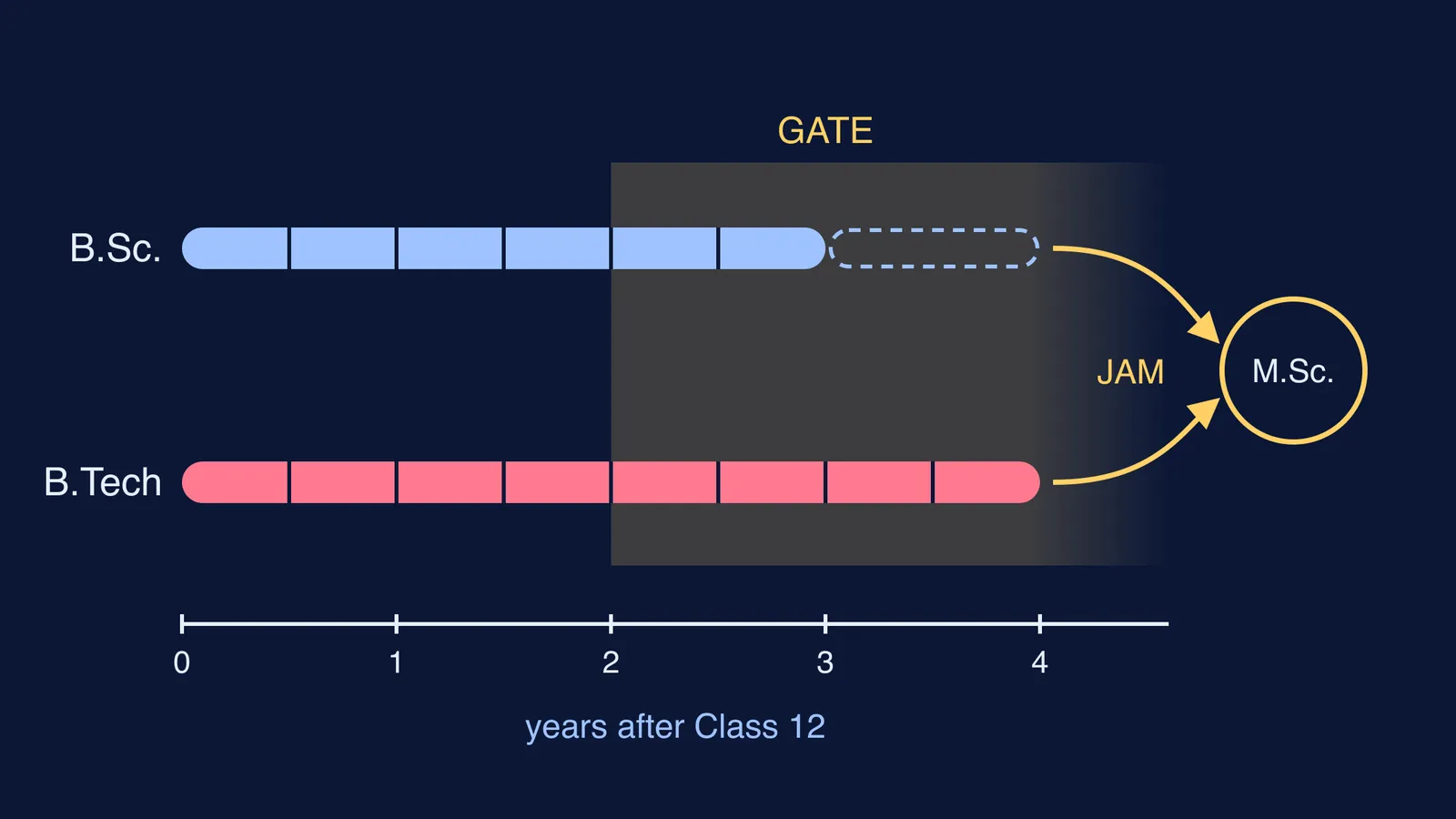
Yes, at most IITs that admit through JAM. The JAM 2027 information brochure from IIT Kharagpur says the exam is on 14 February 2027 and that around 3,000 postgraduate seats at 23 IITs are filled through it. For M.Sc. Physics at IIT Bombay (60 seats), the listed qualification is a B.Sc. or B.S. with physics for two years and maths for one, with "No restrictions for engineering degrees". IIT Delhi, IIT Kanpur and IIT Madras use the same words. Not every programme does (IIT Goa asks for three years of physics), and the brochure calls these tables tentative, so check each institute's final admission brochure.
GATE is open to both. The GATE 2027 eligibility page admits students in the third or higher year of any undergraduate degree, including B.Sc. and B.Tech. The GATE 2027 home page says scores are used for postgraduate and doctoral admissions and by several public sector undertakings for recruitment, though qualifying "does not guarantee admission, scholarship, or employment".
How do you choose between them?
Answer five questions on paper:
When you finish a hard physics problem, do you want to know why the formula holds (lean B.Sc.) or what you could build with it (lean B.Tech)?
Do circuits, coding and design drawings excite you, or do they feel like a detour from physics?
Is research your first plan? Both routes reach JAM and GATE, so pick the stronger physics department you can get into.
Do you want a job straight after the degree? Ask each department where its last two batches went.
Can your family plan for three or four years, and possibly an M.Sc. after that?
When you visit or email a department, ask: "How many lab hours a week do first-year students have? Which electives ran last year? How many of your last batch went on to an M.Sc. or PhD?" Our guide to questions to ask professors before choosing a branch has more.
For the derivation evening, the Fermi Concept Library has a lesson for every physics concept and shows its place in the map of the subject. For the building evening, the Fermi Simulation Lab has interactive simulations for the ideas that are easier to see than to read.
Next, read our guide to career options after B.Sc. physics in India, and compare it with integrated M.Sc. programmes after Class 12 if you already know you want research.