

On this page
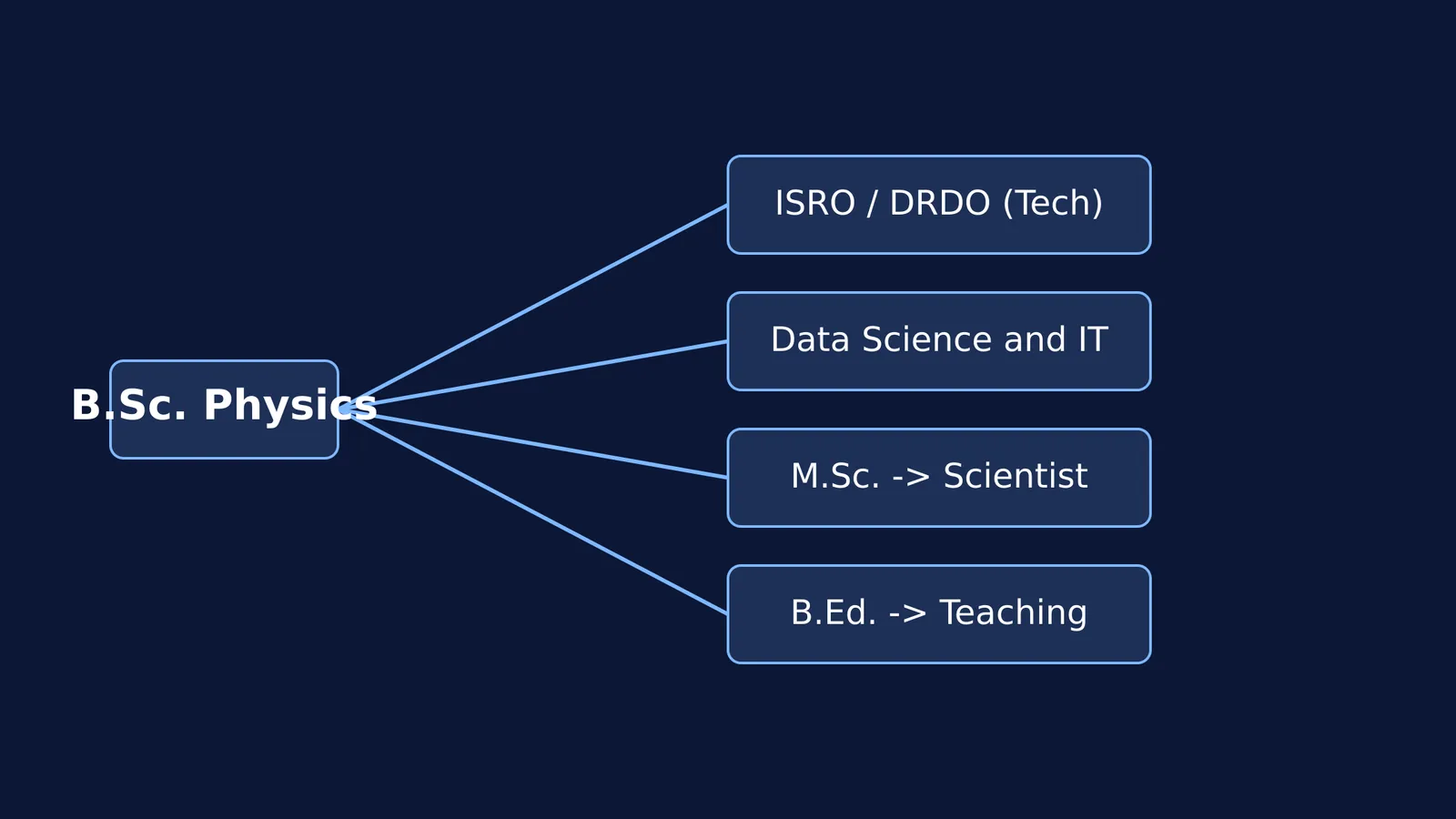
A B.Sc. in physics equips you with a rigorous understanding of mechanics, electromagnetism, and mathematical modelling. But what happens after you graduate? While many assume teaching or a Ph.D. are the only paths, a physics degree is actually a versatile qualification that opens doors to technical roles in both the government and private sectors.
Can you join ISRO or DRDO after a B.Sc. in physics?
Yes, you can enter India's space and defence research organisations directly after your undergraduate degree. Both the Indian Space Research Organisation (ISRO) and the Defence Research and Development Organisation (DRDO) regularly recruit physics graduates for technical roles.
At ISRO, B.Sc. physics graduates with a first-class degree (minimum 60%) can apply for the post of Scientific Assistant, which is a Group 'B' non-gazetted technical role placed in Level 7 of the Central Pay Commission matrix (Source). The selection process typically involves a written test covering core physics concepts and a qualifying practical skill test in a laboratory. DRDO offers a similar entry route through its Senior Technical Assistant-B (STA-B) cadre. Working in these roles gives you practical experience with satellite payloads, optical instruments, and defence technology.
How do you become a scientist in India?
To join organisations like the Bhabha Atomic Research Centre (BARC) or ISRO as a full Scientist/Engineer (a Group 'A' gazetted officer), you generally need a master's degree. The most common pathway is to pursue an M.Sc. in physics at a top institute.
The gateway to these postgraduate programmes is the Joint Admission test for Masters (JAM). Conducted by the IITs, this competitive exam tests your undergraduate physics knowledge. Securing a top rank opens M.Sc. and joint M.Sc.-Ph.D. programmes at IITs and NITs. The exam is numerical-heavy, so students who rely purely on theory often struggle. If you find yourself in that position, understanding why you understand physics theory but still fail numericals is a critical first step in your preparation.
If you have gaps in your foundational mathematics or core physics concepts before the exam, the Fermi Concept Library holds every concept in physics, chemistry, biology, mathematics and computing, each with its own lesson and its place in the map.
Is data science a good career for physics graduates?
Physics graduates are valued in the corporate sector, particularly in data science and quantitative analysis. Data science relies on statistics, calculus, and the ability to model complex systems—skills you practice every time you solve a thermodynamics or quantum mechanics problem. Furthermore, analysing large experimental datasets in physics labs closely mirrors the work data scientists do when processing real-world business metrics.
To make this transition, you need to add programming to your skill set. Learning Python, SQL, and basic machine learning algorithms will make you a strong candidate for roles like Data Analyst or Junior Data Scientist. You do not need a computer science degree to start; for example, you can practice your coding by learning to write your own physics simulation in Python. Because physics students are trained to find patterns in noisy experimental data, they often excel at extracting business insights from large datasets.
What are the options in teaching and academia?
If you enjoy explaining concepts and conducting experiments, education remains a robust career path. To teach physics in Indian schools, you will need to complete a Bachelor of Education (B.Ed.) after your B.Sc., which qualifies you for government and private school teaching roles. A B.Ed. focuses on pedagogy and classroom management, preparing you for the practical realities of teaching science to younger students.
If you prefer higher education, the path involves completing an M.Sc., clearing the CSIR-NET or UGC-NET exams, and pursuing a Ph.D. This qualifies you for Assistant Professor roles at universities and allows you to lead your own independent research projects.


