

On this page
What is a five-year integrated MSc?
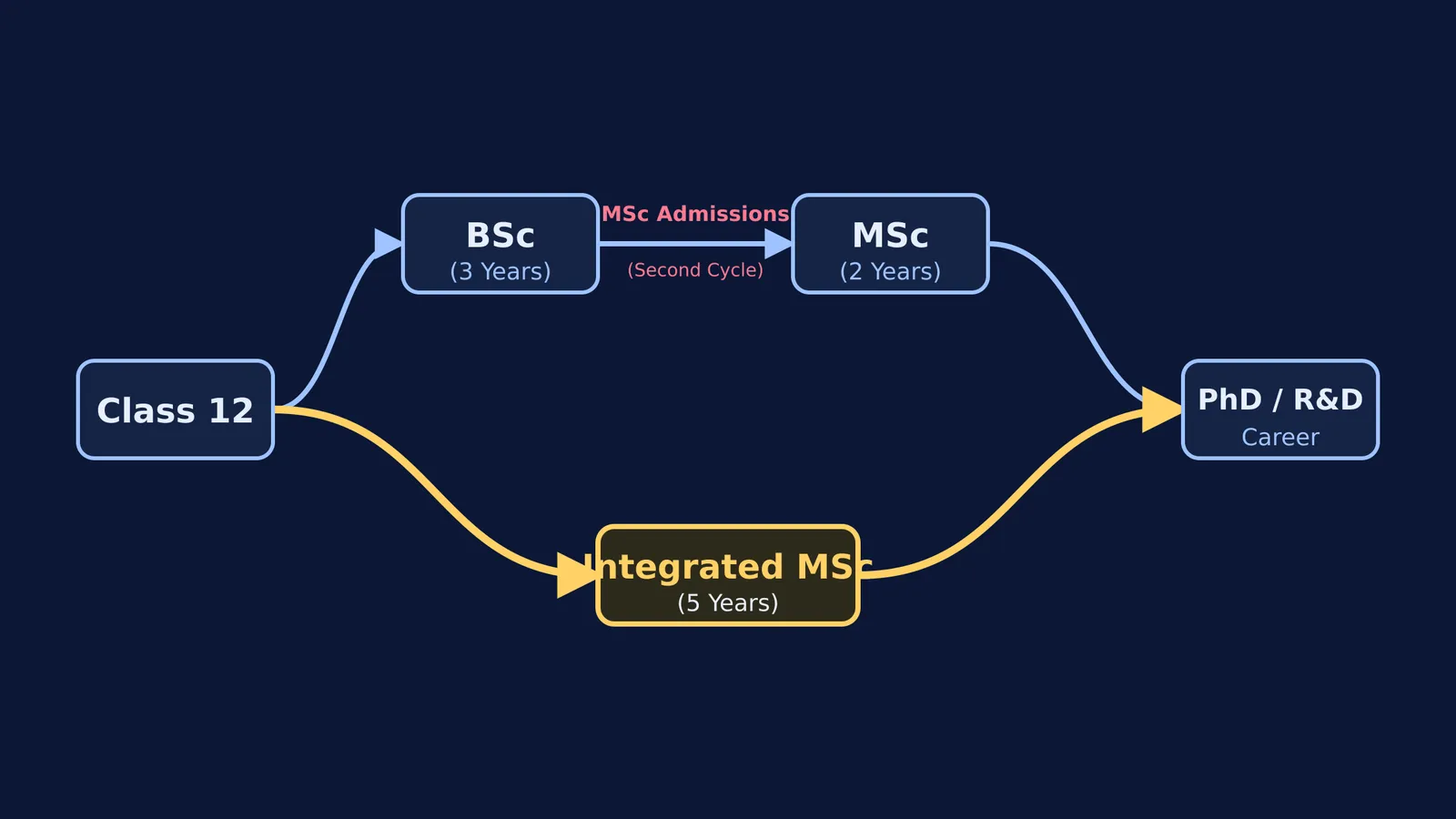
Unlike a traditional sequence where you complete a three-year BSc and then apply for a two-year MSc, a five-year integrated program combines both degrees into a single, continuous academic journey. These programs are explicitly designed to nurture research scientists from day one. You skip the stress of a second admissions cycle and get earlier, deeper exposure to laboratory work.
Most of these programs mandate a year-long research project or thesis in the fifth year. Graduates frequently go on to pursue PhDs at top global universities or enter R&D roles in industries such as biotechnology and materials science.
How to get into the IISERs?
The Indian Institutes of Science Education and Research (IISERs) are the country's premier destinations for undergraduate science. Across seven campuses—Pune, Kolkata, Mohali, Bhopal, Thiruvananthapuram, Tirupati, and Berhampur—they offer a five-year BS-MS Dual Degree Programme (IISER Admissions).
Admission is now conducted solely through the IISER Aptitude Test (IAT) (IISER Admissions). The exam tests biology, chemistry, mathematics, and physics, making it essential to have a strong grip on all four subjects. To be eligible, you must have passed Class 12 in the science stream with at least three of these subjects.
If you are studying for the IAT, you will need to master the reasoning behind concepts, not just the final formulas. The Fermi Problem Library has worked problems with a step-by-step solver that explains the reasoning rather than printing an answer, which is ideal for tackling tricky, multi-concept questions.
What about NISER and UM-DAE CEBS?
If your interest lies in the basic sciences with a pathway into atomic energy and national labs, the National Entrance Screening Test (NEST) is your gateway. NEST offers admission to the five-year integrated MSc at two autonomous institutions under the Department of Atomic Energy (DAE): NISER Bhubaneswar and UM-DAE CEBS Mumbai (NEST).
These institutes offer exceptional financial support. Admitted students are eligible for the DISHA scholarship, which provides ₹60,000 per year along with a ₹20,000 grant for summer internships (NEST). To be eligible, general category students must secure at least 60% aggregate marks in Class 12.
When preparing for exams like NEST, which draw deeply from the core Class 11 and 12 syllabus, brushing up on complex topics is crucial. For instance, you should be comfortable with everything from calculating limits of the form 1^∞ in mathematics to determining the shapes of interhalogen compounds in chemistry. If you have gaps in your understanding, the Fermi Concept Library covers every concept in physics, chemistry, biology, mathematics and computing, each with its own lesson and its place in the map.
Can you apply through CUET?
Yes. The Common University Entrance Test (CUET-UG) has opened doors to integrated science programs at various Central Universities. For example, the University of Hyderabad (UoH) offers five-year integrated MSc programmes in subjects like Physics, Chemical Sciences, and Systems Biology (UoH Admissions).
For these programs, you will generally need to choose the relevant domain subjects (like Physics, Chemistry, and Mathematics or Biology) in your CUET exam.
A framework for your preparation
To succeed in exams like IAT or NEST, follow this structured plan:
Balance the subjects: Both exams test all four sciences. If you are a PCM student, learn the foundational biology chapters from the NCERT textbooks. If you are a PCB student, focus on high-weightage mathematics topics.
Prioritise concepts over speed: These exams test analytical thinking and experimental reasoning more than raw calculation speed.
Use official mock tests: The interface and question patterns of IAT and NEST can feel unfamiliar. Practising with previous years' papers is the best way to adapt.
By starting early and understanding the unique demands of these entrance exams, you can secure a spot in some of India's finest research institutions.


