On this page
At some point in your MSc physics you will tick a box: condensed matter, astrophysics, electronics, nuclear and particle, or atomic and laser physics. It can feel like choosing a life. It isn't. It is choosing which doors are closest when you graduate, and it helps to know which doors exist.
What does an MSc physics specialisation actually change?
It changes two things: the advanced papers in your final semesters, and your project. The project matters more, because it is what a PhD supervisor or an interviewer will ask you about. A condensed matter project might mean measuring a material in the lab; an astrophysics project often means writing code to analyse telescope data; an electronics project usually means building and testing a circuit.
It changes less than you might fear. The official CSIR-UGC NET Physical Sciences syllabus tests every candidate on the same core: mathematical methods, classical mechanics, electromagnetic theory, quantum mechanics, thermodynamics and statistical physics, and electronics and experimental methods. Its advanced part adds atomic and molecular physics, condensed matter physics, and nuclear and particle physics. So whichever specialisation you pick, the exam for research fellowships and lectureship still expects all of it.
Where do physics master's graduates actually work?
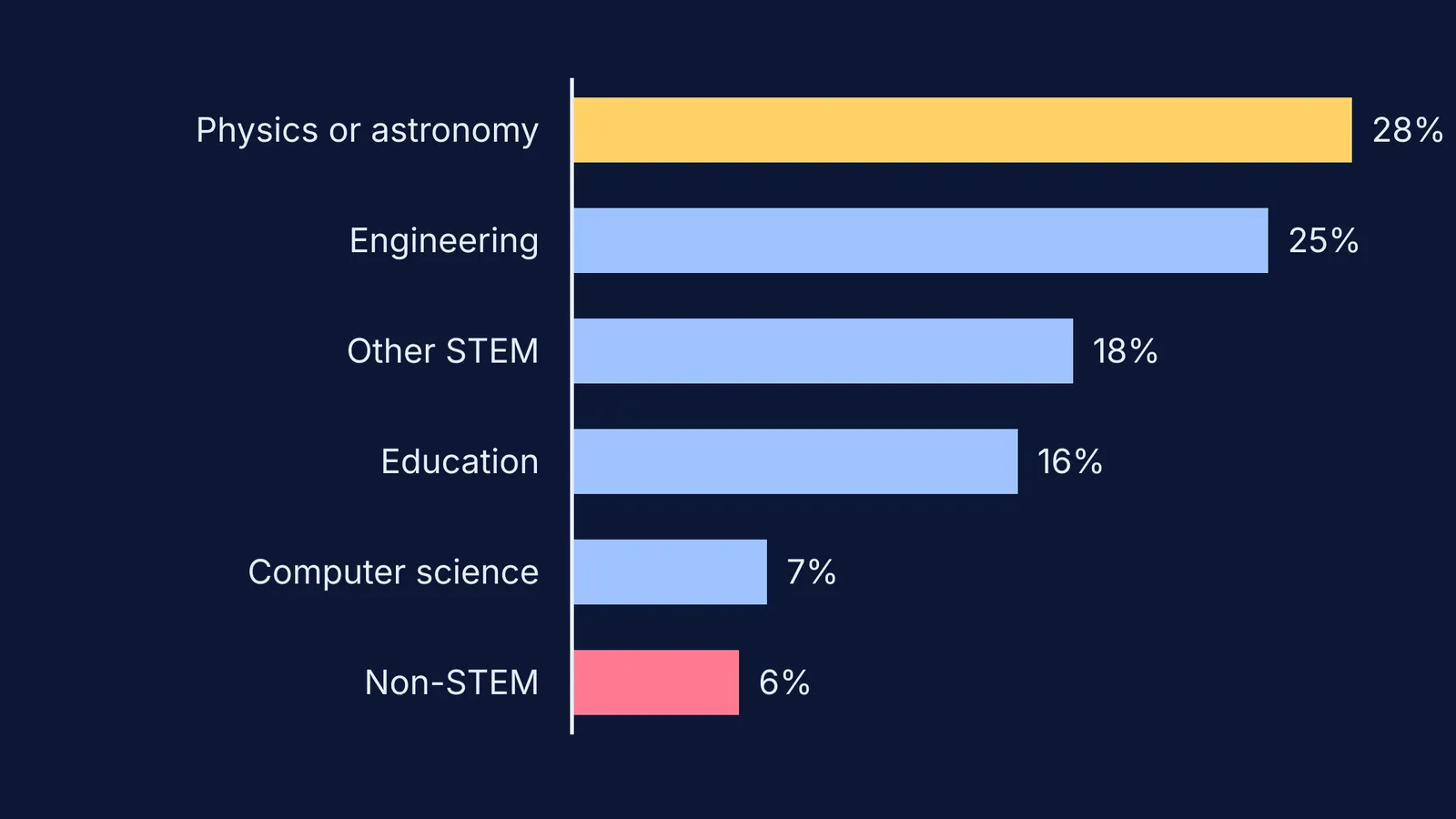
Some of the most detailed data comes from the US. The American Institute of Physics surveyed physics master's graduates from 2021-22 to 2023-24 who left their department, one year after their degree (AIP, Physics Master's Initial Employment, 2025).
Almost half of the employed graduates worked in the private sector, often with job titles containing 'engineer', 'scientist' or 'analyst'.
28% worked in physics or astronomy, 25% in engineering, 18% in other STEM fields, 16% in education, 7% in computer science and 6% outside STEM.
13% of employed graduates worked in high schools, mostly as teachers, and almost all of those teachers taught physics or science.
India's job market is different, so treat these as a shape, not a forecast. The shape is the useful part: most physics master's graduates do not end up in jobs labelled 'physics'. Your specialisation decides which of those other fields you can walk into with the least retraining.
Condensed matter, astrophysics or electronics: which leads where?
Electronics is the most direct road to industry: instrumentation, embedded systems, testing and the chip industry. India is building that industry on purpose. The government's India Semiconductor Mission has an outlay of Rs 76,000 crore for chip manufacturing, design and research. Our guide to the electronics and VLSI career path covers what those roles ask for.
Condensed matter sits between research and industry. It is the physics of solids, semiconductors and superconductors, so it suits a PhD in materials or devices and pairs well with electronics if you want industry later.
Astrophysics leads mostly to a PhD. In India, several astronomy research institutes admit PhD students through the Joint Entrance Screening Test (JEST), whose participating institutes include the Indian Institute of Astrophysics, IUCAA, the Raman Research Institute, ARIES Nainital and NCRA-TIFR. If you choose it, the skills that travel outside academia are programming and data analysis, so build them deliberately. Our piece on building a research career and PhD in India explains that path.
How do you choose your MSc physics specialisation?
Use this four-question test. Write your answers down before you talk to anyone else.
Which subject do you practise without being told to? That is your interest, not the one that sounds impressive.
What do you want the year after your MSc: a job, a PhD, or NET and teaching? Job points towards electronics or condensed matter; PhD leaves all options open.
What will your project make: code, a device, or data? Choose the output that matches step 2.
Who will supervise you? An engaged supervisor in your second choice beats an absent one in your first.
A worked example: a hypothetical student, Meera, loves astrophysics but her family needs her earning soon after her MSc. She does not have to drop astrophysics. She picks it, asks for a project that analyses survey data in Python, and takes the electronics lab seriously. If a PhD place comes, she is ready; if not, she has data and coding skills that industry also hires for.
Before you commit, test yourself on the real ideas, not the brochure. If band theory or stellar structure still feels hazy, the Fermi Concept Library has a lesson for every concept in physics, each shown in its place in the map, so you can see what each specialisation builds on.
If you are still at the BSc stage, start with our overview of career options after a BSc in physics.