

On this page
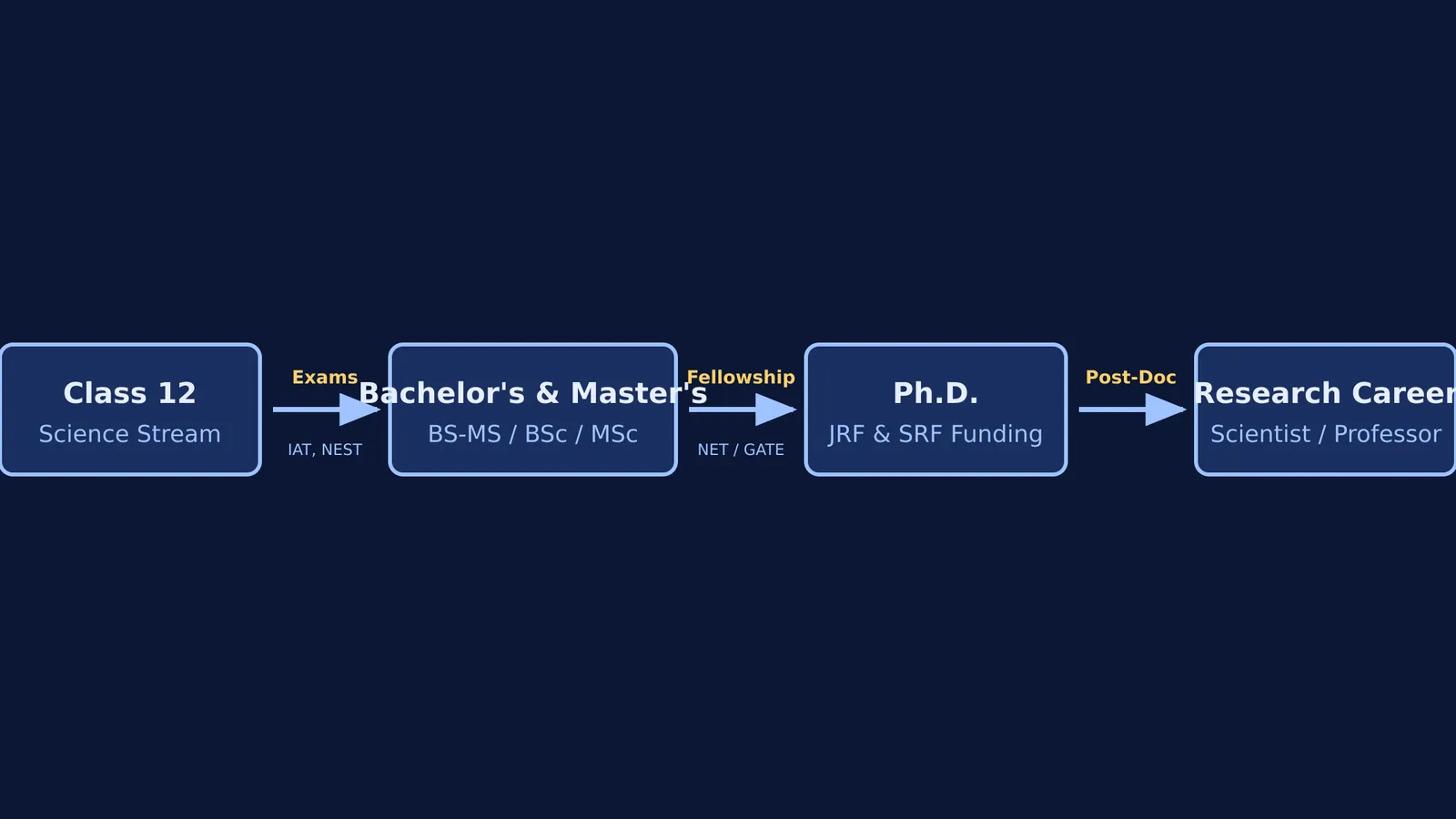
India has built a robust pipeline for students who want to dedicate their careers to science, offering direct routes from Class 12 into premier research institutes. If you are fascinated by research—whether it is understanding the genome like Lalji Singh: from snake chromosomes to DNA evidence in Indian courts, or developing public health solutions like M. K. Bhan and Rotavac, India's own rotavirus vaccine—the path is well-defined. It involves an undergraduate degree, a master's, and a Ph.D., supported by government fellowships at almost every step of the journey.
Which entrance exams lead to premier research institutes?
The traditional route of completing a Bachelor of Science (BSc) at a local university and then pursuing a master's is still common and valid. However, India now offers specialized Integrated BS-MS dual degree programs designed specifically to train the next generation of scientists.
To enter these premier institutes right after your 12th board exams, you should target these specific entrance tests:
IAT (IISER Aptitude Test): This computer-based test is your gateway to the seven Indian Institutes of Science Education and Research (IISERs) and the undergraduate program at the Indian Institute of Science (IISc). The exam tests your knowledge across Physics, Chemistry, Biology, and Mathematics (IISER Admissions).
NEST (National Entrance Screening Test): This competitive exam admits students to the prestigious five-year integrated MSc programs at NISER Bhubaneswar and UM-DAE CEBS Mumbai. The NEST 2026 exam is scheduled for June 6, 2026 (NEST).
JEE Advanced: While primarily known for engineering admissions, top ranks in JEE Advanced also open doors to the IISc Bachelor of Science (Research) program and specialized engineering physics or applied science degrees at various IITs.
If you need help mastering foundational concepts for the IAT or NEST, the Fermi Concept Library holds every concept in physics, chemistry, biology, mathematics and computing, each with its own lesson and its place in the map.
What fellowships are available for science students?
One of the biggest advantages of pursuing pure science in India is the strong financial support structure. You do not have to self-fund a decade of higher education, as multiple agencies exist to fund scholars.
At the undergraduate level, top performers in their respective board exams or competitive entrance tests can receive the INSPIRE Scholarship. Funded by the Department of Science and Technology (DST), it provides ₹80,000 per year to eligible students enrolled in basic and natural science courses.
Once you complete your master's degree and qualify to start a Ph.D., you will typically take exams like the CSIR-UGC NET or GATE to secure a Junior Research Fellowship (JRF). According to the official Office Memorandum (O.M. No. DST/PCPM/Z-06/2022) issued by the Department of Science and Technology, the JRF stipend was revised to ₹37,000 per month effective from January 1, 2023. After two years of rigorous research and a successful assessment by a review committee, you are upgraded to a Senior Research Fellow (SRF), which carries a stipend of ₹42,000 per month. Additionally, scholars receive a House Rent Allowance (HRA) if they do not use campus accommodation, along with a yearly contingency grant for research expenses.
For exceptionally meritorious students, the Prime Minister's Research Fellows (PMRF) scheme offers even higher stipends ranging from ₹70,000 to ₹80,000 per month during the Ph.D. program.
What does a research life look like during a Ph.D.?
A Ph.D. in India typically takes several years to complete. Unlike a bachelor's degree, where your schedule is filled with standard lectures and highly structured exams, a Ph.D. is an independent pursuit of entirely new knowledge.
Your first year usually involves advanced coursework to build a solid foundation in your niche area of study. After that, your daily life shifts to the laboratory, the field, or the computer terminal. You will read dozens of published papers, design your own experiments, face frequent failures, and slowly gather reliable data. When you are stuck on a difficult mathematical proof or a complex data analysis problem during your coursework, the Fermi Problem Library provides worked problems with a step-by-step solver that explains the reasoning rather than printing an answer.
Once your research yields novel results, you will write manuscripts, submit them to peer-reviewed scientific journals, and eventually compile and defend your thesis. After finishing your Ph.D., most scientists complete a Post-Doctoral Fellowship—often abroad or at another premier Indian institute—to gain independent expertise. Finally, you can apply for permanent faculty or scientist positions at universities, IITs, or government organizations like ISRO, DRDO, and CSIR.
The journey requires immense patience and resilience, but it leads to a uniquely rewarding career where your daily job is to discover things that no one else in the world knows yet.


