

On this page
The gray (Gy) is named after Louis Harold Gray, a British physicist and radiobiologist who dedicated his life to studying how radiation affects living cells. Born in 1905 to a working-class family in London, Gray showed an early aptitude for science. He earned a scholarship to Trinity College, Cambridge, where his career investigating the physics of radiation began.
Gray's work was instrumental in moving radiation therapy from a trial-and-error medical practice into a precise, mathematically rigorous science. In 1975), ten years after his death, the General Conference on Weights and Measures adopted the gray as the official SI unit of absorbed radiation dose to honour his lifelong contributions.
What does the gray (Gy) measure?
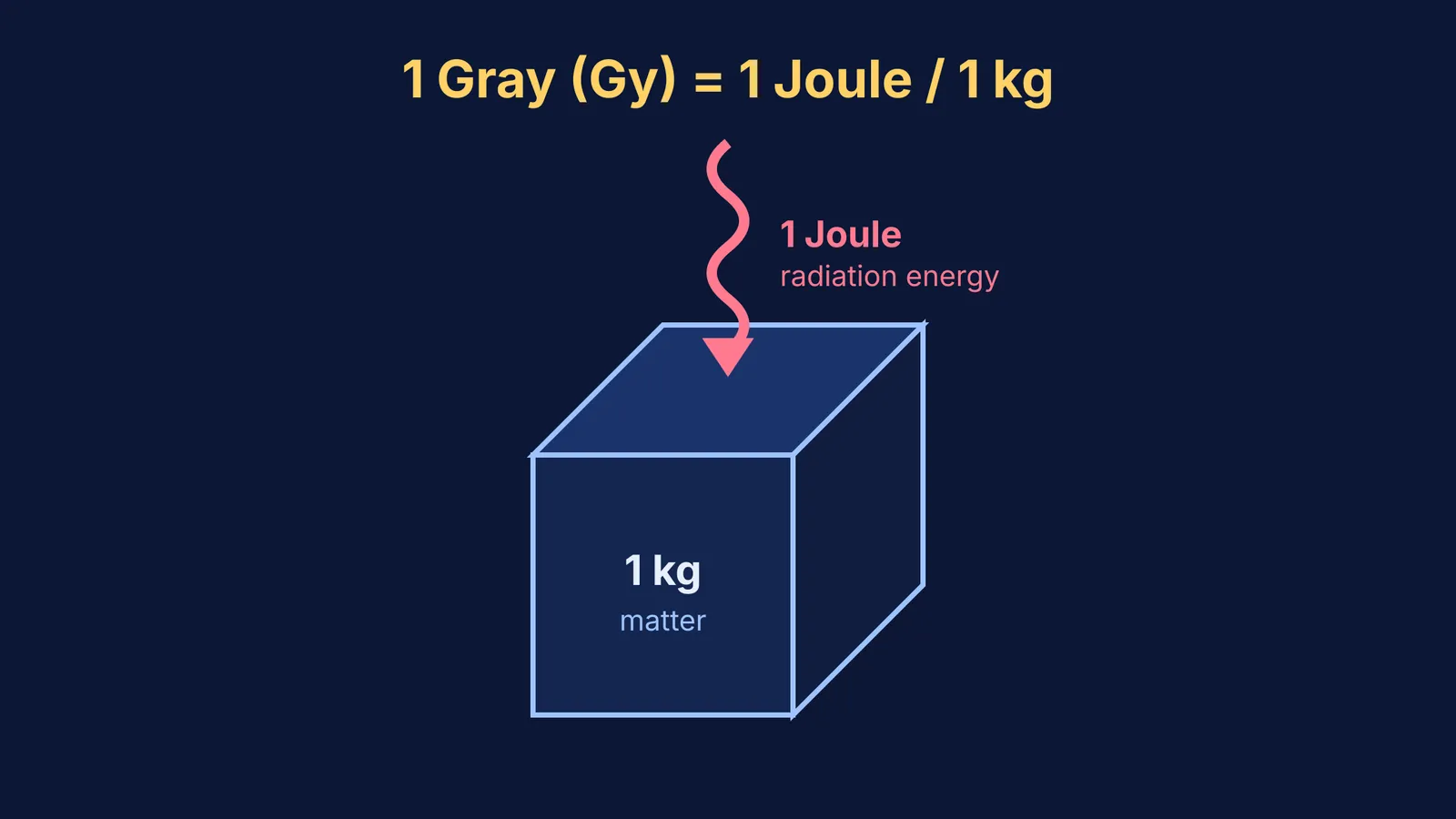
The gray measures the "absorbed dose" of ionizing radiation. One gray is defined as the absorption of one joule of radiation energy per kilogram of matter) (1 Gy = 1 J/kg). It replaced the older cgs unit, the rad, where 1 Gy equals 100 rads).
This measurement is completely independent of what is absorbing the radiation or what type of radiation is being absorbed. Whether it is a piece of plastic, a liter of water, or human tissue, one gray always means one joule of energy has been deposited into every kilogram of that material.
When medical physicists plan radiotherapy for a cancer patient, they prescribe the dose in grays. Because delivering the full curative energy at once would damage too much healthy tissue, doctors split the total dose into small daily fractions to give healthy cells time to recover.
How did Louis Harold Gray bridge physics and biology?
Gray started his research career as a pure physicist. He studied at Cambridge's Cavendish Laboratory under James Chadwick, the scientist who discovered the neutron. Gray later moved to Mount Vernon Hospital in London, taking on the role of hospital physicist. There, he built an early neutron generator specifically to study how neutrons damage cells, crossing the boundary from physics into biology.
In 1936, he developed the Bragg–Gray cavity theory. This mathematical equation solved a major problem: how to calculate the energy a solid material absorbs when you can only measure the ionization in the air. The theory showed that by placing a tiny gas-filled cavity inside the material, physicists could measure the ionization in the gas and calculate the exact energy deposited in the surrounding solid. This breakthrough made modern radiation dosimetry possible.
Gray also introduced the concept of Relative Biological Effectiveness (RBE) in 1940. He proved that different types of radiation do different amounts of damage even if the absorbed energy is identical. For instance, neutrons cause much more severe biological damage than X-rays of the same energy.
Students studying modern physics or biology might struggle to picture how abstract ideas like energy absorption, cavity ionization, or cell mutation work together. Fermi's AI tutor can work out what you already know and build a plan for the session, writing on a board and checking your understanding as it goes. For complex physics numericals involving radiation energy, the Fermi Problem Library has worked problems with a step-by-step solver that explains the reasoning rather than just printing an answer.
What is the difference between the gray and the sievert?
While the gray measures the pure physical energy absorbed, the sievert (Sv) measures the biological effect of that energy on human health.
Because some types of radiation cause more concentrated harm to tissue than others for the exact same amount of energy absorbed, the sievert takes the biological damage into account using radiation weighting factors. One gray of X-rays or gamma rays equals one sievert. However, one gray of heavy alpha particles equals 20 sieverts), because alpha particles dump their energy in a much shorter, more destructive track.
Worked example: Calculating absorbed radiation dose
To find the absorbed dose, we use the definition: Absorbed Dose = Total Energy Absorbed ÷ Mass of Tissue).
If a 2-kilogram block of tissue absorbs 5 joules of X-ray energy, what is the absorbed dose?
Plug in the numbers: Absorbed Dose = 5 Joules ÷ 2 kg.
Calculate: 5 ÷ 2 = 2.5 J/kg.
State the final answer: Since 1 J/kg is exactly 1 gray, the absorbed dose is 2.5 Gy.
This straightforward division is the starting point for all medical dosimetry. For more on radiation in medicine, read about George de Hevesy and radioactive tracers in living things, or learn about counting alpha and beta decays in a radioactive decay series.


