On this page
Every second, the Sun turns hydrogen into helium deep in its core, and a small slice of mass disappears along the way. That missing mass becomes the sunlight on your face. Below are the chain of reactions, the numbers behind them and a worked calculation you can redo in five minutes for the nuclei chapter of JEE Main physics.
How does nuclear fusion power the Sun?
The Sun's core is at about 15 million degrees Celsius, according to NASA's Sun facts page. At that temperature, hydrogen nuclei (protons) move fast enough that a few of them get close enough to fuse, even though their positive charges push them apart. Our post on why fusion needs such high temperatures explains that part.
Stars turn hydrogen into helium by two routes: the proton-proton (pp) chain and the CNO cycle. In the Sun, the pp chain produces about 99% of the energy. The Borexino neutrino experiment, reporting in Nature in 2020 (abstract on arXiv), put the CNO cycle's share at about 1%.
What are the steps of the proton-proton chain?
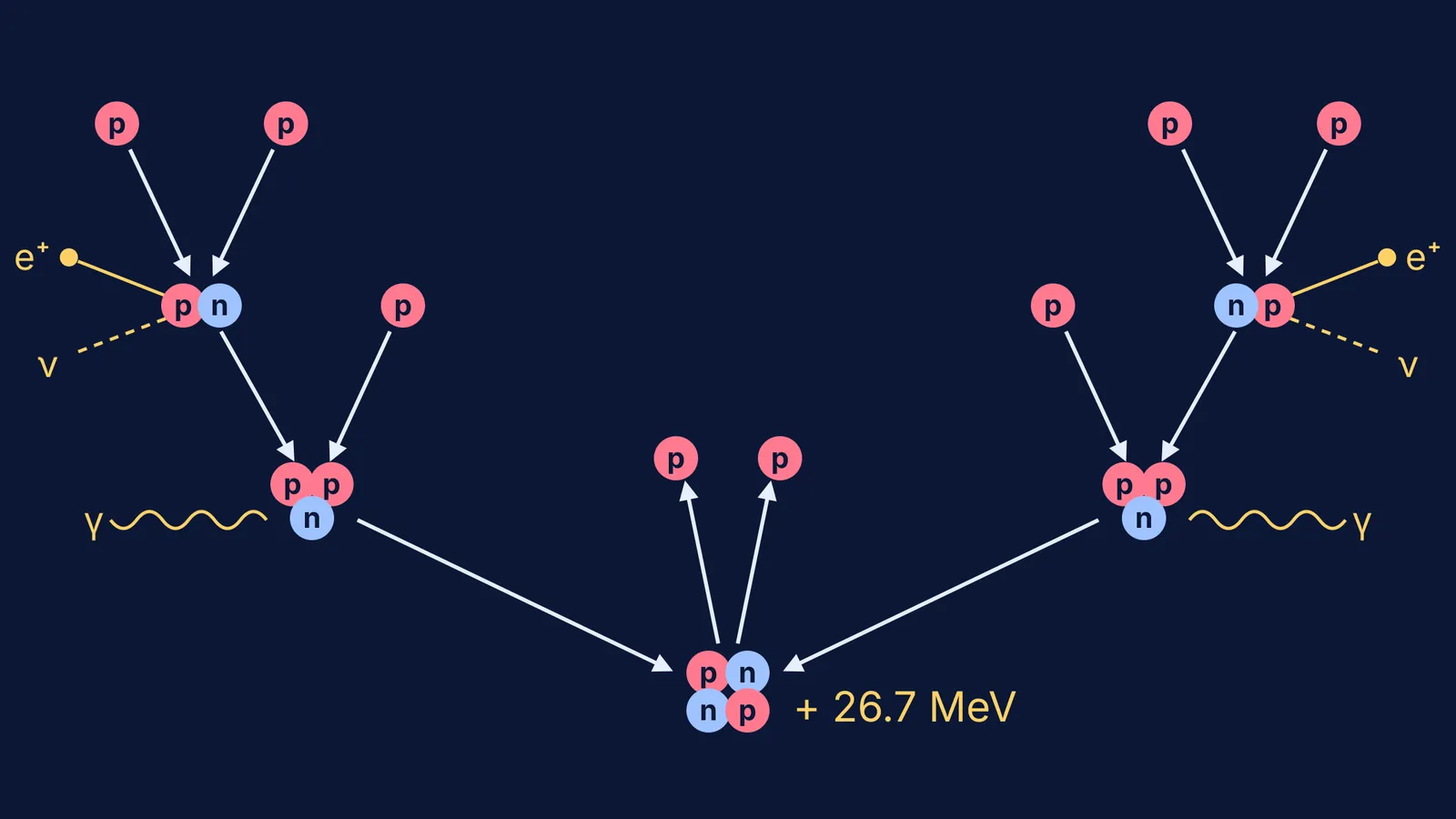
The main branch has three steps, as set out by the University of Calgary's Energy Education encyclopedia:
Two protons fuse. Usually they fly apart again, but sometimes one proton turns into a neutron through the weak nuclear force. That makes deuterium (one proton and one neutron) and releases a positron and a neutrino.
A third proton hits the deuterium, forming helium-3 and a gamma ray.
Two helium-3 nuclei collide, forming helium-4 and giving back two protons.
Steps 1 and 2 have to happen twice to make the two helium-3 nuclei, so six protons go in and two come back out. The net result is that four protons become one helium-4 nucleus. The diagram at the top of this post shows the full count.
Where does the 26.7 MeV come from?
Weigh what goes in and what comes out. NIST lists the atomic mass of hydrogen-1 as 1.00782503 u and the atomic mass of helium-4 as 4.00260325 u. One atomic mass unit is equivalent to 931.494 MeV, according to NIST's CODATA value.
Worked example:
Mass in: 4 × 1.00782503 u = 4.03130013 u.
Mass out: 4.00260325 u.
Mass defect: 4.03130013 − 4.00260325 = 0.02869688 u.
Energy: 0.02869688 × 931.494 MeV ≈ 26.73 MeV.
Fraction of mass converted: 0.02869688 ÷ 4.03130013 ≈ 0.712%.
So each helium-4 nucleus made in the Sun's core releases about 26.7 MeV, and about 0.7% of the hydrogen's mass becomes energy. Some of that energy leaves with the neutrinos, which quickly escape the Sun. The rest heats the core and eventually reaches us as light. If you need a refresher on the conversion factor, see our explainer on why 1 amu equals 931 MeV.
How much mass does the Sun lose every second?
Now scale it up. The International Astronomical Union fixes the nominal solar luminosity at 3.828 × 10²⁶ W (IAU 2015 Resolution B3). The speed of light is exactly 299,792,458 m/s (NIST).
Mass turned into energy each second: L ÷ c² = 3.828 × 10²⁶ ÷ (2.998 × 10⁸)² ≈ 4.26 × 10⁹ kg, about 4.26 million tonnes. The Energy Education page gives the same figure.
Hydrogen fused each second: 4.26 × 10⁹ kg ÷ 0.00712 ≈ 6.0 × 10¹¹ kg, roughly 600 million tonnes.
Our post on how much of the Sun's mass is converted each second works through this as an exam-style problem.
How do you use this in an exam?
Use this checklist for any fusion or Q-value question:
Write the net reaction first (four hydrogen-1 to one helium-4 for the Sun), and check that charge and nucleon number balance.
Choose either atomic masses or nuclear masses, and use the same kind throughout.
Subtract the mass that comes out from the mass that goes in. A positive answer means energy is released.
Multiply by 931.5 MeV per u, or by c² if your masses are in kg.
Check your answer: for the pp chain, expect about 0.7% of the mass, the figure Energy Education gives, not 7% or 70%.
If a Q-value problem goes wrong and you can't see where, the Fermi Problem Library has worked problems with a step-by-step solver that explains the reasoning rather than printing an answer. If mass defect or binding energy itself feels shaky, the Fermi Concept Library gives each concept its own lesson and its place in the map.
Next time you stand in the sunlight, remember that you are feeling the 0.7% of hydrogen's mass that the Sun's core gave up.