

On this page
Every second, the Sun shines by fusing hydrogen into helium in its core. But this process is not perfectly conservative: the resulting helium is slightly lighter than the hydrogen that went into making it. That missing mass is converted into the energy that eventually reaches Earth as sunlight.
If you are a student working through modern physics problems for JEE or NEET, you might wonder exactly how much mass is converted to keep the Sun shining. The answer is surprisingly simple to calculate if you know the Sun's luminosity and the speed of light.
How much mass does the Sun lose per second?
According to astronomical data, the Sun converts matter into energy at a rate of 4.26 billion kg (4.26 million tonnes) every second. This mass loss is what powers the entire solar system.
To maintain this immense energy output, the Sun's core fuses about 600 billion kg of hydrogen into helium every second. The fusion happens through a process called the proton-proton chain. When four hydrogen nuclei (protons) combine to form a single helium nucleus, the final product is roughly 0.7% less massive than the four original protons. This tiny difference in mass between the input hydrogen and the output helium becomes pure energy.
How do we calculate the Sun's mass loss?
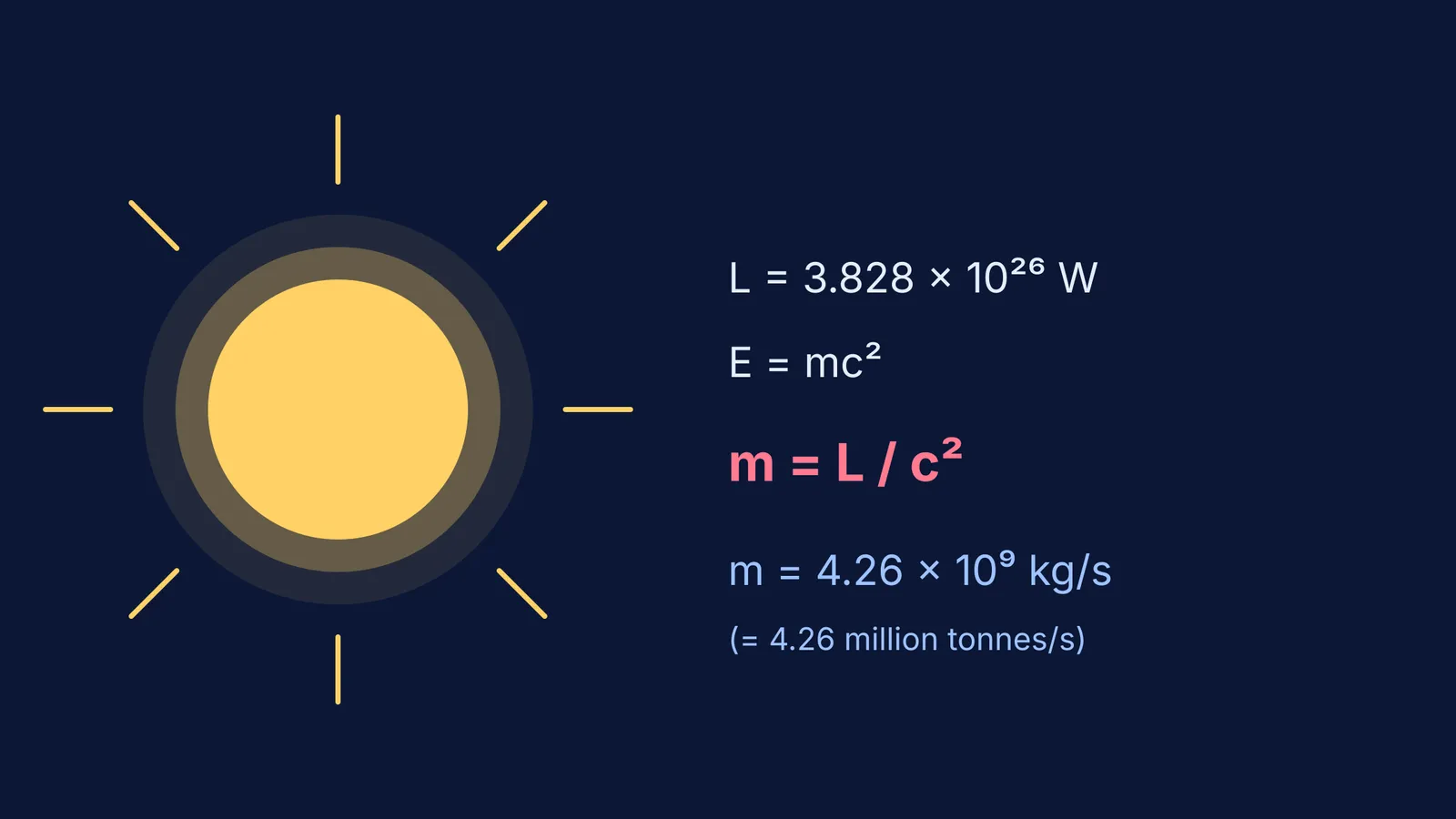
The Sun radiates energy at a rate known as its luminosity. The nominal value for solar luminosity (L) is 3.828 × 10²⁶ watts (or joules per second) according to the IAU.
To find the mass lost, we use Albert Einstein's famous mass-energy equivalence formula:
E = mc²
Since luminosity is energy per second (E/t), we can rearrange the formula to find the mass converted per second (m/t):
m = L / c²
The speed of light (c) is exactly 299,792,458 metres per second. If we plug the numbers in, we get:
m = (3.828 × 10²⁶ J/s) / (299,792,458 m/s)²
This calculation gives a mass loss rate of roughly 4.26 × 10⁹ kilograms every second. Because one metric tonne is 1000 kg, this works out to 4.26 million tonnes of mass per second.
Will the Sun run out of mass?
While 4.26 million tonnes per second sounds catastrophic, the Sun's total mass is an enormous 2 × 10³⁰ kg. At its current rate, the Sun has lost only a tiny fraction of a percent of its mass over its 4.5 billion-year life. In the very distant future, roughly five billion years from now, the Sun will expand into a red giant and lose about a third of its total mass as it ages. As the Sun's gravitational pull weakens from this mass loss, Earth's orbit will actually expand outward.
When studying these immense scales in physics, it can be hard to know where to start setting up the equations. If you are practising nuclear physics numericals or calculating the number of photons emitted per second by a lamp or a laser, the Fermi Problem Library has worked problems with a step-by-step solver that explains the reasoning rather than printing an answer.
If you are revising other atomic topics where mass and energy balance out, such as counting alpha and beta decays in a radioactive decay series or calculating photon energy with E = 1240/λ, you can test your understanding by looking closely at the mass defect in each step. Setting up the energy balance carefully is the key to solving these modern physics questions.


