

On this page
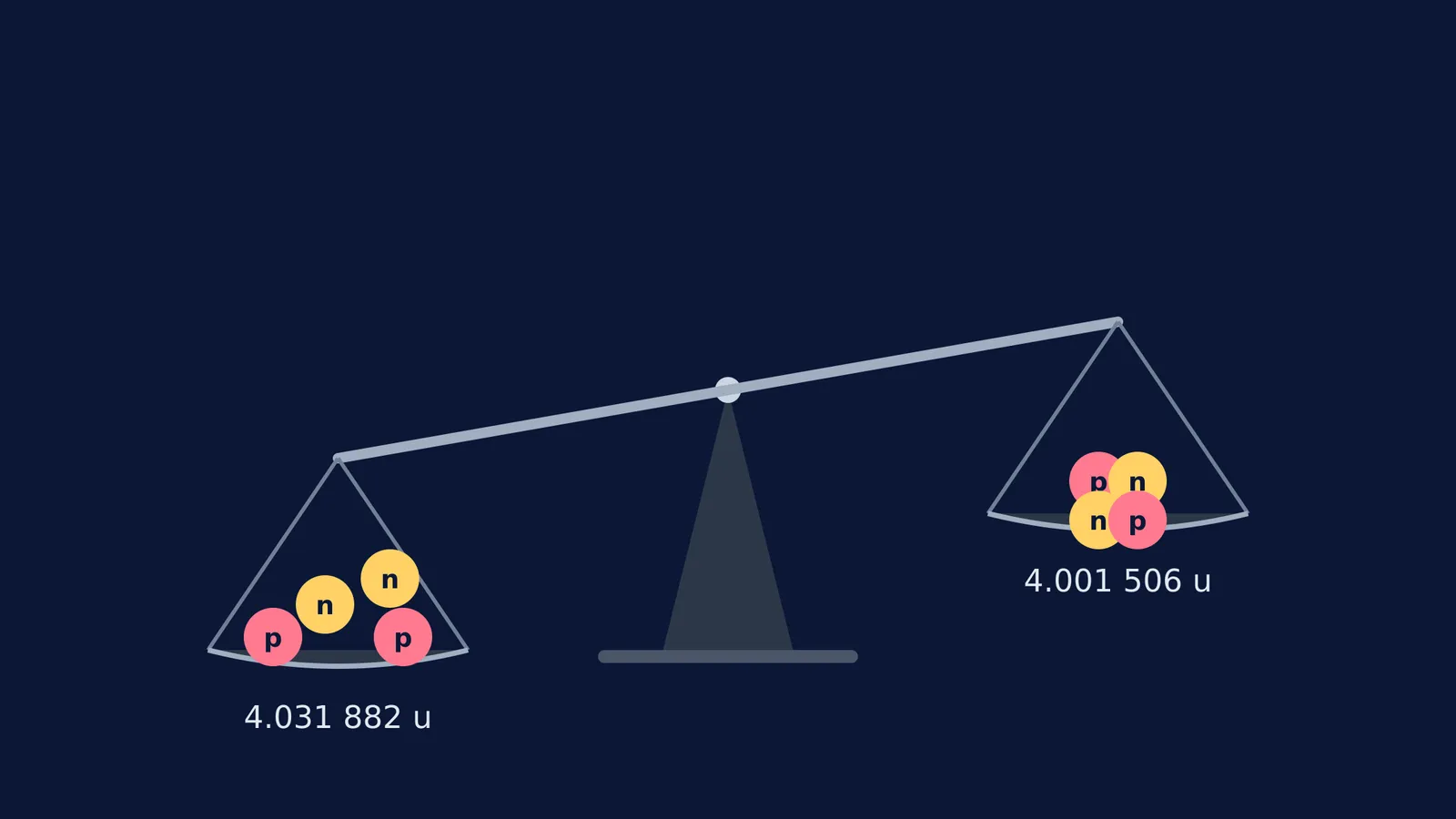
When you calculate the mass of a nucleus, you will find it is always lighter than the sum of its individual protons and neutrons. That missing mass—the mass defect—has been converted into the energy holding the nucleus together. To find out exactly how much energy that is, you need to know how to switch from atomic mass units (amu or u) to megaelectronvolts (MeV).
Here is where the 1 amu equals 931.5 MeV conversion comes from, how to derive it yourself, and how to use it.
What is an atomic mass unit?
The unified atomic mass unit (u) is a standard measure of mass on a nuclear scale. It is defined as exactly one-twelfth of the mass of a single unbound neutral atom of carbon-12 at rest.
According to the 2022 CODATA recommended values from the National Institute of Standards and Technology (NIST), one atomic mass constant (m_u) is 1.660 539 068 92 × 10⁻²⁷ kg.
Because protons, neutrons and nuclei are so small, measuring them in kilograms requires tracking enormous negative exponents. Using atomic mass units makes the numbers manageable: a proton has a mass of about 1.007 u, and a neutron is about 1.008 u.
Where does 931.5 MeV come from?
The conversion factor is not arbitrary; it is a direct result of E = mc². If you have a mass of 1 u, you can calculate its energy equivalent by multiplying it by the square of the speed of light.
To do the derivation, we need two exact constants:
The speed of light in a vacuum (c) is exactly 299,792,458 m/s.
The elementary charge (e), used to convert joules to electronvolts, is exactly 1.602 176 634 × 10⁻¹⁹ C.
First, calculate the energy in joules (J) using E = mc²: E = (1.660 539 × 10⁻²⁷ kg) × (299,792,458 m/s)² E ≈ 1.492 418 × 10⁻¹⁰ J
Next, convert joules to electronvolts (eV). One electronvolt is the energy gained by an electron accelerating through a one-volt potential difference, which equals 1.602 176 × 10⁻¹⁹ J. E in eV = (1.492 418 × 10⁻¹⁰ J) / (1.602 176 634 × 10⁻¹⁹ J/eV) ≈ 931,494,102 eV
Finally, divide by one million to get megaelectronvolts (MeV): E ≈ 931.494 MeV
The official NIST CODATA value for the atomic mass constant energy equivalent is 931.494 103 72 MeV. For most classroom calculations, you can safely round this to 931.5 MeV.
If you are reviewing these constants before an exam and want to ensure you see how they connect across topics, the Fermi Concept Library maps every physics idea so you can follow the links between mass, energy and atomic structure.
How do you use the conversion in a mass defect calculation?
The primary use for the 931.5 MeV factor is finding the binding energy of a nucleus. Here is a step-by-step worked example for an alpha particle (a helium-4 nucleus), which consists of two protons and two neutrons.
Step 1: Find the mass of the parts Using NIST CODATA values, a proton's mass is 1.007 276 u and a neutron's mass is 1.008 665 u. Total nucleon mass = (2 × 1.007 276 u) + (2 × 1.008 665 u) = 4.031 882 u
Step 2: Find the mass of the bound nucleus The measured mass of an intact alpha particle is 4.001 506 u. (Notice this is less than the parts).
Step 3: Calculate the mass defect Subtract the intact mass from the parts mass to find the "missing" mass (Δm). Δm = 4.031 882 u - 4.001 506 u = 0.030 376 u
Step 4: Convert to MeV Multiply the mass defect by the conversion factor to find the total binding energy. 0.030 376 u × 931.5 MeV/u ≈ 28.3 MeV
This means 28.3 MeV of energy was released when this nucleus formed, and you would need to supply exactly that much energy to break the alpha particle back into individual protons and neutrons.
To see these relationships dynamically, you can build an atom and monitor its stability using a build an atom simulation. If you ever get stuck on which unit goes where in a calculation, reviewing how to use dimensions to check your physics answers can prevent costly exam mistakes.


