

On this page
Free simulations such as PhET's Build an Atom let you drag protons, neutrons and electrons into an atom and watch the element, charge and mass number change. According to PhET's Build an Atom teacher guide, the Atom screen shows the element, net charge and mass number, the Symbol screen adds the atomic symbol, and the Game screen has four levels of five challenges. Both building screens have an optional nuclear stability readout. Predict before every click.
What does each particle change in an atom?
Each particle controls one thing, as OpenStax Chemistry 2e, section 2.3 sets out:
Protons decide the element. The number of protons in the nucleus is the atomic number (Z), the defining trait of an element.
Protons plus neutrons give the mass number. The mass number (A) is the total number of protons and neutrons.
Protons minus electrons give the charge. Atomic charge = number of protons − number of electrons.
Electrons barely add mass. A proton has a mass of 1.0073 amu, a neutron 1.0087 amu, and it takes about 1800 electrons to equal the mass of one proton (OpenStax Chemistry 2e).
How do you predict the element, mass number and charge?
Run the same three steps every time you add or remove a particle:
Count protons, find that atomic number on the periodic table, and name the element.
Add protons and neutrons to get the mass number.
Subtract electrons from protons to get the charge.
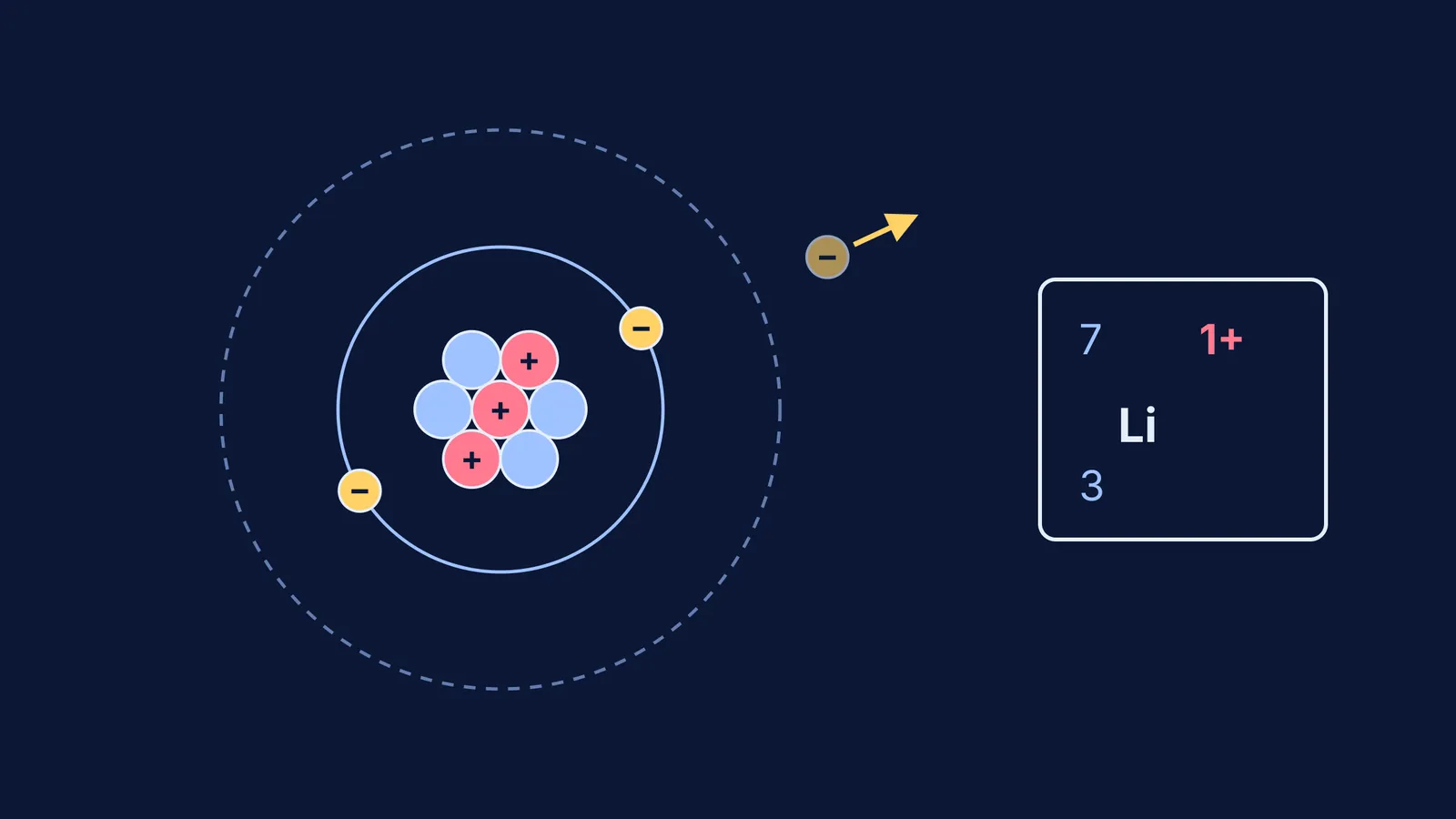
Here is the worked example drawn at the top of this post.
3 protons, 4 neutrons, 3 electrons. Z = 3, so lithium. A = 3 + 4 = 7. Charge = 3 − 3 = 0. A neutral lithium-7 atom.
Remove one electron. Still lithium, still A = 7, but charge = 3 − 2 = +1. You have made the ion Li⁺, written with 7 on top, 3 at the bottom and 1+ at the top right.
Add a proton instead. Z = 4, so the element becomes beryllium. Only this move changes the name.
What makes an isotope and what makes an ion?
An isotope is the same element with a different number of neutrons. OpenStax gives magnesium as an example: it exists as a mixture of three isotopes, each with atomic number 12 and mass numbers 24, 25 and 26. Our post on average atomic mass from isotope abundance shows how those isotopes combine into the mass on the periodic table.
An ion is an atom whose proton and electron counts are not equal, so it carries a charge (OpenStax Chemistry 2e). More electrons than protons gives a negative charge; fewer gives a positive one. Which electrons leave first matters in Class 11, and our guide to electron configuration of ions like Fe³⁺ and Cu⁺ covers that.
Why are some atoms unstable?
Stability is about the nucleus, so adding or removing electrons never changes it. OpenStax Chemistry 2e, section 21.1 describes a narrow band of stability: lighter stable nuclei generally have equal numbers of protons and neutrons, heavier stable nuclei have increasingly more neutrons than protons, and all isotopes of elements with atomic numbers greater than 83 are unstable.
Try carbon. Six protons and six neutrons gives carbon-12, on the equal-numbers line for light nuclei. Add two neutrons and you have carbon-14, which decays by beta emission with a half-life of 5730 years (OpenStax, section 21.3). Beta decay, roughly a neutron turning into a proton, is seen in nuclides with too many neutrons for their protons.
Know the simulation's limits. The PhET guide calls an isotope stable when its half-life is too long to measure, and shows an unstable nucleus vibrating rather than decaying. Shell sizes are not to scale, and you can build ions not found in nature.
A 10-minute predict-then-check routine
The PhET sim has checkboxes for the element name, neutral atom or ion, and nuclear stability (PhET guide).
Untick all three checkboxes and collapse the Periodic Table, Net Charge and Mass Number panels.
For each build below, write the element, mass number, charge and expected stability before opening them again.
Build 6 protons, 6 neutrons, 6 electrons. Add one neutron: same element or not?
Build 8 protons, 8 neutrons, 10 electrons. Predict the charge.
Build 11 protons, 12 neutrons, 10 electrons. Predict A and the charge.
Make one atom you expect to be unstable, and say why.
For every wrong prediction, write which of the three rules you broke. Then play Game levels 2 and 3.
Predicting first gives the simulation a job to do; what PhET research says interactive simulations are good for explains why guided tasks matter. For more ideas that are easier to see than to read, try the Fermi Simulation Lab. If you are stuck on why a prediction failed, Fermi's AI tutor can run the simulation with you and check your understanding as it goes.


