

On this page
The National Testing Agency opened applications for the Joint CSIR-UGC NET December 2026 on 7 October. The form is open until 5 November and the exam is on 19, 22 and 27 December 2026, according to its public notice. If you are doing a BSc or MSc in science and wondering whether research is a real option, this is the exam that decides fellowship eligibility.
What is CSIR NET JRF?
The Joint CSIR-UGC NET is a national test that decides whether Indian nationals are eligible for a Junior Research Fellowship (JRF), appointment as Assistant Professor, or admission to a PhD, according to the December 2026 Information Bulletin. It is held for the Council of Scientific and Industrial Research (CSIR), set up in 1942 and now part of the Ministry of Science and Technology, and the University Grants Commission (UGC).
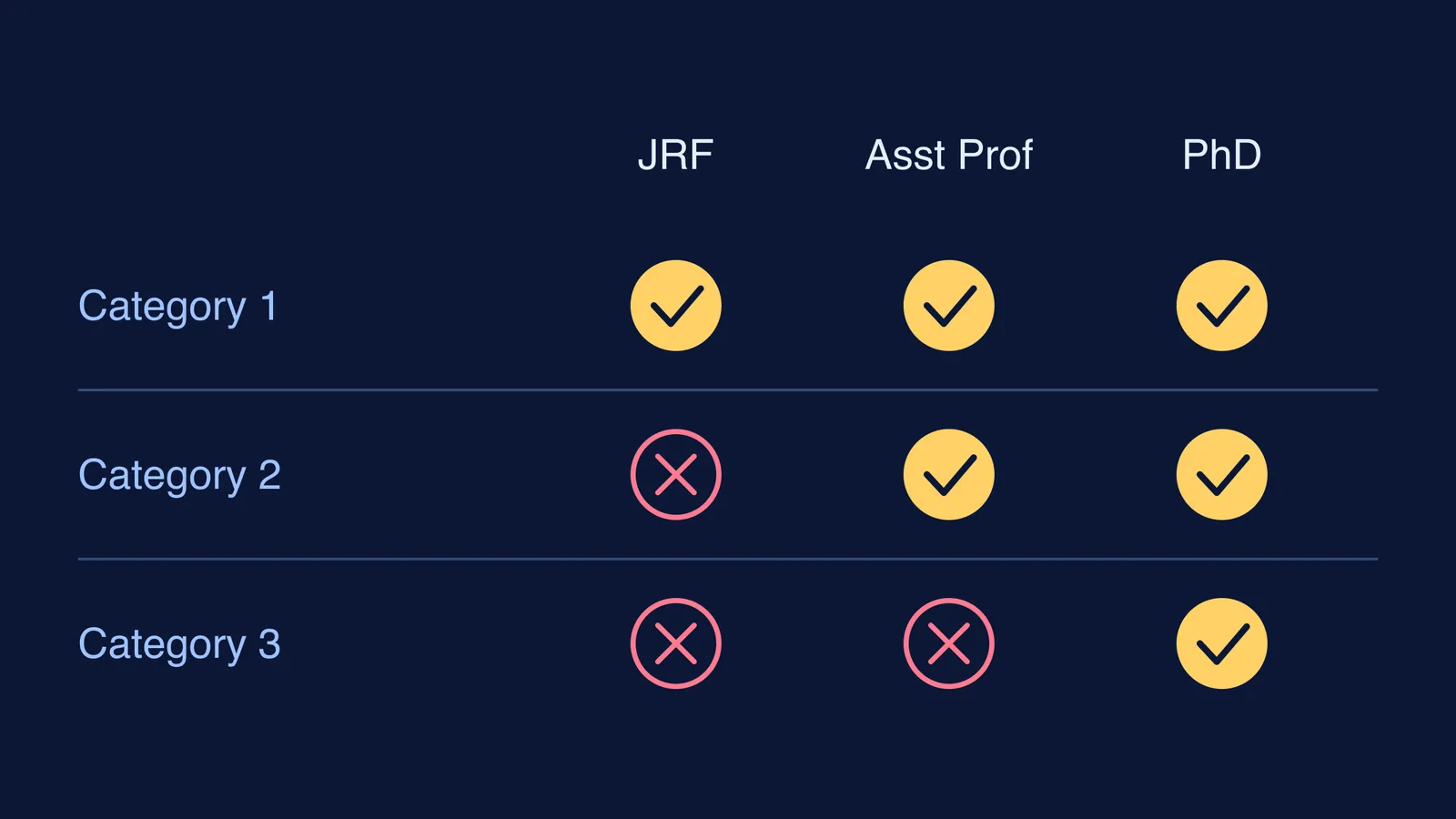
There are five subjects: Chemical Sciences; Earth, Atmospheric, Ocean and Planetary Sciences; Life Sciences and Bio-Technology; Mathematical Sciences; and Physical Sciences. Your result puts you in one of three categories:
Category 1: eligible for JRF, Assistant Professor and PhD admission.
Category 2: eligible for Assistant Professor and PhD admission, not JRF.
Category 3: eligible for PhD admission only.
Who can take CSIR NET?
The bulletin sets these rules for December 2026:
A master's degree with at least 55% marks, or 50% for OBC-NCL, SC, ST, PwD/PwBD and third gender candidates.
Final-year master's students can apply provisionally, but must pass with the required marks within two years of the result (one year if you qualify for PhD admission only).
Four-year bachelor's graduates need at least 75% in aggregate. They can qualify for JRF and PhD admission, but not Assistant Professor.
For JRF, you must be no older than 30 on 1 December 2026, with up to five years' relaxation for OBC-NCL, SC, ST, PwD/PwBD, third gender candidates and women. Assistant Professor and PhD-only have no upper age limit.
The fee is ₹1,150 for General candidates, ₹600 for General-EWS and OBC-NCL, and ₹325 for SC, ST, PwD/PwBD and third gender candidates.
How does CSIR NET link to fellowships?
A JRF selected through CSIR NET receives ₹37,000 a month for the first two years, plus a contingency grant of ₹20,000 a year, according to the bulletin. If you are registered for a PhD and an expert committee approves your progress, it becomes a Senior Research Fellowship (SRF) at ₹42,000 a month from the third year.
JRF holders are admitted to a PhD through an interview under the UGC's 2022 PhD regulations.
The fellowship can be held at universities, IITs, CSIR labs and other recognised institutions in India. It has a fixed tenure and does not guarantee a job afterwards.
In Life Sciences, the Department of Biotechnology also awards DBT-JRF fellowships through this exam.
For Category 2 and 3, NET marks carry 70% weight in PhD admission (the interview 30%) and stay valid for one year.
The number of fellowships in each subject is limited and varies from cycle to cycle, and a results committee decides how many candidates qualify.
What does the CSIR NET paper look like?
It is a 180-minute computer-based test of multiple-choice questions in three parts (bulletin). Part A is general aptitude, common to all subjects. Part B covers subject topics. Part C asks higher-order questions where you apply concepts to a problem. The bulletin lists the subject syllabus as Annexure II.
Worked example: guessing in Physical Sciences
The Physical Sciences paper has 75 questions, of which you answer at most 55, for 200 marks. A right answer earns 2, 3.5 or 5 marks in Parts A, B and C; a wrong one loses a quarter of that (bulletin). Only your first 15, 20 and 20 answers per part are marked.
Take a Part C question with four options:
Pure guess: a 1 in 4 chance of +5 and 3 in 4 of −1.25 averages about +0.31 marks.
Two options ruled out: half +5, half −1.25 averages about +1.9 marks.
One option you can defend: +5.
Every option you can rule out with a reason is worth marks, and that comes from knowing why wrong answers are wrong. The Fermi Problem Library has worked problems with a step-by-step solver that explains the reasoning rather than printing an answer. In Mathematical Sciences, Part C has no negative marking, but you score only by picking every correct option.
A plan for BSc and MSc students
Track your marks now: eligibility depends on them.
If you want an MSc first, read our guide to IIT JAM for BSc students.
In your final MSc year, apply provisionally and practise Part A, which is the same in every subject.
Fix weak syllabus units before mocks. The Fermi Concept Library covers every concept in physics, chemistry, biology, mathematics and computing, each with its own lesson.
Before accepting a fellowship, read about a research career and PhD in India and how to choose a PhD supervisor.
Applications for December 2026 close on 5 November; the official notice has every date.


