

On this page
What is the IIT JAM exam?
IIT JAM is a computer-based entrance test held once a year for admission to postgraduate science programmes at the Indian Institutes of Technology (IITs), the Indian Institute of Science (IISc), and other top institutions. The exam is conducted by one of the IITs on a rotational basis; for instance, IIT Delhi organized the 2025 edition.
The test spans three hours and consists of 60 questions worth 100 marks. The paper is divided into three sections: multiple choice questions (MCQ), multiple select questions (MSQ), and numerical answer type (NAT) questions. Section A contains 30 MCQs and carries negative marking for incorrect answers, which means wild guessing can heavily penalize your final score. Section B includes 10 MSQs where one or more options can be correct, and you only score points if you select all the correct answers without picking any wrong ones. Section C contains 20 NAT questions that do not carry negative marks, but they require you to compute the exact numerical answer using a virtual calculator, testing your precision and calculation skills under pressure.
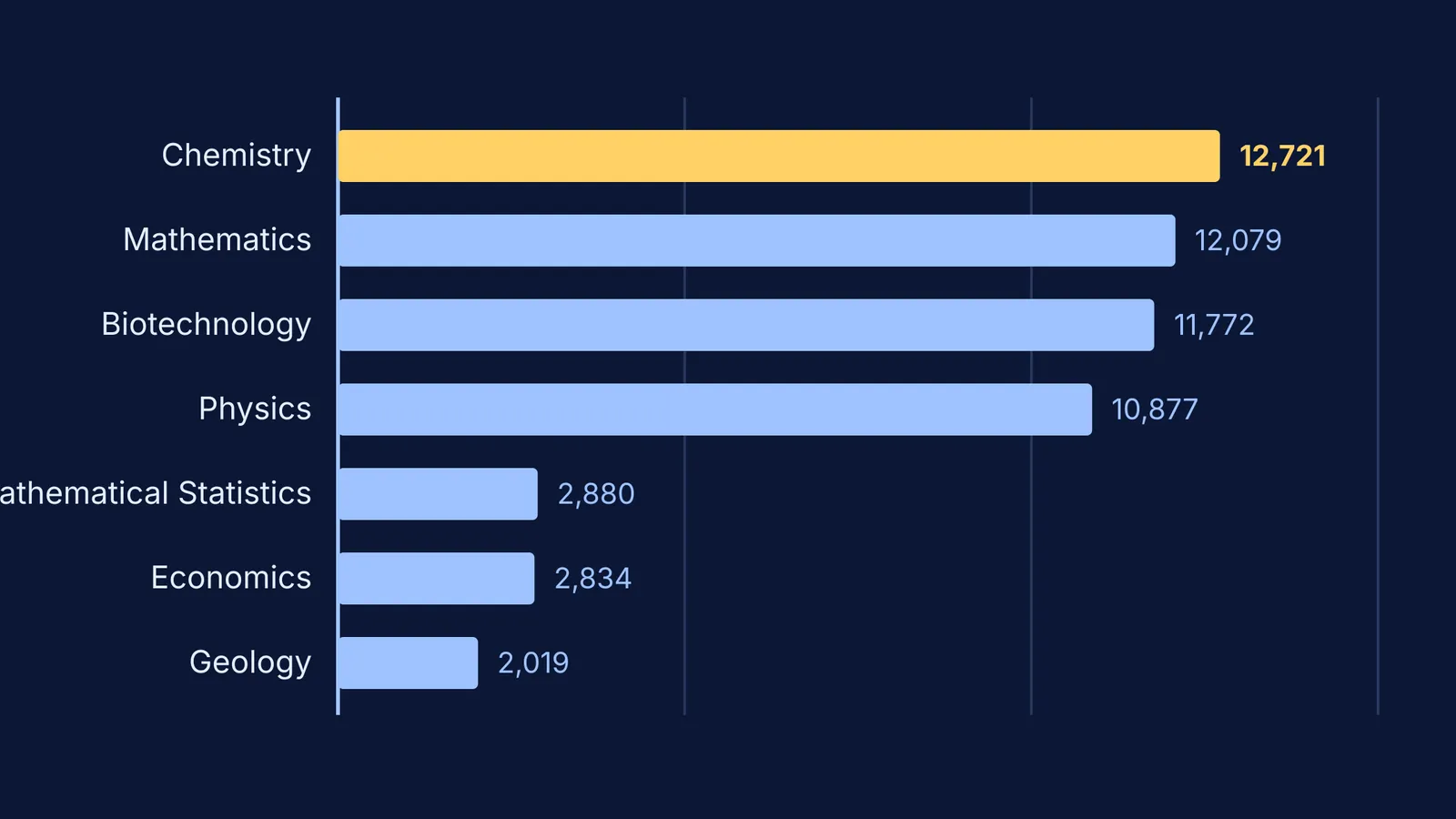
You choose one or two of the seven available subjects: Biotechnology, Chemistry, Economics, Geology, Mathematics, Mathematical Statistics, and Physics. According to the official IIT Delhi statistical report, 55,182 candidates appeared for the exam in 2025. Chemistry was the most popular subject with 12,721 test-takers, closely followed by Mathematics and Biotechnology.
What degrees can you get through IIT JAM?
Clearing IIT JAM opens the door to research and academic careers in pure and applied sciences. The scores are used for admission to several rigorous postgraduate tracks across the country:
Two-year Master of Science (M.Sc.) programmes at various IITs and National Institutes of Technology (NITs). These are foundational for students heading into industry roles, standard teaching paths, or preparing for exams like the CSIR NET.
Joint M.Sc.-Ph.D. and M.Sc.-Ph.D. Dual Degree programmes. These tracks are designed to seamlessly transition a student from master's coursework directly into a doctoral thesis, saving time for those certain about pursuing deep research in academia or specialized laboratories.
Integrated Ph.D. programmes at IISc Bangalore and the Indian Institutes of Science Education and Research (IISERs), which are heavily research-focused from the very first semester and involve extensive laboratory rotations.
These degrees are designed for students who want to build careers in scientific research, advanced teaching, or specialized technical industries such as pharmaceuticals and data science. The admission process for NITs and IIEST Shibpur happens through a centralized counselling system known as CCMN.
Who is eligible to take the test?
If you are a science graduate or are currently completing your degree, you are eligible to sit for the exam. You must hold a Bachelor's degree (such as a B.Sc., B.S., B.Tech, or B.E.) to apply. Engineering graduates frequently take the physics or mathematics papers to shift their career trajectory toward fundamental research.
Students in the final year of their undergraduate programme are fully eligible to take the test. There is no age restriction for candidates, and you can attempt the exam as many times as you like. While there is no strict minimum percentage required simply to appear for the entrance test, individual admitting institutes usually demand at least 55% aggregate marks (or a 5.5/10 CGPA) in the qualifying degree for general category students, and 50% for reserved categories, before they grant final admission.
What does the syllabus look like?
The IIT JAM syllabus maps closely to the standard undergraduate curriculum taught across Indian universities, but the questions demand a much deeper conceptual clarity. For instance, the physics paper goes far beyond basic formulas, requiring you to set up complex integrals and understand boundary conditions in electromagnetism. The chemistry paper demands a strong grasp of reaction mechanisms and stereochemistry, rather than rote memorization of named reactions.
Because the exam tests your ability to apply concepts to unseen problems, relying solely on your college semester notes is rarely enough. You will need to engage in active learning and solve problems from standard textbooks.
How should you plan your study time?
Because the syllabus covers three years of undergraduate coursework, cramming at the last minute rarely works. A successful preparation phase usually lasts between six and nine months, allowing time to understand the theory deeply and practice numerical problems.
Months 1 to 3: Review the syllabus and gather standard university textbooks. Focus entirely on clearing your fundamental concepts rather than solving previous papers.
Months 4 to 6: Begin practicing numerical answer type (NAT) questions and multiple select questions. Decide early on between coaching or self-study so you have a steady structure.
Months 7 to 9: Take full-length timed mock tests. Analyse your mistakes to find exactly which topics are costing you marks.
Building a consistent habit is more important than studying for ten hours a day. Whether you prefer morning or night study, try to block out the same hours each week to figure out how to build a study routine that lasts.
If you are revising undergraduate physics or chemistry, Fermi's AI tutor can work out what you already know and build a plan for the session. When you get stuck on a difficult question, the Fermi Problem Library provides worked problems with a step-by-step solver that explains the reasoning rather than simply printing an answer.


