On this page
Choosing a doctoral supervisor is the single most consequential decision of an academic career. While applicants frequently fixate on institutional rankings or glamorous research topics, empirical evidence reveals that your direct mentor shapes whether you complete your degree, how quickly you graduate, and how your wellbeing fares along the way. A systematic review of 163 empirical articles by Anna Sverdlik and colleagues in the International Journal of Doctoral Studies identified supervisory support as the single most critical external factor governing doctoral completion, time-to-degree, and researcher wellbeing.
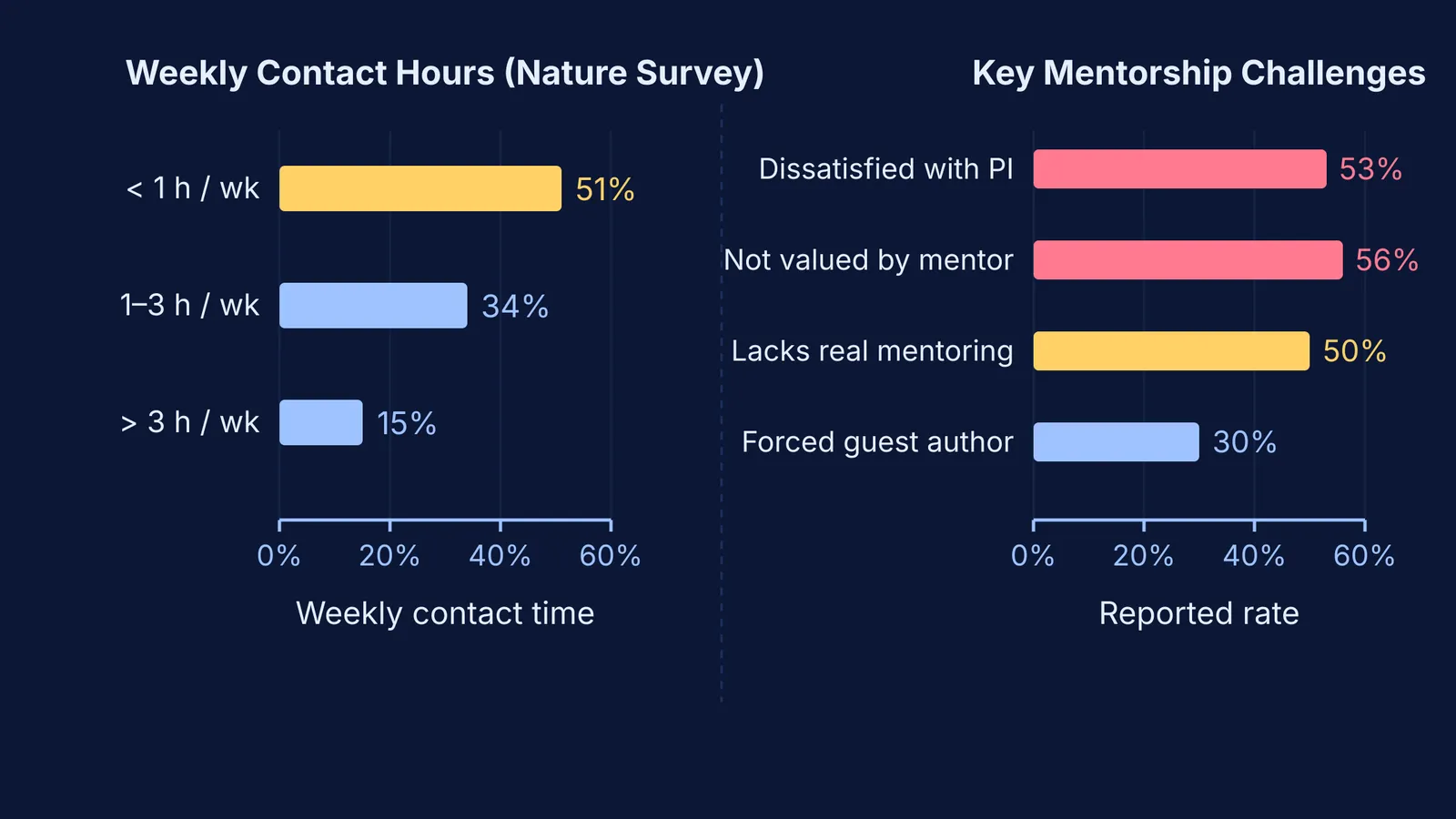
When mentorship falters, doctoral progress quickly derails. In a landmark global survey of over 6,300 graduate researchers published in Nature, Chris Woolston found that 53% of dissatisfied doctoral students cited their relationship with their supervisor as a primary source of dissatisfaction. Furthermore, 51% of respondents reported receiving less than one hour of one-on-one contact with their principal investigator each week.
Why does supervisor choice matter more than project prestige?
The psychological impact of graduate advising is profound. A cross-sectional study of 2,279 graduate students across 26 countries published in Nature Biotechnology by Teresa M. Evans and colleagues revealed that 41% of respondents experienced moderate to severe anxiety, while 39% struggled with moderate to severe depression. Crucially, approximately 50% of students facing anxiety or depression disagreed that their advisor provided genuine mentorship, and 56% did not feel valued by their mentor.
Whether you are preparing for industrial research or mapping out research careers and fellowships in India, selecting an advisor who provides structured guidance, respects your intellectual independence, and maintains active project funding matters vastly more than the prestige of a famous name.
How do you read a prospective supervisor's papers?
Before contacting a potential advisor, examine the research group's publication record over the past three to five years. In experimental and computational sciences, authorship placement follows clear conventions: the first author is typically the student or postdoctoral fellow who performed the experiments, analyzed data, and drafted the manuscript, whereas the principal investigator (PI) sits in the final, senior corresponding position.
Check whether doctoral scholars regularly occupy the first-author slot on primary research papers. In a study of 1,336 doctoral researchers published in PLOS ONE, Mads Paludan Goddiksen and colleagues found that roughly 30% of doctoral candidates had granted guest authorship to a person in power, with half reporting they did so because a senior figure explicitly instructed them to. If a laboratory head frequently claims first authorship on student-driven benchwork, it suggests potential credit hoarding.
When reviewing recent lab publications, verify three specific points:
First-author attribution: Check papers from the past 36 months to ensure graduate students consistently lead primary research publications.
Publication cadence: Ensure the lab publishes original papers steadily every one to two years, rather than enduring multi-year droughts that delay thesis submissions.
Technical transparency: Confirm that the lab shares detailed datasets, reproducible experimental protocols, and open-source computational code.
Vetting a prospective laboratory's papers also requires evaluating whether their theoretical foundations and problem formulations are sound. The Fermi Concept Library offers lessons on core ideas across physics, chemistry, biology, mathematics, and computing, helping prospective students review fundamental principles and assess whether a laboratory's technical claims rest on solid scientific ground.
What questions should you ask current students and alumni?
Current students and lab alumni provide your clearest view of day-to-day realities. Because junior scholars may feel constrained when speaking inside department offices, arrange a private 15-minute phone or video conversation. Former lab members who have already defended their dissertations can offer especially candid perspectives on graduation timelines and recommendation letters.
When emailing current scholars, introduce your academic background, mention a specific recent paper from their group, and request a brief conversation to learn about day-to-day mentoring and lab expectations.
During your conversation, ask targeted, operational questions:
How often do you meet one-on-one with the professor, and do scheduled meetings happen consistently?
How does the professor handle failed experiments, rejected manuscripts, or project dead-ends?
What is the average time-to-degree for doctoral scholars in this laboratory?
Does the professor support students who target careers in industry or policy, or is there an exclusive preference for academic postdocs?
What are the unwritten expectations around weekend hours, holiday leave, and after-hours communication?
Connecting earlier undergraduate experiences such as writing structured academic project reports to full doctoral research will help you assess whether a supervisor provides structured, actionable feedback on written drafts.
How can you evaluate lab culture and working expectations?
A healthy laboratory strikes a sustainable balance between intellectual autonomy and active support. Some supervisors adopt an extreme hands-off style that leaves early-stage students stranded, while others micromanage bench protocols to the point of stifling initiative. Observe group seminars whenever possible: do students share preliminary, negative, or imperfect results openly, or does the meeting resemble a hostile cross-examination?
Examine student retention and career destinations on the lab roster. A flourishing research group prominently displays where past members have landed across universities, government laboratories, and industry. A pattern of scholars quitting midway or taking over six years to submit their thesis warrants scrutiny. For students entering through direct integrated PhD programs after a bachelor's degree, institutional oversight committees review progress every six months, but formal review panels cannot replace day-to-day supervisory warmth.
Balancing graduate coursework and qualifying examinations alongside initial laboratory rotations requires rigorous analytical problem-solving habits. The Fermi Problem Library provides worked problems with a step-by-step solver that explains the reasoning rather than printing an answer, allowing students to strengthen their foundational problem-solving methods before embarking on independent thesis research.