

On this page
The path to a doctoral degree in science has shifted. Rather than treating a bachelor's, master's and PhD as three isolated steps, Indian institutes now offer direct pipelines into research.
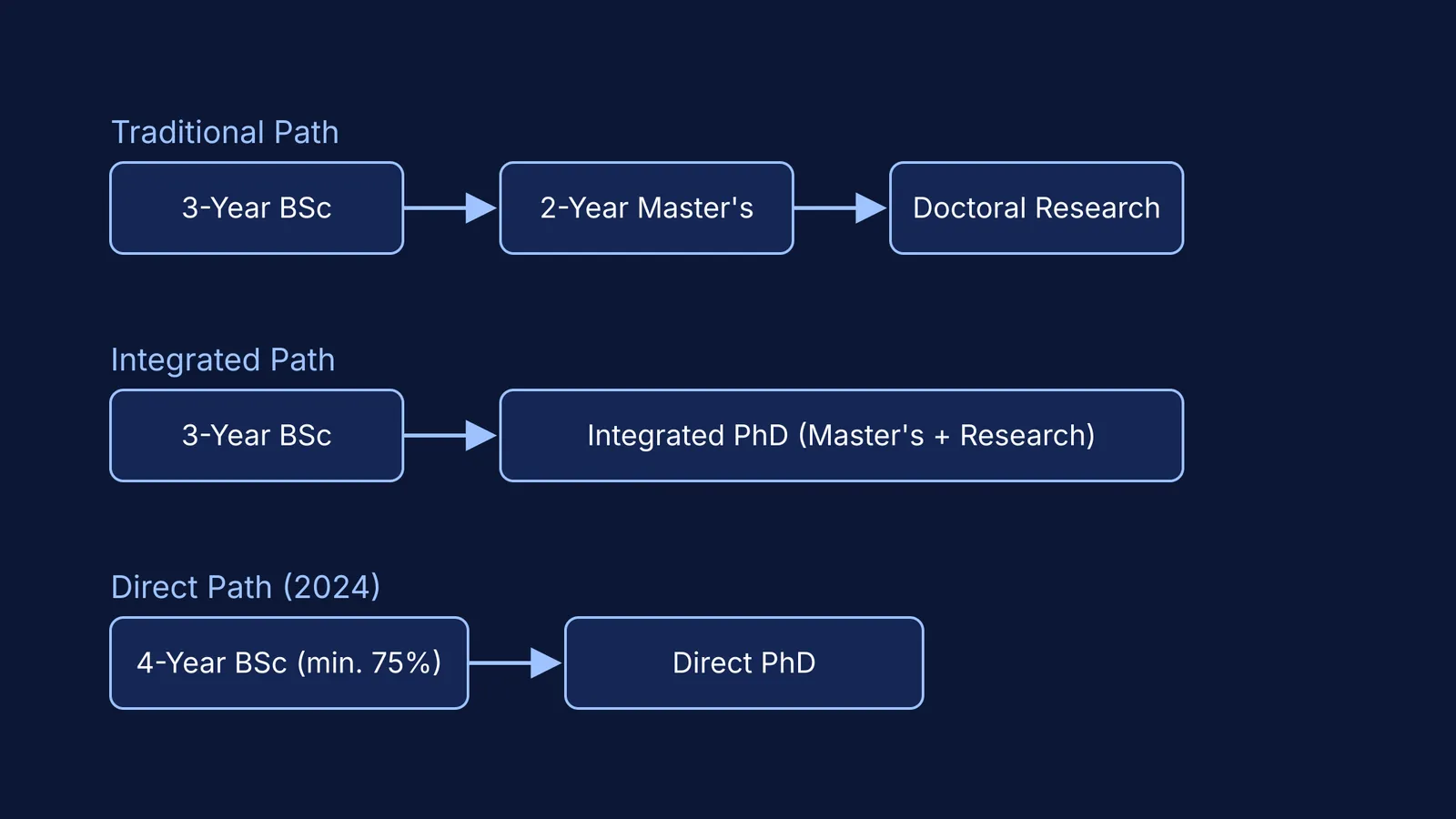
For science students finishing their undergraduate studies, the options boil down to two fast-track routes: the Integrated PhD for three-year BSc graduates, and the new Direct PhD for four-year degree holders. Both routes save time, guarantee financial support earlier, and push you into a lab sooner.
What is an Integrated PhD?
An Integrated PhD (I-PhD) combines a master's-level coursework phase of two years and a doctoral research project into one continuous programme. They are offered by India's premier science institutes, including the Indian Institute of Science (IISc), the Indian Institutes of Science Education and Research (IISERs) and the Tata Institute of Fundamental Research (TIFR).
This early phase mimics a rigorous master's course, heavily weighted towards coursework and lab rotations. After passing a comprehensive examination, students upgrade to full PhD status.
This route saves you the friction of applying for a separate PhD halfway through your master's. If you discover research is not for you, most institutes offer an exit option, allowing you to leave with an MS degree after three years (including one year of thesis research).
Can you do a Direct PhD after a BSc?
In April 2024, the University Grants Commission (UGC) opened a new shortcut. Under the revised guidelines, students with a four-year (eight-semester) bachelor's degree can skip the master's phase entirely and enter a PhD directly.
To qualify for this Direct PhD route, you must secure a minimum of 75% marks in aggregate (or a 7.5 CGPA) in your undergraduate degree. A 5% relaxation is given to candidates from reserved categories. Crucially, the 2024 rules also allow these four-year degree holders to sit for the National Eligibility Test (UGC NET) in any subject they wish to research, irrespective of their undergraduate major.
How much is the fellowship stipend?
One of the biggest draws of an integrated or direct research path is early financial independence.
During the master's phase of an Integrated PhD, institutes pay a monthly starting stipend. Once you clear the coursework and register as a doctoral candidate, your funding jumps to the standard Junior Research Fellowship (JRF) rate. Following recent government revisions, the JRF pays ₹37,000 per month plus House Rent Allowance (HRA). After two years of research, this upgrades to a Senior Research Fellowship (SRF) at ₹42,000 per month.
If you want to look into other fields of study and the careers they lead to, read our guide on talking about STEM careers beyond engineering and medicine.
How do you prepare for the entrance exams?
Admission into these programmes is fiercely competitive. You will need to clear a national entrance test followed by a technical interview.
IIT-JAM (Joint Admission Test for MSc): The primary gateway for physics, chemistry, mathematics and biotechnology at IITs, IISc and IISERs.
JEST (Joint Entrance Screening Test): Used heavily by research institutes like TIFR and the Raman Research Institute, mainly for physics and theoretical computer science.
UGC NET: The new standard for four-year bachelor's graduates aiming for a Direct PhD in universities across India.
Because these exams test conceptual depth rather than formula memorisation, standard textbook reading is rarely enough. Working through past papers is essential, but only if you understand where your reasoning went wrong. The Fermi Problem Library has worked problems with a step-by-step solver that explains the reasoning rather than printing an answer, helping you fix the gaps in your approach before the exam.
If you are reviewing fundamental ideas for the JAM or JEST interviews, the Fermi Concept Library maps every concept in physics, chemistry, biology, mathematics and computing, each with its own lesson and its place in the map.
Who should consider an Integrated PhD?
Committing to a PhD at a young age is a large decision. These programmes are built for students who are already certain they want a career in academic research or industrial R&D.
If you are unsure whether you want to spend several years in a lab, a traditional MSc might be a safer bet. It allows you to pause and re-evaluate before applying for a PhD. But if you have clear research interests and want to access top-tier faculty and funding immediately, the integrated and direct pathways offer the fastest road to a scientific career.
You can further reduce the financial strain of studying by exploring Scholarships for science students in India: where to look.


