

On this page
Writing a college project report can feel overwhelming, but breaking it down into a standard structure makes the task straightforward. Most scientific and engineering reports use a framework that guides the reader from your initial question to your final conclusion.
How do you structure a project report?
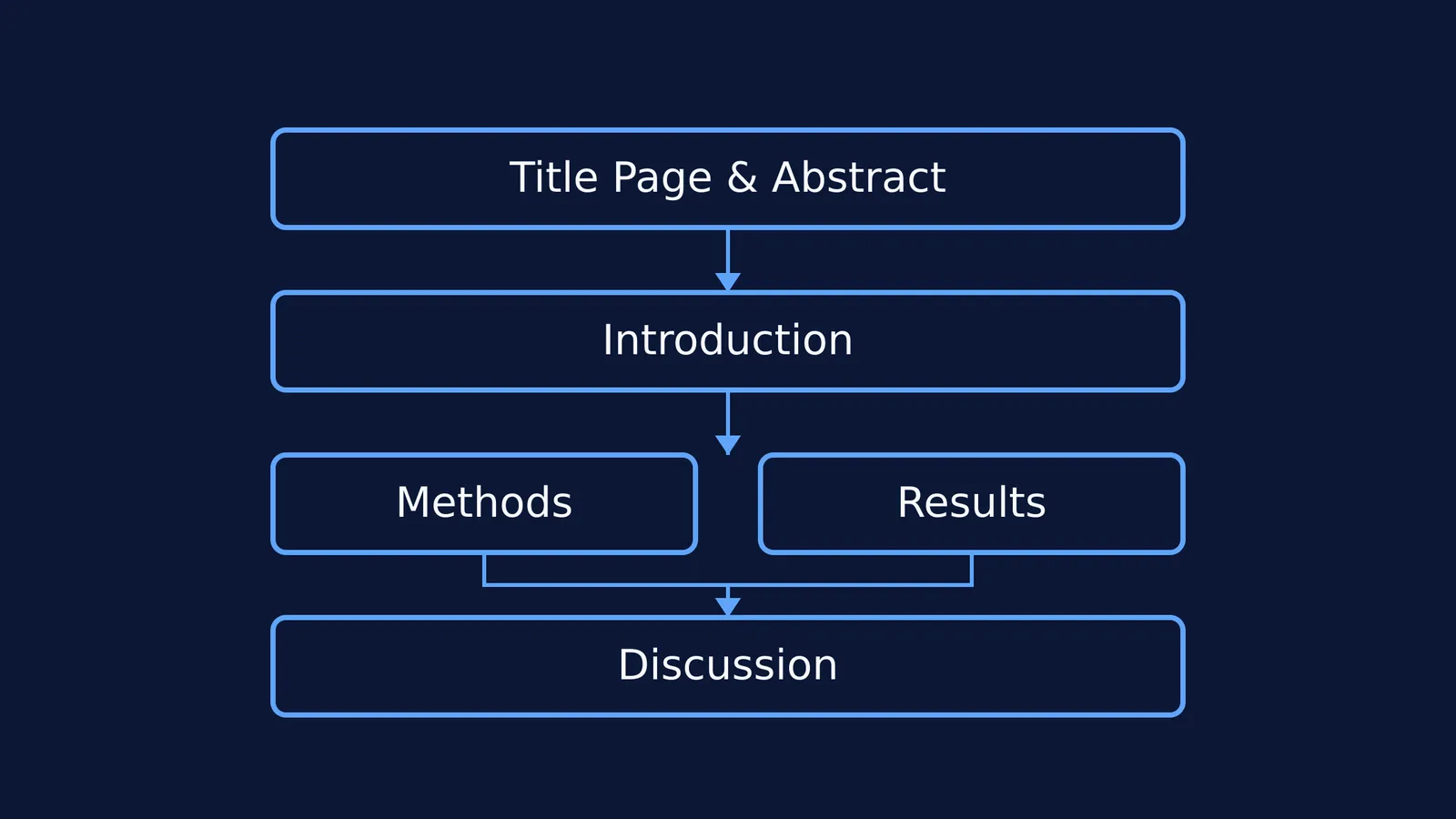
A standard project report typically follows the IMRaD framework—Introduction, Methods, Results, and Discussion. While your specific university might add a literature review or a separate conclusion chapter, the core flow remains the same:
Title Page and Abstract: The front matter that tells the reader what the report is about.
Introduction: Sets the background and states your problem or research question.
Methodology: Explains exactly what you did, in enough detail that someone else could replicate it.
Results: Presents your findings using text, tables, and graphs, without interpreting them.
Discussion and Conclusion: Explains what your results mean, why they matter, and what should happen next.
References and Appendices: Lists the sources you cited and includes raw data or extra code.
When you need to review background theory for your introduction, the Fermi Concept Library contains every concept in physics, chemistry, biology, mathematics and computing, each with its own lesson and its place in the map.
How long should an abstract be?
An abstract is a single paragraph of no more than 250 words (Purdue OWL). You should write it last.
Because it serves as a standalone summary, your abstract must include the problem, your method, the key results, and the main conclusion. Keeping it under the word limit forces you to strip away background filler and focus entirely on what your project achieved. If a sentence does not state a concrete fact or finding about your own work, remove it.
How do you write the methodology and results?
The methodology section is a recipe. Write it in the past tense and be precise about the equipment, software, and procedures you used. If you built a circuit, list the exact components. If you ran a simulation, specify the initial conditions.
Your results section should be purely factual. Use tables and figures to make complex data readable, and always include a clear caption for every visual. Remember that neatness matters; for example, neat working and layout can cut errors significantly when presenting mathematical steps in your appendices. Do not explain *why* the results happened here—save your interpretation for the discussion chapter.
How do you discuss your findings?
The discussion is where you interpret your results. Did the experiment behave as you expected? If not, why? This is the section where you compare your data against the theory you introduced earlier.
Be honest about the limitations of your project. If a sensor failed or a sample was contaminated, state it clearly and explain how it affected the final data. Academic writing values transparency over perfect but fabricated results.
How can you avoid plagiarism in your report?
Plagiarism is a common issue, often caused by poor note-taking or last-minute rushing.
To keep your work original and properly cited, use this drafting checklist:
Take notes in your own words: When reading sources, close the book or tab before writing your summary. This prevents accidental copy-pasting.
Track your sources immediately: Write down the author, title, and link the moment you decide to use a fact. Do not rely on AI tools to find your sources later, as AI can make up references.
Quote properly: If you must use someone else's exact words, put them in quotation marks and cite the page number.
Understand the material: You cannot explain something in your own words if you do not understand it. If your project involves complex physics or maths calculations, the Fermi Problem Library has worked problems with a step-by-step solver that explains the reasoning rather than printing an answer, helping you grasp the core ideas before you start writing.
By sticking to a standard structure and tracking your sources from day one, writing a project report becomes an exercise in clear communication rather than a chaotic scramble.


