

On this page
When India's first research reactor, Apsara, went critical in August 1956, a 26-year-old mechanical engineer named Malur Ramasamy Srinivasan was on the team that built it. He went on to help build India's fleet of power reactors, most of them pressurised heavy water reactors (PHWRs). He died on 20 May 2025, aged 95, according to the Department of Atomic Energy.
Who was M. R. Srinivasan?
Srinivasan earned a bachelor's degree in mechanical engineering from University Visvesvaraya College of Engineering in 1950, then a master's and a PhD in gas turbine technology at McGill University in Montreal, according to his biography.
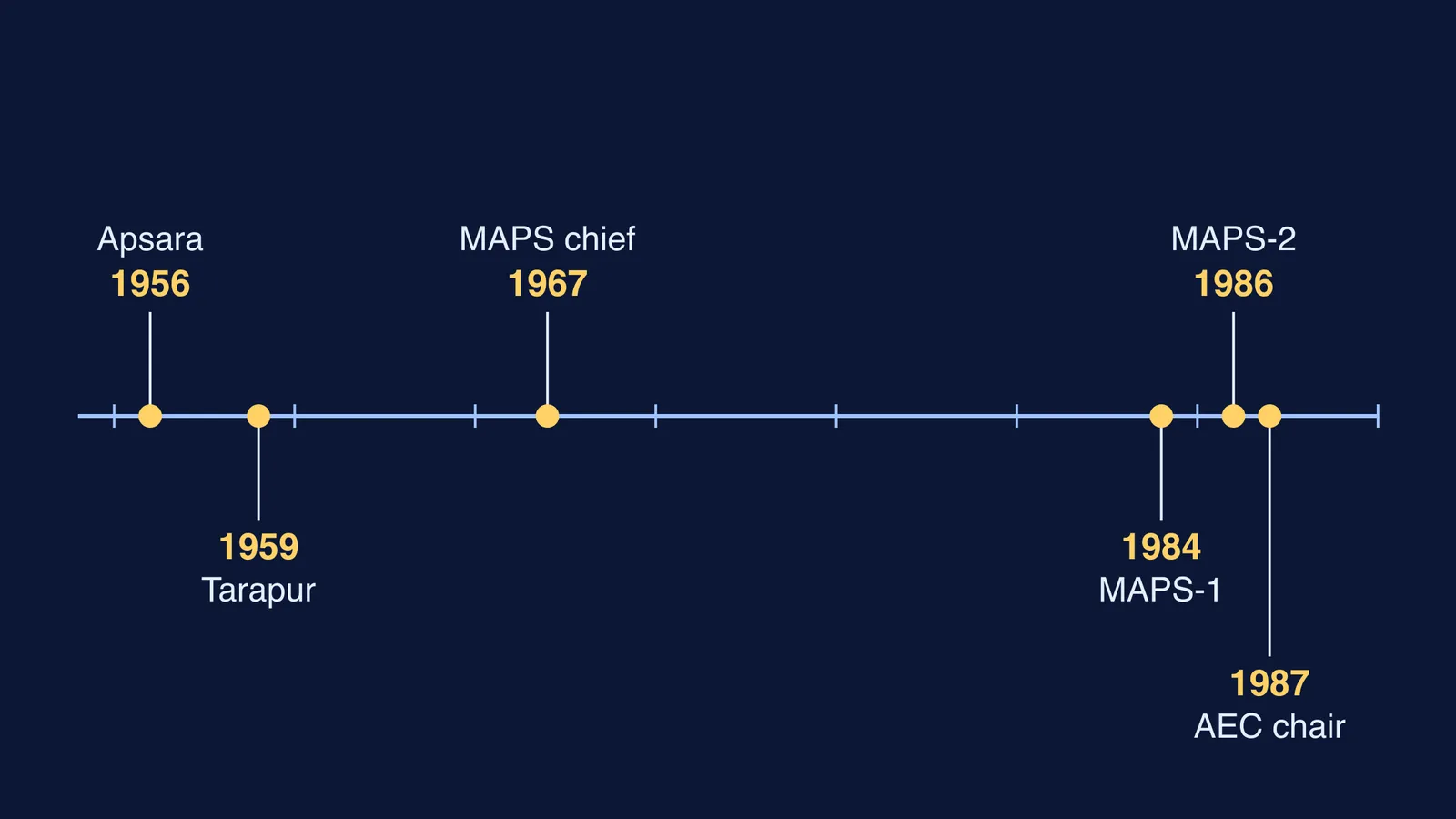
He joined the Department of Atomic Energy (DAE) in September 1955 and worked closely with Homi Bhabha on building Apsara, which reached criticality in August 1956, says the DAE obituary. The same notice traces his climb:
1959: Principal Project Engineer for India's first atomic power station
1967: Chief Project Engineer, Madras Atomic Power Station
1974: Director, Power Projects Engineering Division
1984: Chairman, Nuclear Power Board
1987: Chairman of the Atomic Energy Commission, Secretary of DAE, and founder-chairman of the Nuclear Power Corporation of India (NPCIL)
That first power station was Tarapur, and the Indian National Academy of Engineering obituary credits him with a key role in building it. He received the Padma Shri in 1984, the Padma Bhushan in 1990 and the Padma Vibhushan in 2015.
For the physics done at Apsara, read our profile of P. K. Iyengar and neutron physics at Apsara.
Why did India choose pressurised heavy water reactors?
A pressurised heavy water reactor is a nuclear reactor that uses heavy water (deuterium oxide, D2O) as both its coolant and its neutron moderator, as this overview of PHWRs explains. Heavy water absorbs very few neutrons, so the chain reaction can keep going on natural uranium, with no enrichment plant needed.
That matters because natural uranium contains only about 0.7% uranium-235, the isotope that splits easily, according to the World Nuclear Association.
The World Nuclear Association's India profile gives the reasoning: the PHWR "required less natural uranium than the BWRs, needed no enrichment, and could be built with the country's engineering capacity at that time – pressure tubes rather than a heavy pressure vessel being involved." The first Indian PHWR, Rajasthan 1, was built with Atomic Energy of Canada, started up in 1972, and the later Indian designs grew out of it.
How did the Madras plant change India's nuclear power?
The Madras Atomic Power Station (MAPS) at Kalpakkam has two PHWR units of 220 MWe each, per NPCIL's list of plants. Unit 1 began commercial operation on 27 January 1984 and Unit 2 on 21 March 1986.
MAPS-1 was the country's first indigenously built nuclear power reactor, reported IANS. The INAE obituary says Srinivasan's contribution to refining and adapting PHWRs "went on to become the backbone of nuclear power in India", and that he oversaw units at Kalpakkam, Rawatbhata, Kaiga, Kakrapar and Narora. Under his leadership, India saw 18 nuclear power reactors developed, the DAE notes.
The backbone claim holds today: 20 of the 24 units on NPCIL's list are PHWRs.
How much uranium does a 220 MW reactor split each day?
Assume each uranium-235 fission releases about 200 MeV, the typical value given in this summary of nuclear fission, and that the reactor produces 220 MW of heat.
Energy per fission: 200 MeV × 1.602 × 10^-13 J/MeV = 3.20 × 10^-11 J.
Fissions per second: 2.20 × 10^8 J/s ÷ 3.20 × 10^-11 J = 6.87 × 10^18.
Fissions per day: 6.87 × 10^18 × 86,400 s = 5.93 × 10^23.
Moles: 5.93 × 10^23 ÷ 6.022 × 10^23 = 0.985 mol.
Mass: 0.985 mol × 235 g/mol = about 231 g of uranium-235 per day.
At about 0.7% uranium-235, that is the amount in roughly 33 kg of natural uranium. MAPS units are rated 220 MW of electricity on NPCIL's list, so its reactors make more heat and split more atoms; treat this as an illustration, not plant data. More in how much uranium a reactor uses per day.
If a step like the MeV-to-joule conversion trips you up, the Fermi Problem Library has worked problems with a step-by-step solver that explains the reasoning rather than printing an answer.
What can students take from Srinivasan's career?
Engineering is physics plus constraints. Before you memorise "PHWR uses natural uranium", ask what India lacked in the 1960s and what this design avoided.
Write every trade-off as a pair. What does a choice cost, and what does it save? Enrichment versus heavy water is a model answer.
Follow the next stage. PHWRs were step one; read about Anil Kakodkar's thorium reactor design to see where the plan leads.
To revise moderators, chain reactions and binding energy from the ground up, the Fermi Concept Library gives each concept its own lesson and its place in the map.


