

On this page
India holds an estimated 846,000 tonnes of thorium in its coastal monazite sands, representing the world's largest known deposit, according to the World Nuclear Association's thorium report. Yet commercial power stations could not run directly on this natural reserve because natural thorium consists of Thorium-232, which is fertile rather than fissile.
To transform this dormant resource into electricity, nuclear engineer Anil Kakodkar developed the Advanced Heavy Water Reactor (AHWR) at BARC, combining thermal neutron breeding with passive cooling.
Why can't nuclear reactors burn Thorium-232 directly?
In nuclear physics, heavy nuclei fission when absorbing a neutron, releasing roughly 200 MeV of energy, as outlined in the World Nuclear Association's thorium report. However, thermal fission depends on nucleon pairing.
Thorium-232 is an even-even nucleus (90 protons, 142 neutrons). Absorbing a thermal neutron (0.025 eV) adds 4.8 MeV of binding energy, falling 1.7 MeV short of its 6.5 MeV fission barrier. Thorium-232 is therefore fertile, requiring fast neutrons above 1 MeV to split.
To generate power, Thorium-232 must capture a neutron and undergo two beta decays into fissile Uranium-233. In 1954, Dr. Homi J. Bhabha established India's Three-Stage Nuclear Power Programme, detailed in the World Nuclear Association's country profile on India:
Stage 1: Pressurised Heavy Water Reactors produce power and Plutonium-239 from natural uranium.
Stage 2: Fast Breeder Reactors burn plutonium and breed Uranium-233 in thorium blankets.
Stage 3: Advanced reactors burn Uranium-233 and thorium in a closed cycle.
Earlier Trombay scientists proved these neutron properties in experimental reactors, as explored in P. K. Iyengar's neutron physics work at the Apsara reactor.
How did Anil Kakodkar design the Advanced Heavy Water Reactor?
Anil Kakodkar recognized that waiting for commercial fast breeders would delay large-scale thorium utilization. Working with co-designer R. K. Sinha, Kakodkar formulated a 300 MWe (920 MWth) reactor design published in *Nuclear Engineering and Design*. The AHWR generates 65% to 75% of its power from thorium, as documented in the World Nuclear Association's thorium report.
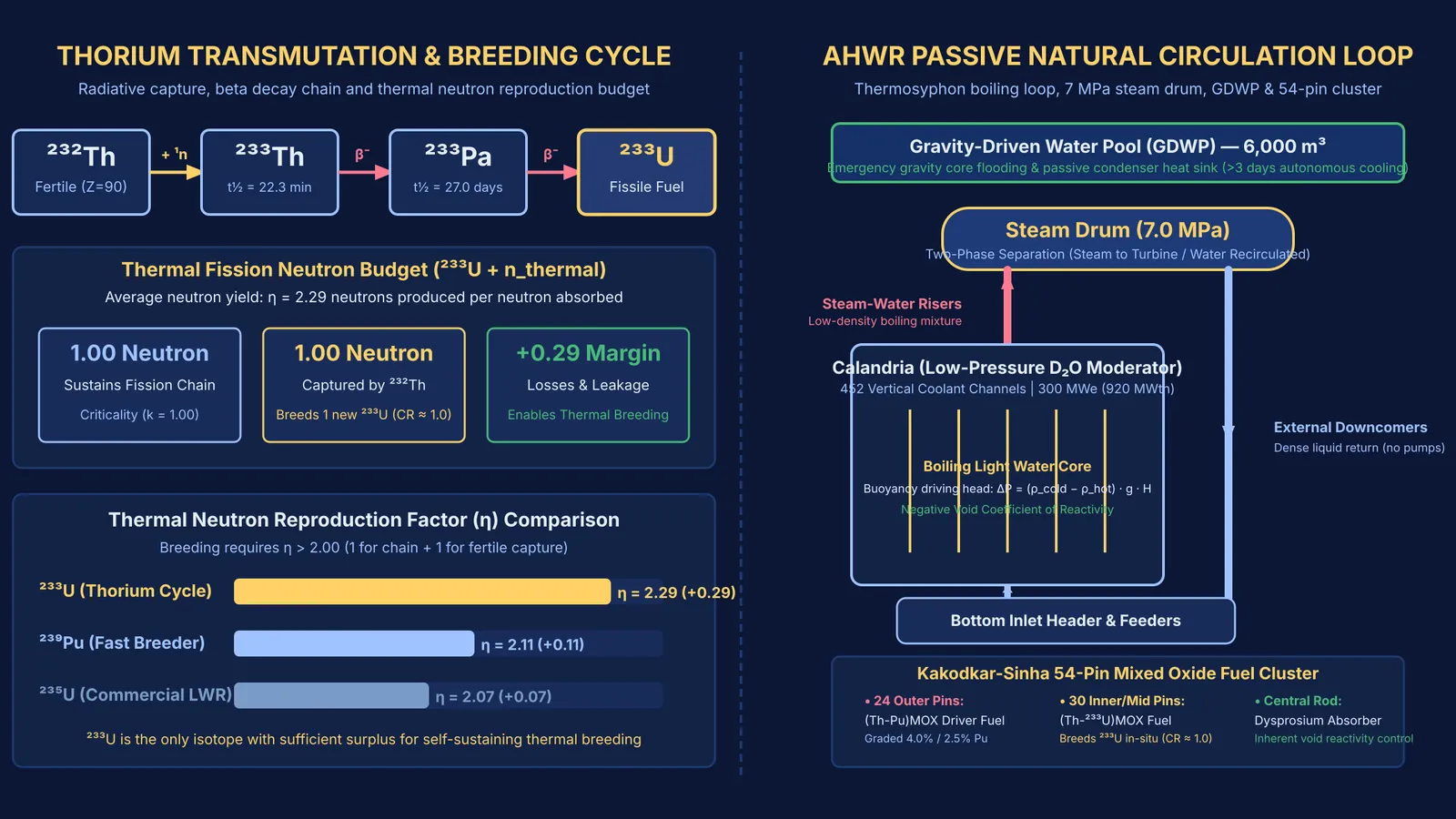
The AHWR houses 452 vertical coolant channels inside a low-pressure calandria filled with heavy water (D₂O) moderator. Each channel contains a 54-pin fuel cluster:
12 inner and 18 intermediate pins contain mixed thorium and Uranium-233 oxide ((Th-²³³U)MOX).
24 outer pins contain mixed thorium and plutonium oxide ((Th-Pu)MOX).
A central displacer rod contains dysprosium to regulate neutron absorption.
This configuration achieves a Uranium-233 conversion ratio of approximately 1.0, breeding as much fissile fuel from thorium as it consumes.
What makes the AHWR's passive safety systems fail-safe?
Standard reactors rely on electric pumps to circulate coolant. If power fails during a station blackout, the core risks overheating.
Kakodkar eliminated primary coolant pumps entirely. As detailed in *Nuclear Engineering and Design*, the AHWR cools its core through natural convection of boiling light water. The two-phase mixture rises into an elevated steam drum at 7 MPa pressure, while denser liquid returns down external downcomers.
Regarding this architecture, Kakodkar stated: "Most safety functions will be based on the principles of physics, which cannot fail." The design incorporates three passive barriers:
Natural circulation thermosyphon: Buoyancy removes core heat continuously without mechanical pumps.
Gravity-Driven Water Pool (GDWP): A 6,000 m³ pool floods the core by gravity, providing at least 3 days of passive cooling.
Negative void coefficient: Coolant voiding decreases reactivity, automatically shutting down the fission chain.
How does thorium breed fissile Uranium-233 in a thermal spectrum?
Thorium breeding follows nuclear kinematics and neutron budgets, outlined in the World Nuclear Association's thorium report.
Transmutation equations:
Neutron capture: ²³²₉₀Th + ¹₀n → ²³³₉₀Th + γ
Beta decay: ²³³₉₀Th → ²³³₉₁Pa + e⁻ + ν̄_e (half-life = 22.3 minutes)
Beta decay: ²³³₉₁Pa → ²³³₉₂U + e⁻ + ν̄_e (half-life = 26.97 days)
Fission energy release:
Thermal fission of Uranium-233 yields 200 MeV (3.204 × 10⁻¹¹ J), generating roughly 23,000 kWh of heat per gram.
Thermal reproduction factor (η):
Breeding requires η (neutrons produced per neutron absorbed) to exceed 2.00:
Uranium-235: η ≈ 2.07 (margin: +0.07)
Plutonium-239: η ≈ 2.11 (margin: +0.11)
Uranium-233: η ≈ 2.29 (margin: +0.29)
Because 1.00 neutron sustains criticality and 1.00 breeds replacement fuel, Uranium-233's 0.29 surplus enables self-sustaining thermal breeding. For core physics, see our guide on how nuclear fission releases energy in reactors and worked mass defect and nuclear binding energy calculations.
What does the thorium cycle teach us about Class 12 nuclear energy?
Connecting the AHWR to Class 12 physics reinforces three concepts:
Fertile versus fissile nuclei: Even-even nuclei require fast neutrons to split, whereas odd-neutron nuclei fission with thermal neutrons.
Transmutation kinetics: Protactinium-233 has a half-life of roughly 27 days, as recorded in the World Nuclear Association's thorium report; high flux causes parasitic capture before decay.
Thermal hydraulics: Passive safety relies on hydrostatic head (Δρ · g · h), linking mechanics to thermodynamics.
When you want to explore the underlying theory behind nuclear binding energy curves, fission barriers, and radioactive decay series, the Fermi Concept Library covers every concept in physics with its own lesson and its place in the concept map.
If you are working through numerical problems on mass defect, Q-values, and radioactive half-life kinetics for CBSE or JEE, the Fermi Problem Library offers worked problems with a step-by-step solver that explains the reasoning rather than printing an answer.
To see how neutron moderation alters cross-sections and how density gradients drive thermosyphon circulation, the Fermi Simulation Lab provides interactive simulations for the ideas that are easier to see than to read.


