

On this page
When you look at a towering nuclear power station, it is hard to imagine that its immense daily power output comes from just a few kilograms of fuel. Unlike chemical burning—where thousands of tonnes of coal are consumed daily to produce a similar electrical output—nuclear fission releases energy on an entirely different scale. This staggering energy density is exactly why nuclear submarines can operate for decades without refuelling, and why a single uranium pellet holds as much energy as a train car full of coal.
But exactly how much uranium does a 1000 MW reactor use per day? By breaking the process down from a single atomic nucleus to the entire power plant, you can calculate the exact mass required for daily operations. This calculation is a classic thermodynamics problem that weaves together energy, power, mass, and efficiency.
How much energy is in one fission?
The calculation begins at the atomic level, with the strong nuclear force holding the nucleus together. When a slow-moving neutron strikes and splits a heavy nucleus of uranium-235 (U-235), the atom fragments into lighter elements. During this split, a tiny fraction of the mass is completely converted into energy, following Albert Einstein's famous mass-energy equivalence principle.
A single fission of U-235 releases an average of 200 MeV of energy (World Nuclear Association). In standard SI units, that is 3.2 × 10⁻¹¹ Joules per atom. While this might sound incredibly small, the sheer number of atoms in a macroscopic sample makes the total energy enormous.
Because one kilogram of U-235 contains roughly 2.56 × 10²⁴ atoms, fissioning every single atom in that kilogram releases about 82 terajoules (TJ) of energy.
How much uranium does a 1000 MW reactor use per day?
Let's look at a reactor designed to generate 1000 megawatts (MW) of heat. Power is the rate of energy transfer, so one megawatt is exactly one million Joules per second.
Over a full 24-hour day (which is 86,400 seconds), a 1000 MW thermal output adds up to 86.4 TJ of heat. If we divide this daily requirement by the energy density we found above (82 TJ/kg according to the World Nuclear Association), the result is roughly 1.05 kg. Therefore, a 1000 MW thermal reactor consumes just over 1 kg of U-235 per day.
Working through these conversions systematically builds a strong foundation for advanced physics problems. If you find yourself getting stuck when setting up the units, the Fermi Concept Library has every concept in physics mapped out with its own lesson to help you trace the connections.
Thermal vs electrical power: the 33% efficiency
When we talk about a 1000 MW nuclear plant, we usually mean its electrical output delivered to the grid, not the raw heat generated in the core.
Turning that intense heat into electricity requires boiling water into high-pressure steam to spin a massive turbine. The laws of thermodynamics, specifically the Carnot limit, strictly restrict the efficiency of this cycle. Typical nuclear power plants operate with a thermal efficiency of roughly 33% (Wikipedia). This means only a third of the reactor's heat is successfully converted into electricity; the remaining two-thirds are lost to the environment through cooling towers or nearby bodies of water.
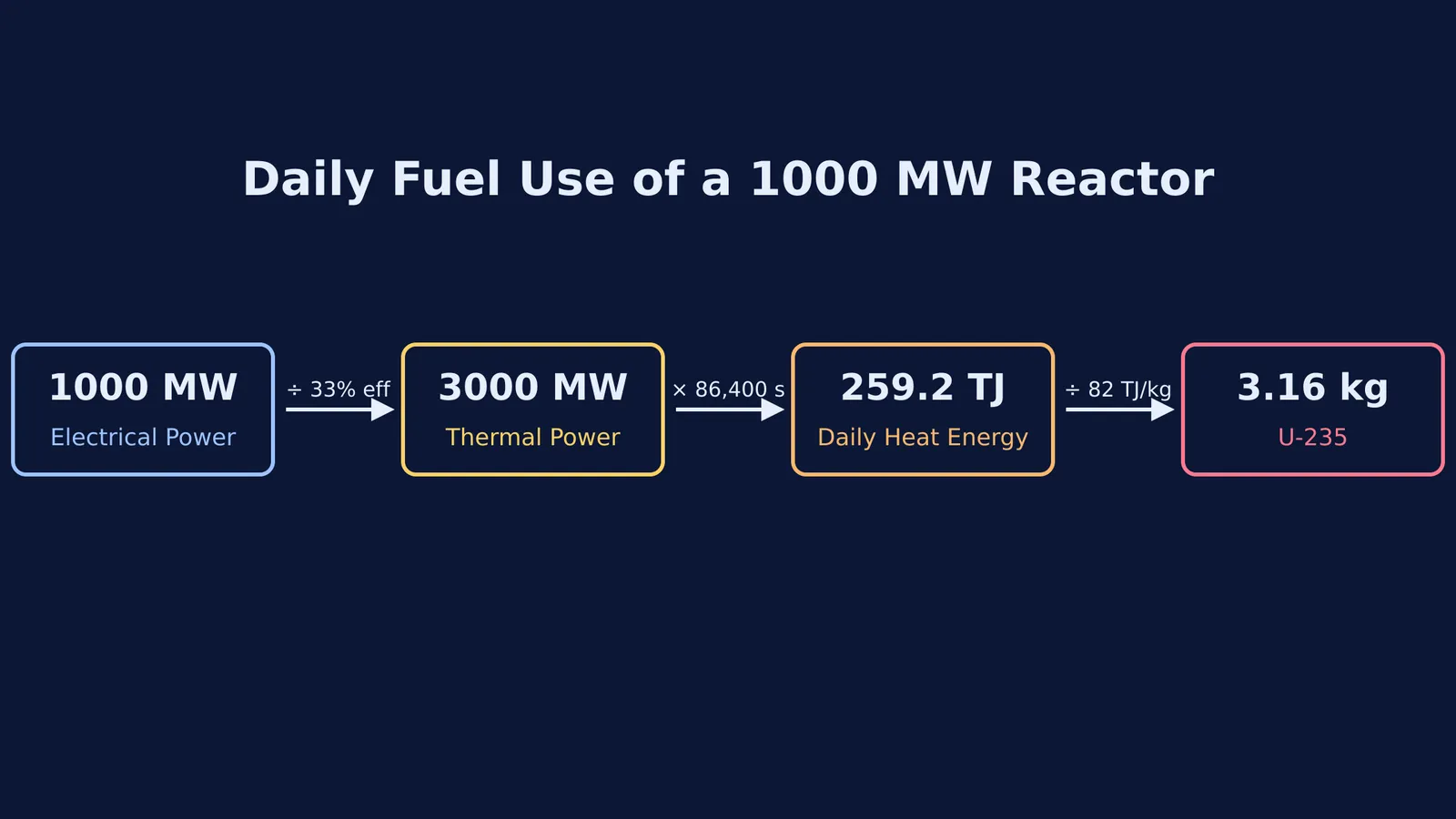
To produce 1000 MW of electrical power, the reactor must therefore generate 3000 MW of thermal heat. Following the exact same mathematical logic as before, three times the heat requires three times the fuel. A 1000 MW electrical plant therefore fissions approximately 3.16 kg of U-235 daily.
If you are practicing these multi-step thermodynamics problems, the Fermi Problem Library has worked problems with a step-by-step solver that explains the reasoning rather than printing an answer.
Framework: The three steps to fuel mass
You can use this systematic method to calculate the daily fuel use for any nuclear reactor, regardless of its size:
Find total daily energy: Multiply the stated power output (in Joules per second) by 86,400 seconds to get the energy per day.
Account for efficiency: Divide by the thermal efficiency (for example, 0.33) if the given power is electrical rather than thermal (Wikipedia).
Divide by energy density: Divide the total Joules by the mass-energy density of the fuel (82 × 10¹² J/kg for pure U-235, as per the WNA).
Just as a bomb calorimeter measures energy from combustion, you can determine the exact consumption of a nuclear core by tracking the energy from the fundamental atom all the way to the electrical grid.


