

On this page
The path to becoming a nurse in India has become more standardised. According to the Indian Nursing Council (INC), admissions for the 2024–25 academic year and beyond are strictly entrance-based. Direct admission based only on Class 12 board marks is no longer permitted, ensuring all candidates are evaluated on a level playing field.
What is the BSc Nursing admission process after 12th?
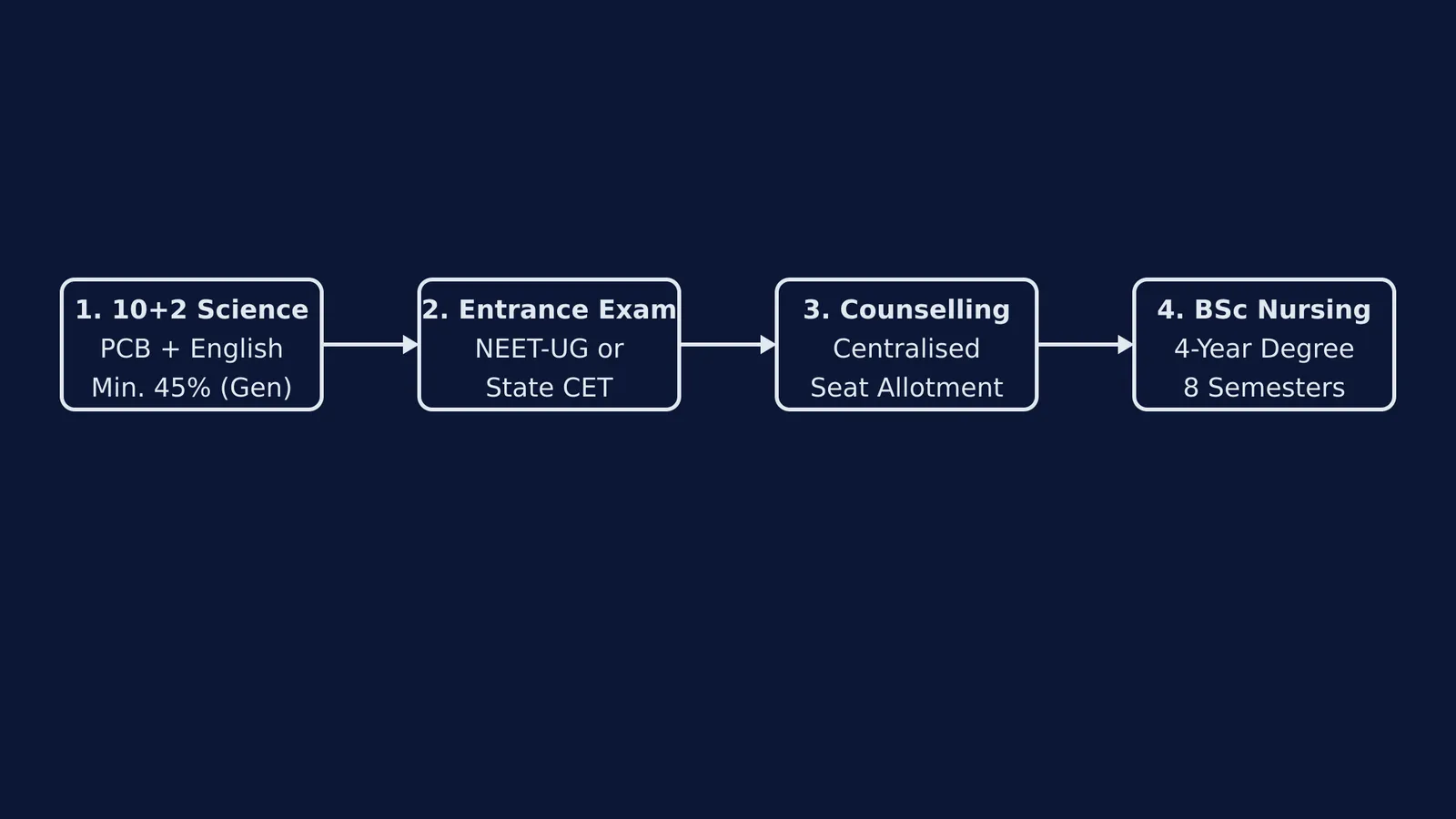
To secure a seat in a four-year BSc Nursing programme, you must now pass a Common Entrance Test (CET). The INC Notification No. 3 of 2024 mandates that all state nursing councils and universities admit students solely through these official entrance exams.
The admission cycle typically begins in the spring, with entrance exams taking place between May and June. Once the entrance test results are declared, successful candidates participate in centralised counselling. During counselling, you are allotted a seat in a nursing college based on your exam rank, your category, and the college preferences you submit. This transparent process replaces the older system of applying directly to individual colleges with your 12th-grade marks.
What are the eligibility criteria for BSc Nursing?
Before you fill out any application forms, you must meet the basic academic and age requirements set by the INC.
You must have passed 10+2 with Science (Physics, Chemistry, and Biology) and English.
General category students need a minimum of 45% aggregate marks in PCB.
SC, ST, and OBC candidates need a minimum of 40% aggregate marks in PCB.
You must be at least 17 years old by December 31 of the year you are admitted.
Medical fitness is also a strict requirement, and you will need to submit a fitness certificate during admission. Students from recognised open schools like NIOS are also eligible as long as they meet the subject and percentage criteria.
If you are struggling to reach the required marks in your science subjects, a structured approach to revision helps. Fermi's AI tutor works out what you already know and builds a plan for the session, so you can sit down to a clear next step instead of staring at a blank page.
Do you need NEET for BSc Nursing?
Many students wonder if the National Eligibility cum Entrance Test (NEET-UG) is compulsory. The answer depends on where you want to study.
Some central institutions and specific states use NEET-UG scores for BSc Nursing admissions. For example, prominent institutes like the Armed Forces Medical College (AFMC), JIPMER, and the Military Nursing Service (MNS) rely on NEET ranks. For NEET-based admissions, the qualifying cutoff is typically the 50th percentile for the general category and the 40th percentile for reserved categories.
However, NEET is not the only route into the profession. Many states conduct their own CETs specifically for nursing and paramedical courses. Maharashtra has the MH-CET, Karnataka uses KCET, Uttar Pradesh runs the CNET, and West Bengal conducts JENPAS-UG. You should check the specific entrance requirement for the state or university you are targeting.
What subjects are in the BSc Nursing course?
The BSc Nursing degree is a 4-year, full-time programme divided into 8 semesters. In 2021, the INC revised the curriculum to a competency-based semester system to better align with international healthcare standards.
In your first year, you will study Applied Anatomy, Applied Physiology, Applied Sociology, and Nursing Foundations. You can get a head start on some of these human biology concepts by reviewing the Formed elements of blood: RBCs, WBC types and platelets for NEET. The Fermi Concept Library is also useful for reviewing foundational biology and chemistry before you start your degree.
As you progress into the second and third years, the subjects become much more specialised. You will take courses in Pharmacology, Pathology, Medical-Surgical Nursing, Child Health Nursing, and Mental Health Nursing. You will also cover topics relevant to public health and toxicology, such as Opioids, cannabinoids and coca alkaloids: NEET's drug-abuse facts. The final eighth semester is dedicated entirely to an intensive clinical internship in hospital departments like paediatrics, obstetrics, and community health.
The 3-Step Plan for BSc Nursing Prep
Verify your exam: By January of your Class 12 year, check the official website of your state’s common entrance cell or your target university to find out whether they require NEET-UG or a separate state CET.
Clear the syllabus: Build a timeline to finish revising Physics, Chemistry, and Biology by April. Nursing entrance exams are generally held between May and June, leaving you only a few months after your board exams.
Practise mock tests: Entrance tests are multiple-choice and highly competitive. Transition early from writing long descriptive board answers to practising timed, objective questions in the weeks leading up to the exam.


