

On this page
In Class 11 and 12, biology conversations usually center on clinical practice: entrance exams, white coats, and treating patients. Yet every operating theatre, intensive care unit, and diagnostic lab depends on an unseen operational network. Hospital administrators run that network. They manage bed capacity, emergency logistics, infection control, and digital health records. For biology students who enjoy systems thinking and data over bedside clinical care, hospital administration provides an impactful path into healthcare leadership.
What does a hospital administrator actually do?
While doctors treat individual patients, hospital administrators supervise the systems that make clinical care safe and efficient:
Bed capacity and patient throughput: Administrators track occupancy using World Health Organization metrics, specifically Bed Occupancy Rate (BOR)—inpatient days divided by available bed days multiplied by 100—and Average Length of Stay (ALOS). The WHO benchmark targets 80% to 85% occupancy in acute-care hospitals. Exceeding 85% triggers emergency boarding, while rates below 60% leave resources underutilised.
Quality accreditation: Administrators implement standards from the National Accreditation Board for Hospitals & Healthcare Providers (NABH). They track Key Performance Indicators (KPIs) like surgical site infections, medication errors, and discharge turnaround times, targeting 20% faster discharge workflows to free critical beds.
Digital health systems: Administrators oversee hospital management systems and compliance with the Ayushman Bharat Digital Mission (ABDM) from the National Health Authority. They manage 14-digit Ayushman Bharat Health Accounts (ABHA), electronic records, and registry compliance.
Biomedical logistics: Administrators manage medical gas pipelines, central sterile supply departments, pharmaceutical cold chains, and biomedical waste compliance.
Which degree options lead into healthcare management?
Students have multiple academic pathways into hospital management:
Bachelor of Hospital Administration (BHA): A 3-to-4-year undergraduate degree open after Class 12 with Physics, Chemistry, and Biology. Coursework covers medical terminology, healthcare accounting, epidemiology, and outpatient planning.
Life science degree followed by postgraduate study: Many students complete a BSc in biology, biotechnology, nursing, or pharmacy before management. This provides perspective when navigating NEET physics for students who are strong in biology or discussing STEM careers beyond medicine and clinical practice.
Master of Hospital Administration (MHA): A two-year master's degree offered by institutions such as the Tata Institute of Social Sciences (TISS). Open to science, medical, and allied graduates, it combines health economics with hospital residencies. At AIIMS New Delhi, MHA admission via INI-CET requires an MBBS degree or seven years of administrative experience for sponsored candidates.
MBA in Hospital and Health Management: Two-year management programs at institutes like IIHMR University admit graduates with at least 50% marks via CAT, MAT, or CMAT, focusing on hospital finance, insurance, and supply chain management.
Why is a biology background an advantage in hospital operations?
A solid grounding in biology gives administrators a communication advantage. Coordinating with oncologists, radiologists, and head nurses requires understanding disease pathology, anatomy, and pharmacology without an interpreter. When managing infection control, an administrator with microbiology training can evaluate sterilization protocols, disinfectant choices, and antibiotic-resistant outbreaks with confidence.
Building foundational scientific reasoning makes these operational applications natural. The Fermi Concept Library covers every concept across biology, chemistry, physics, and mathematics, helping students understand physiological systems from first principles rather than memorising lists. When working through complex problems, Fermi's AI tutor works out what you already know and builds a plan for the session, guiding your reasoning step by step.
How can administrators evaluate hospital capacity and efficiency?
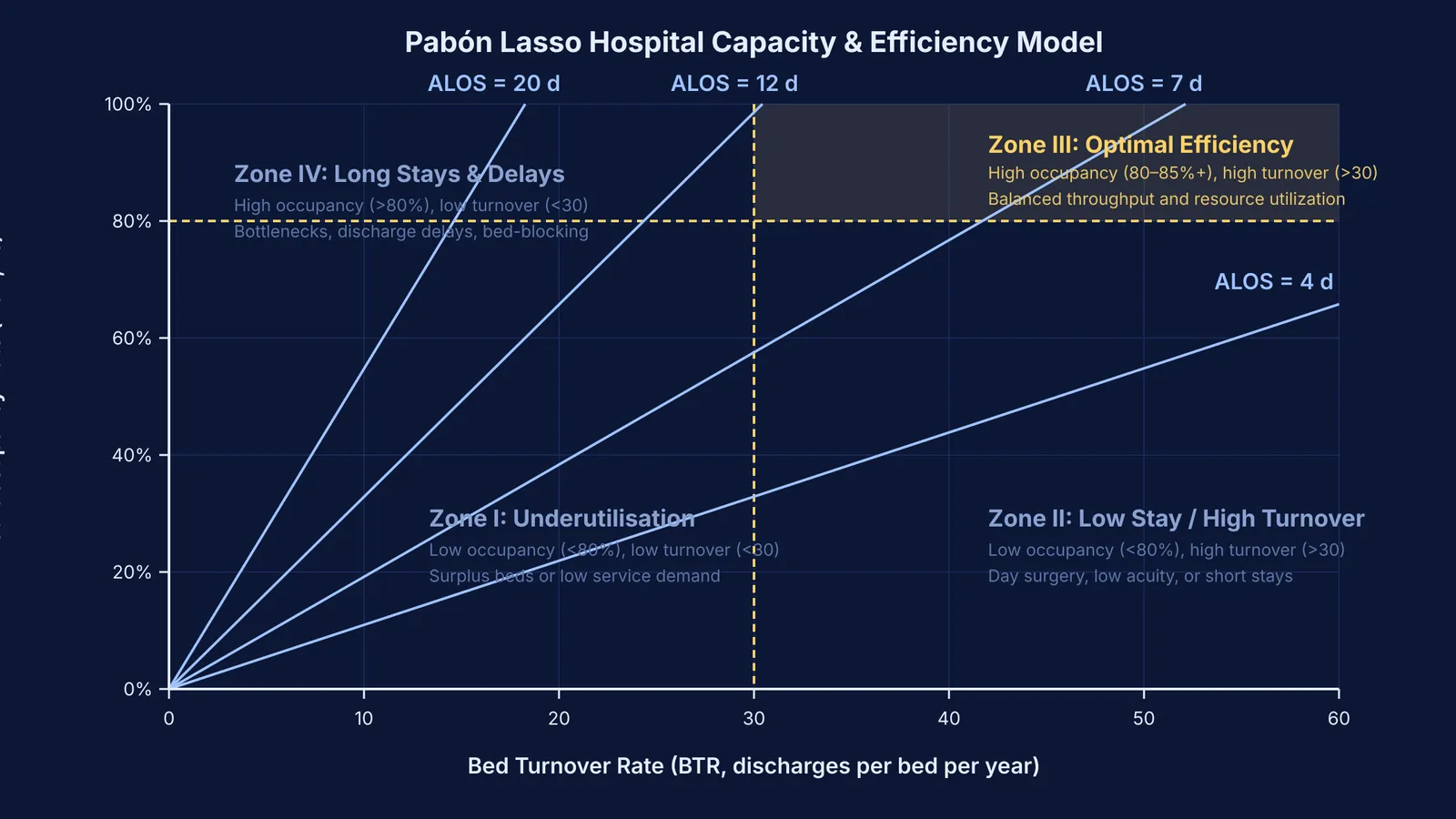
Hospital planners evaluate bed productivity with mathematical models. In a 1986 study in the Bulletin of the Pan American Health Organization, researcher Humberto Pabón Lasso introduced a model plotting Bed Occupancy Rate (BOR) against Bed Turnover Rate (BTR, discharges per bed per year).
The equation BOR = (ALOS × BTR / 365) × 100 links these metrics, where lines radiating from the origin mark constant Average Length of Stay (ALOS). Comparing ward figures against the WHO 80% to 85% occupancy benchmark categorises departments into four zones:
Zone I (low occupancy, low turnover): Underutilised beds and surplus capacity.
Zone II (low occupancy, high turnover): Short patient stays, typical of day surgery centres or unnecessary ward admissions.
Zone III (high occupancy, high turnover): Optimal efficiency with balanced bed occupancy and healthy throughput.
Zone IV (high occupancy, low turnover): Bottlenecks and long patient stays, signalling bed-blocking and discharge delays.
How do you transition from school biology to hospital leadership?
For families supporting a career path outside traditional clinical tracks, building a career in hospital administration follows four practical steps:
Build secondary school science: Master biology concepts while staying comfortable with basic statistics, rates, and ratios.
Select your undergraduate pathway: Choose between an immediate professional degree (BHA) or an undergraduate foundation in life sciences, allied health, or pharmacy.
Gain operational exposure: Complete internships or volunteer stints in hospital front-office coordination, medical records, or diagnostic lab administration.
Prepare for postgraduate entrance tests: Build aptitude in quantitative analysis, data interpretation, and verbal reasoning for MHA and healthcare MBA entrance exams.
Healthcare infrastructure expansion makes this expertise vital. A report by NITI Aayog noted that India has 1.3 hospital beds per 1,000 population, requiring an estimated 3 million additional beds by 2025 to match global standards. With hospitals forming 80% of India's healthcare market, trained administrators are essential to building safe and sustainable health systems.


