On this page
Ants are among the easiest wildlife your child can study without leaving home, and there are a lot of them: a 2022 analysis of 489 studies estimated almost 20 × 10^15 ants on Earth, with a combined biomass greater than that of all wild birds and mammals together (Schultheiss et al., PNAS). This guide gives you a 30-minute activity in three parts: watch a trail, test which crumbs ants choose, and write it down so the patterns show.
Is it safe to watch ants with children?
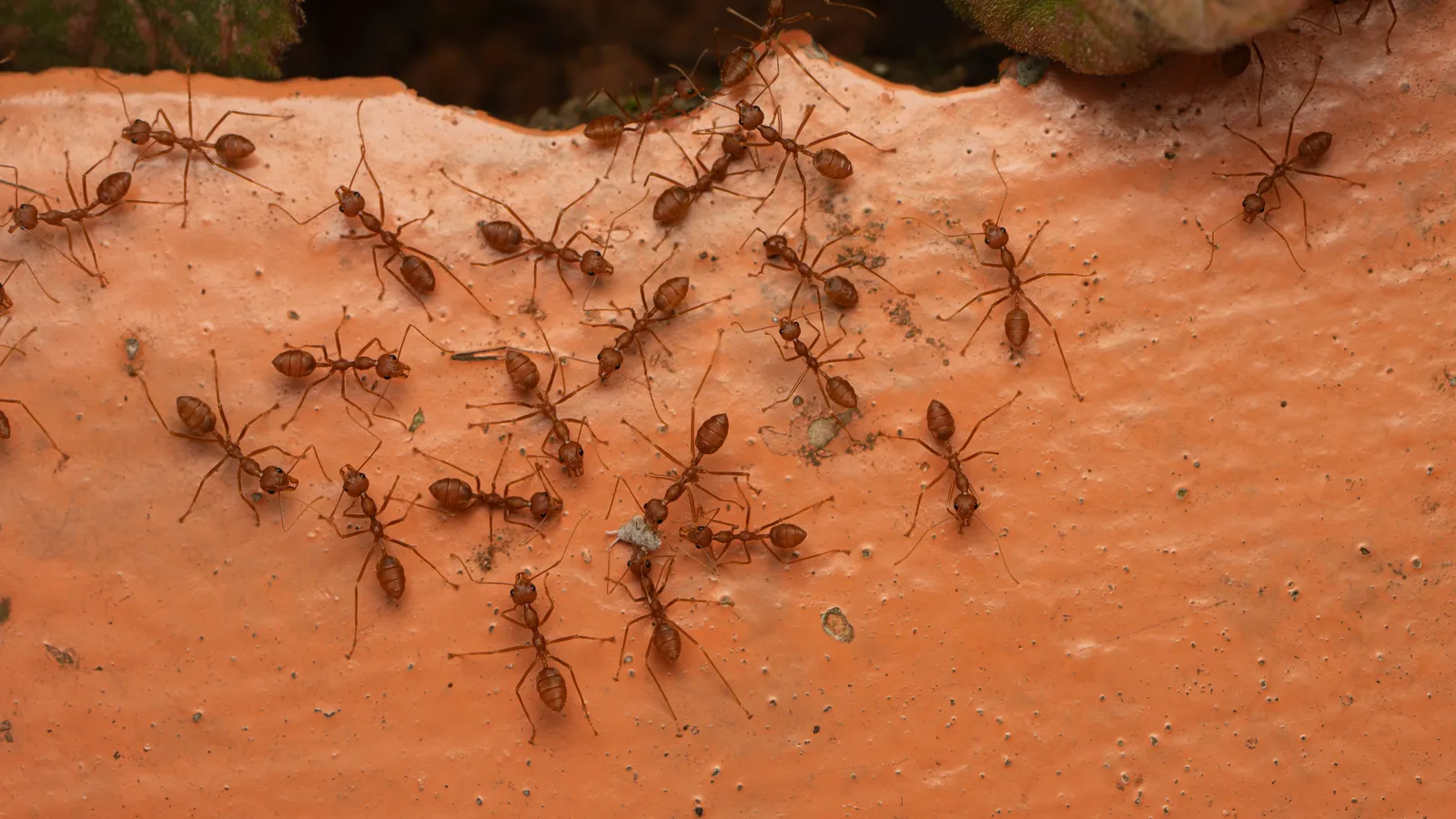
Mostly yes, if you watch rather than handle. The main risk is a bite or sting. Weaver ants, the reddish ants that build leaf nests in mango and other trees in India, have no working sting but can give a painful bite and often spray formic acid into the wound (Weaver ant overview). Some ground-nesting ants sting as well.
Set these rules before you start:
Eyes only, hands behind your back. Younger children find this easier as a game.
Stand or squat beside the trail, never on it, and wear closed shoes.
Leave leaf nests, tree trunks and large mounds alone. Pick a trail on a wall, step or path.
Keep faces back. Use a magnifying glass at arm's length instead of leaning in.
If someone is bitten, the NHS suggests a cold, wet cloth or wrapped ice pack for at least 20 minutes if it swells, and no scratching (NHS: insect bites and stings).
How do ants find food and make a trail?
Ants follow chemical signals called pheromones that they lay on the ground. In a 2009 study of the big-headed ant, Pheidole megacephala, researchers found the ants' behaviour fitted the use of two pheromones: a long-lasting one laid while exploring, which recruited nestmates only weakly, and a shorter-lasting one laid while exploiting food, which recruited far more strongly (Dussutour et al., Journal of Experimental Biology).
Ask your child to predict: "If one ant finds our sugar, how long until there are ten?" Then time it. Our explainer on how ants find the shortest path using pheromone trails takes this further for older children.
How do you test ant food preferences with crumbs?
This is a fair test, the kind your child will meet in school science.
Find an active trail outdoors or on a balcony, away from the kitchen.
On a piece of card, place four rice-grain-sized crumbs in a row, a hand-width apart: sugar, a drop of cooking oil, a crumb of boiled egg or paneer, and a crumb of plain roti. Add a fifth spot with nothing on it as your control.
Lay the card about 10 cm from the trail so every crumb is the same distance away.
Count the ants on each spot every five minutes for 30 minutes.
Repeat the next day with the crumbs in a different order. If the winner changes when the position changes, position mattered more than food.
Don't be surprised if the favourite changes over weeks. In a colony, "carbohydrates are used by the workers and proteins consumed by the larvae", and the amount and balance of nutrients foragers collect depends on whether larvae are present (Dussutour and Simpson, Current Biology). So a colony raising young may show more interest in the egg crumb. To see who does which job inside the nest, read how ant colonies divide work between queen, workers and soldiers.
What should go in a simple ant observation log?
A notebook page with one row per check is enough. Each row needs:
Date, time and place (for example, "back step, shade")
Weather: sunny, cloudy, after rain
Minutes since start: 0, 5, 10, 15, 20, 25, 30
Ants on each crumb, as a number or tally marks
One line of notes: carrying food away, fighting, a new trail forming
Match the job to the age:
Ages 4 to 6: you write, they make tally marks and draw the ants.
Ages 7 to 10: they fill in the whole table and circle the highest number in each row.
Ages 11 and up: they total each crumb across both days and draw a bar chart.
How to read it together: a food is the real favourite only if it leads on both days, in both positions. If not, ask "What changed?" and check the weather column.
If your older child wants to go from ant trails to the biology behind them, the Fermi Concept Library covers every concept in physics, chemistry, biology, mathematics and computing, each with its own lesson. For more backyard projects, try our guide to teaching your child to observe birds and insects at home.
Start this weekend with one trail, five spots on a card and a single log page.