On this page
When an ant discovers a food source, it does not keep the location a secret. It returns to the nest, leaving a chemical trail of pheromones on the ground for other members of the colony to follow. But if there are multiple ways to reach the food, how does the colony know which route is the fastest?
The answer is not that individual ants measure distances or hold a map of the environment in their tiny heads. Instead, the shortest path emerges naturally from the mathematical rules of the pheromone trail itself.
What is the double-bridge experiment?
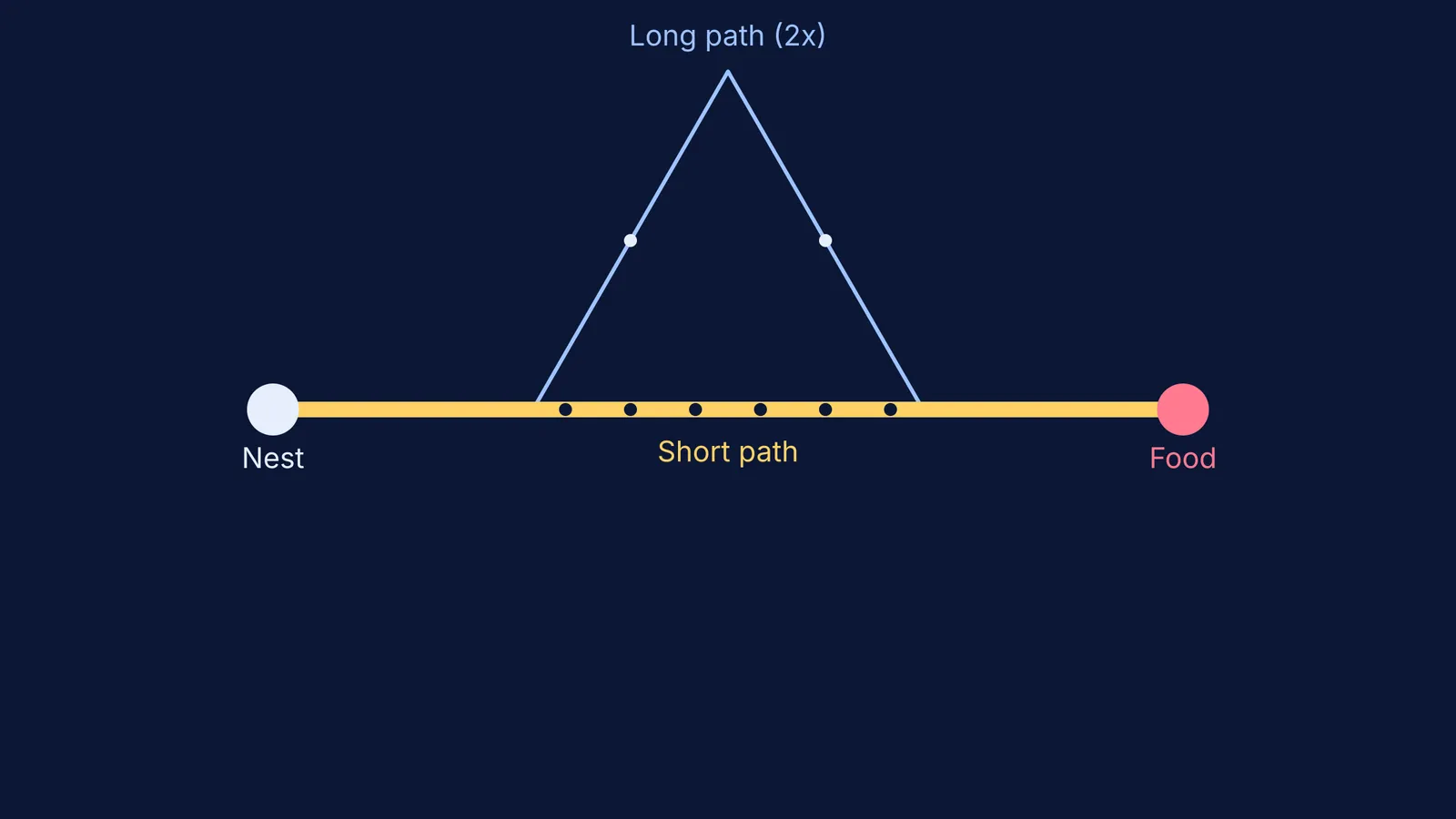
To understand how ants navigate, a team of researchers designed the classic double-bridge experiment in 1989. They connected a nest of Argentine ants to a food source using an apparatus with two bridges. One bridge was a short, direct path, while the other was a longer, curved path that was exactly twice as long.
At first, the ants explored both paths equally. When the initial ants reached the fork in the bridge, they had an equal chance of taking either route. But within a remarkably short time, the entire colony had converged almost exclusively on the shorter bridge.
How do ants find the shortest path to food?
The secret to this collective decision is a simple positive feedback loop based entirely on time.
When an ant takes the shorter path, it reaches the food and returns to the nest much faster than an ant travelling on the long path. Because the round trip is faster, ants on the shorter path can complete more trips in the exact same amount of time.
Every time an ant crosses a bridge, it deposits a fresh pheromone trail. The shorter bridge accumulates pheromones at a significantly faster rate because it handles more ant traffic per minute. When new ants arrive at the fork, they are biologically programmed to choose the path with the strongest scent. They take the shorter route, add their own pheromones to it, and make the trail even stronger. The longer path, meanwhile, is abandoned, and its faint pheromones slowly evaporate into the air.
This process is a prime example of stigmergy, a biological mechanism where individuals communicate indirectly by modifying their shared environment. The pheromone trail acts as an external memory that coordinates the actions of the ants without any central command.
What happens if both paths are the same length?
If researchers use two bridges that are both equal in length, you might expect the ants to split their traffic evenly between them. Instead, the colony still converges on just one path.
Because the ants choose randomly at first, one bridge will inevitably get a few more ants purely by statistical chance. This tiny advantage translates to a slightly stronger pheromone trail on that branch. The positive feedback loop amplifies this random fluctuation, rapidly drawing the rest of the colony to the slightly stronger path until the other route is completely abandoned.
Can a simulation show how ants find the shortest path?
Because the rules of pheromone trails are fundamentally mathematical, we can replicate them in the Simulation Lab to visualise hard ideas and see how changing the variables alters the outcome.
If you want to test how pheromones drive collective decisions, use this simulation checklist:
Change the evaporation rate: Set the pheromones so they never evaporate. You will see the ants get stuck using both paths, because the long path never loses its initial scent.
Change the distance ratio: Test what happens if the paths are nearly identical in length. The colony will take much longer to decide on a winner because the difference in round-trip time is so small.
Block the short path: Let the colony settle on the short path, then simulate a sudden blockage. Watch how the few ants exploring randomly are able to rebuild a new trail on the longer path.
Just as there are limits to physics simulations, biological models rely on isolated variables. However, they let you test the core logic of complex natural systems safely and repeatably.
How do computers use ant colony optimization?
These same mathematical rules do more than just explain biology. In computer science, algorithms inspired by this foraging behavior are called Ant Colony Optimization.
In a digital environment, artificial ants are sent out to explore different solutions to a complex problem, such as finding the most efficient way to connect multiple cities on a map. Like real ants, these software programs leave a virtual pheromone value on the best paths they find. As more programs succeed, they strengthen the numeric value of that route, while less successful routes see their values steadily evaporate.
Today, these algorithms are widely used to solve complex human logistics problems, from routing data packets through internet traffic to planning optimal delivery routes for freight trucks. By copying the simple rules of an insect trail, engineers have proven that decentralized systems can reliably solve some of the hardest optimization problems in modern mathematics.