

On this page
Inside an ant nest a few individuals reproduce, most work, and the jobs change hands in a predictable order. There are a lot of these societies: a 2022 PNAS study by Schultheiss and colleagues estimated that almost 20 × 10^15 ants live on Earth, with a combined biomass of about 12 megatons of dry carbon, more than all wild birds and mammals put together.
What does each member of an ant colony do?
Take the red imported fire ant. The University of Tennessee's fire ant biology page describes three kinds of adult:
Queen: a mated female. After her mating flight she lands, sheds her wings and begins digging a chamber to start a new colony. When workers feed her, a fire ant queen can lay 800 to 1,000 eggs a day, and she can live 7 years or more.
Males: winged, with smaller heads than the females. They die soon after mating.
Workers: wingless, sterile females. They forage, care for the developing brood, defend the nest and feed the queen. A fire ant worker generally lives about 5 weeks.
The same page says an average fire ant colony holds 100,000 to 245,000 workers.
Where do soldier ants fit in?
A soldier is not a separate sex. It is a worker that grew much larger. In *Pheidole*, a genus of about 1,100 species, the small minor workers handle brood care, nest maintenance and foraging, while the major workers, or soldiers, have disproportionately large heads and typically specialise in colony defence and seed milling, according to a 2012 PLOS ONE study by Muscedere and Traniello.
How do worker ants decide which job to do?
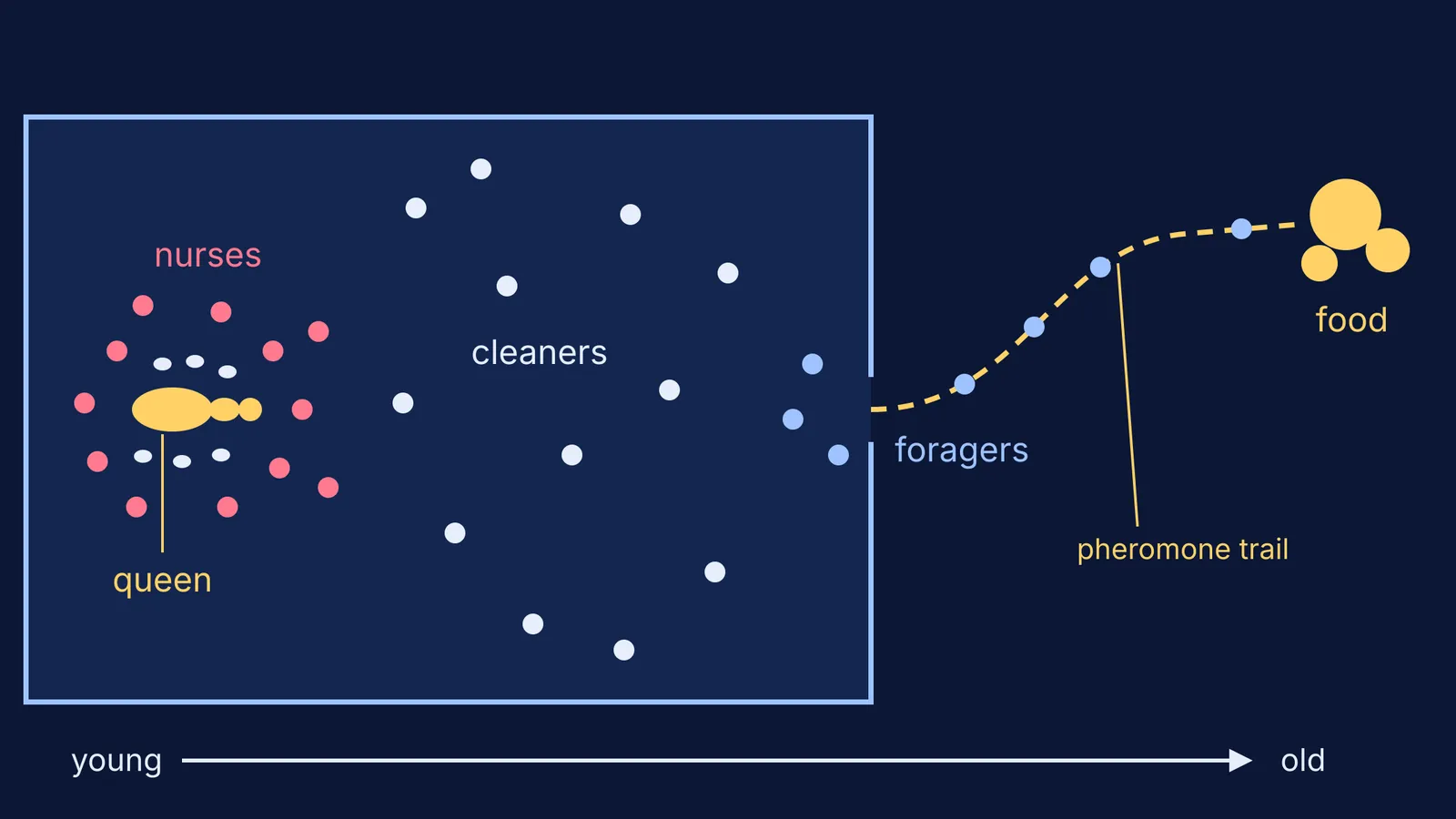
Largely by age. In a study published in 2013, Danielle Mersch, Alessandro Crespi and Laurent Keller glued tiny paper barcodes onto every worker in six colonies of the carpenter ant *Camponotus fellah*, each with about 100 members, and tracked them for 41 days, as Phys.org reported. From more than 9 million recorded interactions, the workers fell into three groups, and ants doing the same job interacted with each other far more than with ants in other jobs.
The editors' summary of their paper in *Science* puts the pattern this way: "As they aged, ants largely progressed from being nurses located near the queen, to nest cleaners who move throughout the colony, and finally to foragers moving in and out at the colony edges."
So work is split by body type and, within the workers, by age. Biologists call the age split age polyethism.
How do ants use chemical trails to find food?
A forager that finds food marks the way home with a chemical. E. O. Wilson showed in a 1959 paper in *Science* that the odour trail of the fire ant is a secretion of the accessory gland of the poison apparatus, released through the extruded sting. Harvard Magazine's account of that work names it Dufour's gland and notes that signal pheromones fade quickly unless other workers reinforce them.
That fading is what makes the system work. Ants that use a trail to reach food add their own marking, so a busy route gets stronger and draws more ants. When the food runs out, the trail is no longer reinforced and it fades. Our explainer on how ants find the shortest path using pheromone trails shows how the same feedback picks the shorter of two routes.
Why are ants called social insects?
Because they meet the biologist's definition of eusociality. CARTA's glossary defines eusociality as "a form of social structure featuring cooperative brood care, overlapping generations of adults, and a reproductive and non-reproductive division of labor." Ants tick all three boxes:
Cooperative brood care: workers raise eggs they did not lay.
Overlapping generations: the queen lives alongside several generations of her adult daughters.
Reproductive division of labour: the queen and males breed; the sterile workers do not.
The same glossary lists bees, wasps, termites, naked mole-rats and some shrimp as eusocial too. For how sex is decided in another social insect, see how haplodiploidy works in honey bees.
How do you write this up in an exam?
Take a typical 5-mark question: *Describe division of labour in an ant colony and explain why ants are called social insects.* A full answer makes five points, roughly one mark each:
Name the castes: queen (lays eggs), males (mate, then die soon after), workers (sterile females).
Add soldiers: large-headed major workers in genera such as *Pheidole* that defend the colony and mill seeds.
Show that jobs change with age: nurse near the queen, then cleaner, then forager.
Explain food trails: a pheromone laid from a gland near the sting, reinforced by ants that use it, fading when they stop.
Define eusociality with its three features and state that ants show all three.
Use four terms correctly: caste, pheromone, age polyethism and eusocial.
If a term such as eusociality or pheromone is still fuzzy, look it up in the Fermi Concept Library, where every concept in biology has its own lesson and its place in the map.


